44 articles
Strategy guides
- guide
How to Beat the Daily Puzzle: A Practical Routine
A repeatable routine for scoring higher on any daily puzzle: warm up, bank the easy level, protect accuracy and use the archive deliberately.
Mara Whitfield · 7 min read
- guide
Working Memory Drills That Actually Work
Four drills that raise your working-memory percentile on GetPlayJoy, and why naming what you see beats staring at it.
Dr. Owen Brackley · 6 min read
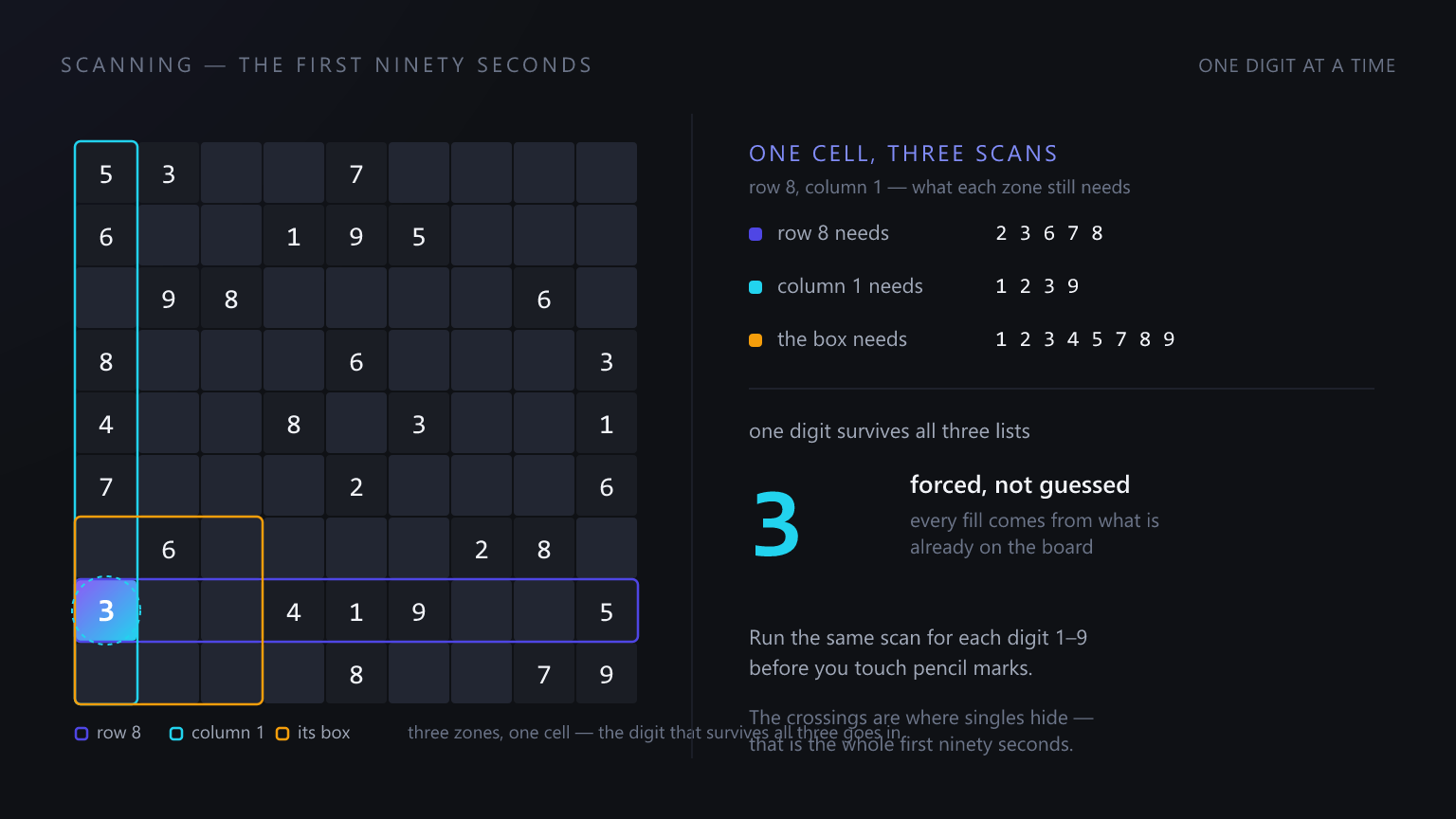
Sudoku Techniques for Beginners: From Scanning to Naked Pairs
The four Sudoku techniques that take you from guessing to solving: scanning, pencil marks, naked pairs and pointing pairs.
Mara Whitfield · 8 min read
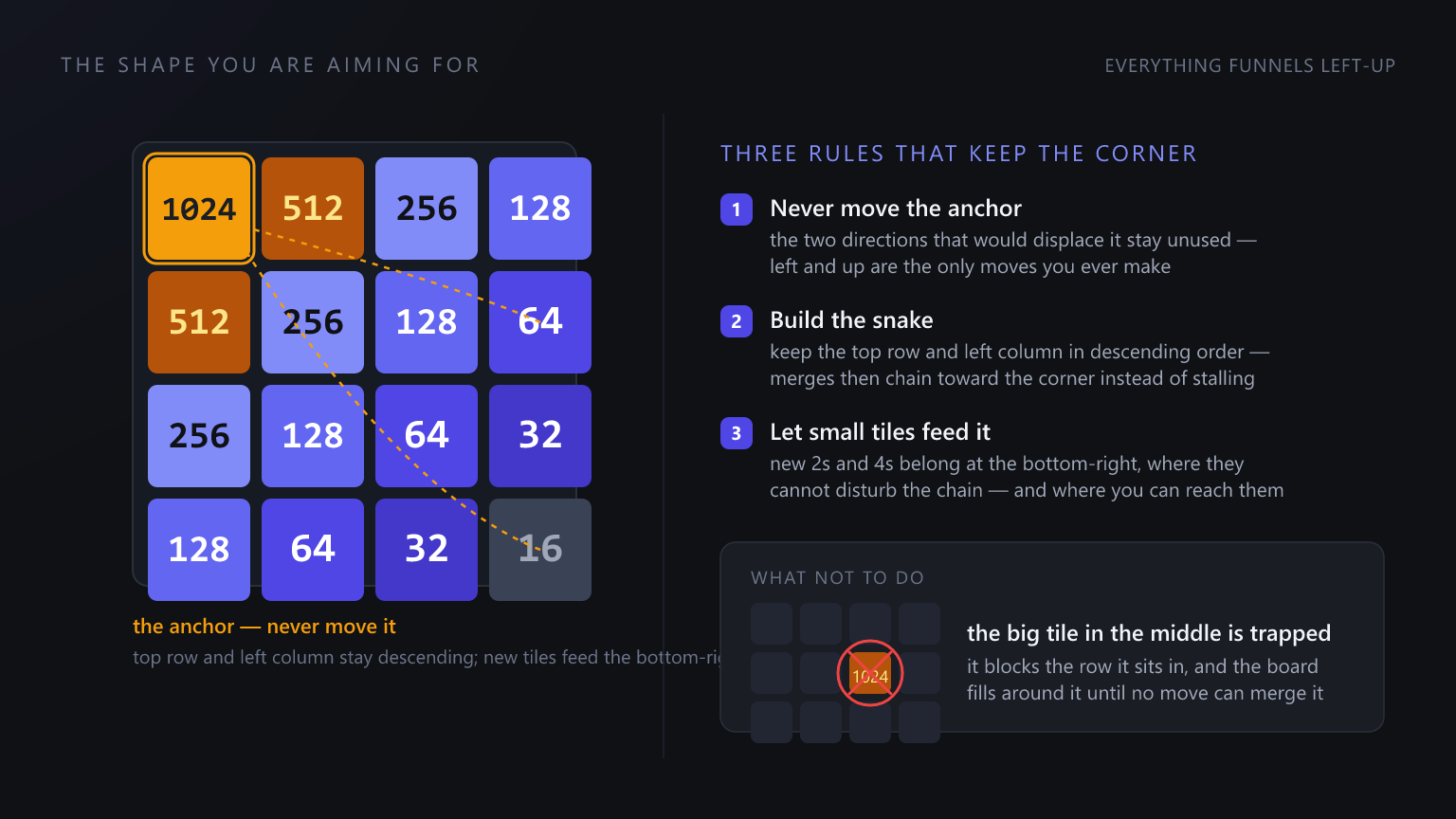
2048 Strategy: Why You Should Always Keep a Corner
The one habit that takes 2048 from luck to routine: build a wall, keep one corner frozen, and merge inward.
Mara Whitfield · 6 min read
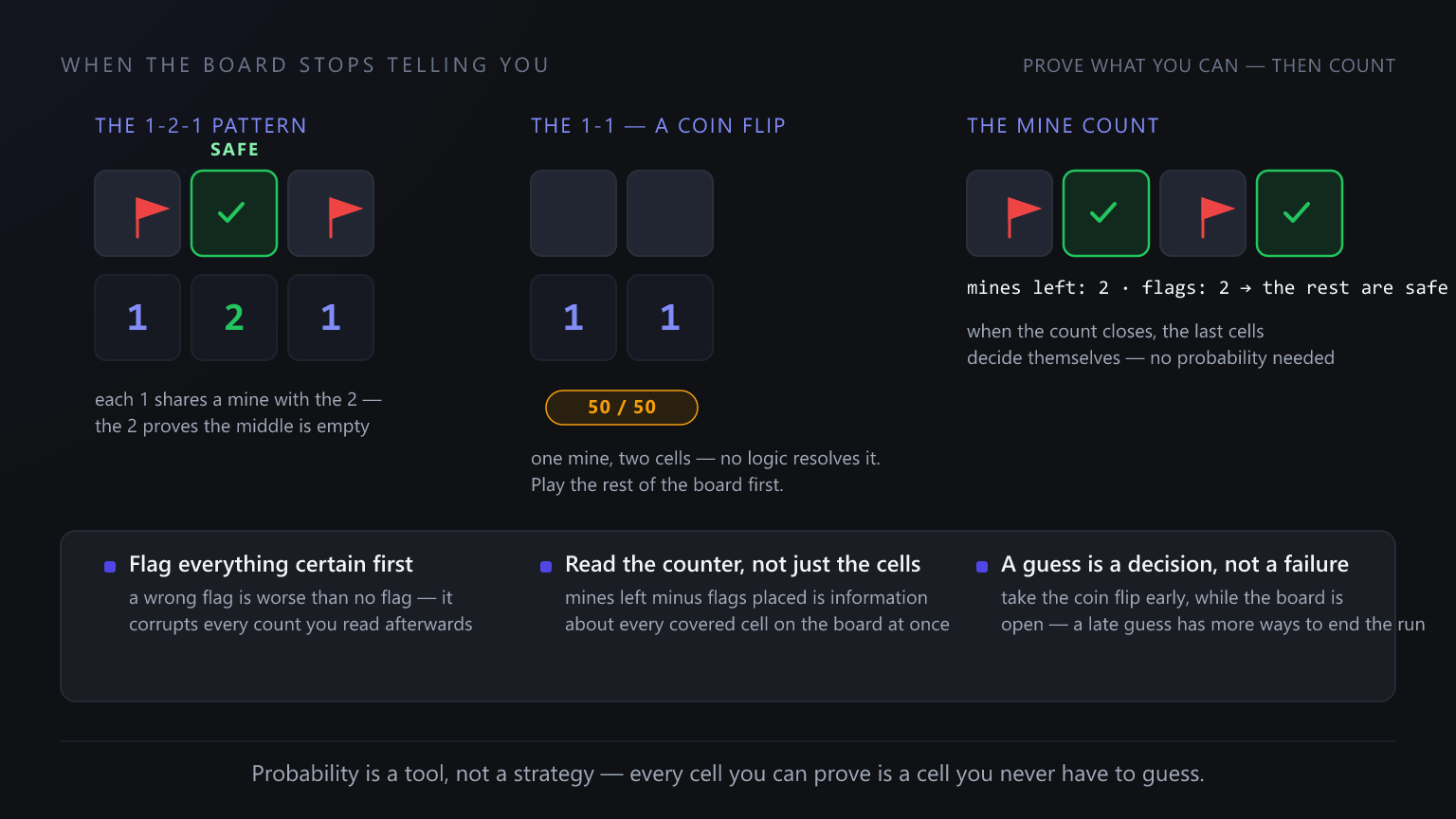
Minesweeper Tips: Using Probability to Avoid Guessing
How to read a Minesweeper board like a constraint problem, and when a "guess" is actually the higher-percentage play.
Mara Whitfield · 7 min read
- guide
Nonogram for Beginners: Reading the Clues Step by Step
How to turn a row of numbers into filled squares, starting with the clues that leave no choice at all.
Mara Whitfield · 7 min read
- guide
The X-Wing: One Sudoku Technique That Unlocks Hard Boards
A plain-language walkthrough of the X-Wing elimination — the first "advanced" Sudoku move most players meet, and the one that breaks open stubborn hard boards.
Mara Whitfield · 8 min read
- guide
How to Read Your Six-Ability Radar (and Why It Matters)
GetPlayJoy turns every run into a percentile across six abilities. Here is what each axis means, where it comes from, and how to train the one you want to move.
Dr. Owen Brackley · 6 min read
- guide
Practice Mode vs the Daily Puzzle: When to Use Each
Daily puzzles are the same board for everyone and feed the leaderboard. Practice mode is endless and private. Knowing when to use each is most of the skill curve.
The GetPlayJoy team · 5 min read
How to Play Sudoku: Rules, Scoring and Every Mode
Sudoku is a logic puzzle where you fill a 9×9 grid so every row, column, and 3×3 box holds the digits 1 through 9 once each. It is free to play on GetPlayJoy with no sign-up and no account, and this guide covers the rules, the scoring curve, and every mode the game offers.
Mara Whitfield · 11 min read
How to Get Better at Sudoku: From Guessing to Logic
Most players chase speed. That is the second thing. The first is removing guesses, because a board solved by logic is faster and cleaner than one solved by hunch — and you can test every technique here for free on GetPlayJoy with no sign-up. This guide shows the techniques that actually move your score, and it walks one real board from opening to finish.
Mara Whitfield · 12 min read
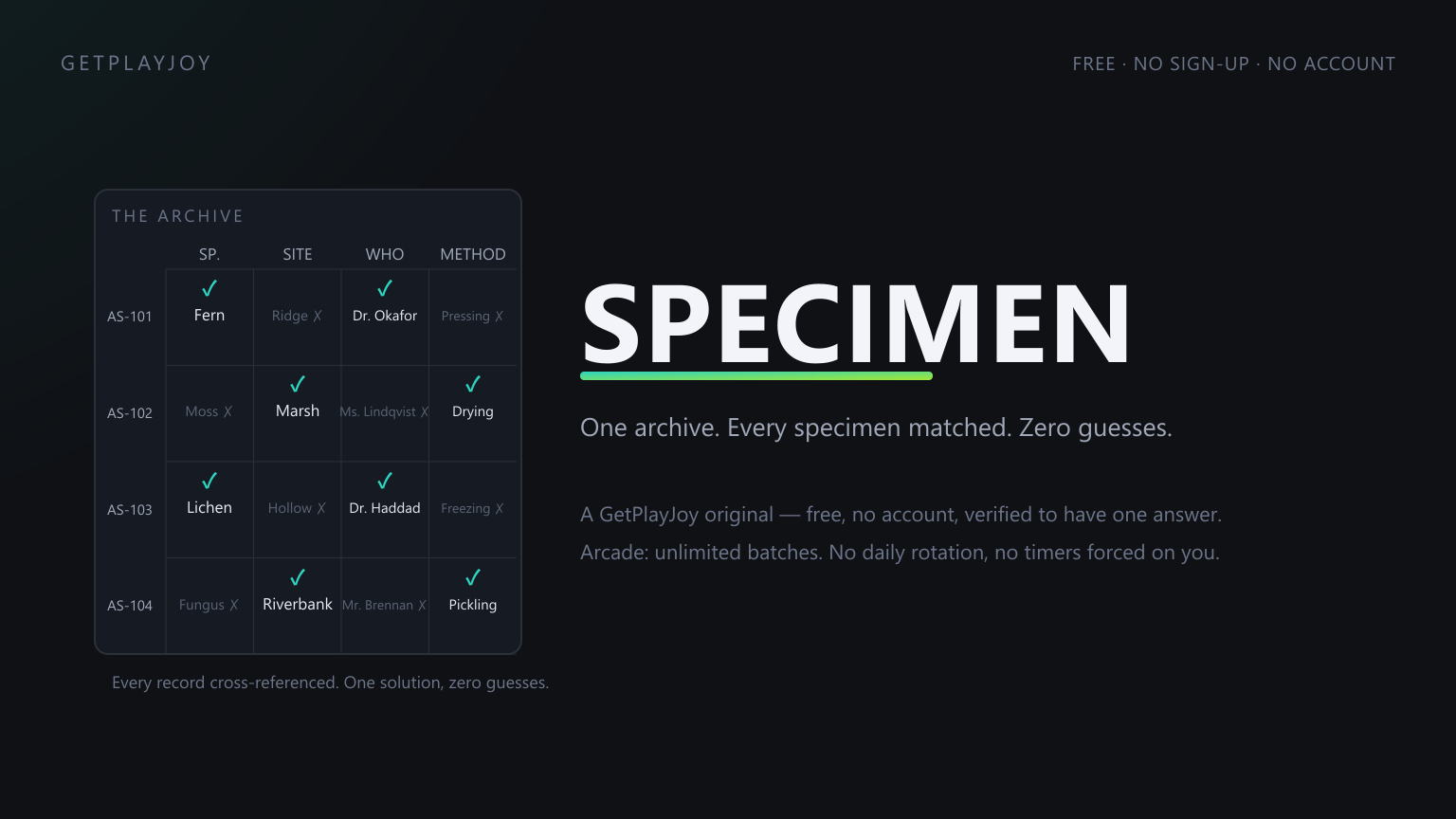
How to Play Specimen: Rules, Scoring and Every Grid Size
Specimen is a logic-grid deduction puzzle where you match specimens to their attributes by cross-referencing archive records, and every batch is built so that guessing is never required. It is free to play on GetPlayJoy with no sign-up and no account, and each batch is verified by a solver to have exactly one answer. This guide covers the archive desk, how a mark is filed, the three grid sizes, the scoring formula, what a mistake really costs, and the two buttons that do most of the teaching.
Mara Whitfield · 11 min read
How to Get Better at Specimen: A Constraint-Propagation System
Getting better at Specimen is not about spotting the answer faster. It is about applying one repeatable rule — propagate every forced deduction before you look for a clever one — and knowing when a batch has stopped handing out free reads. This guide is free to read and the game is free to play, no sign-up and no account required at GetPlayJoy. Below is the exact order a strong solver works a batch: singletons, then column elimination, then order records, then the relational records that pin a repeatable column, then the entailment step that separates a good batch from an easy one. Each step comes with the number that tells you it is working.
Mara Whitfield · 12 min read
Where to Play the Official Specimen (And How to Spot a Copy)
The official Specimen is the logic-grid puzzle at getplayjoy.com/games/logicgrid, and it is the only version built on the GetPlayJoy engine that guarantees every batch has exactly one solution. It is free to play with no sign-up, no account, and no download. This page tells you where the real thing lives, what the official build does that clones routinely skip, the red flags that mark a copy, and why any of it matters when the puzzle in front of you looks the same.
The GetPlayJoy team · 8 min read
The Sudoku Daily: Reset Times and the Six-Day Rotation
The Sudoku daily is a single 9×9 board that the whole world receives on the same calendar date, and you get one ranked attempt at it. Sudoku holds the ranked slot once every six days, because six games share one daily puzzle; on the other five days the game page still deals unlimited practice boards, unranked and free. It is free on GetPlayJoy with no sign-up and no account, and this guide covers exactly when the board resets, why the answer is never published, and how to share your result without spoiling the grid.
Mara Whitfield · 9 min read
Where to Play the Official Sudoku (And How to Spot a Copy)
Sudoku has no owner, but the GetPlayJoy version is one specific build with a date-seeded daily and a server that re-checks every score. It is free with no sign-up at getplayjoy.com/games/sudoku, and this guide gives you the in-game facts that prove you are on the real board, plus what a copy can never give you back.
The GetPlayJoy team · 9 min read
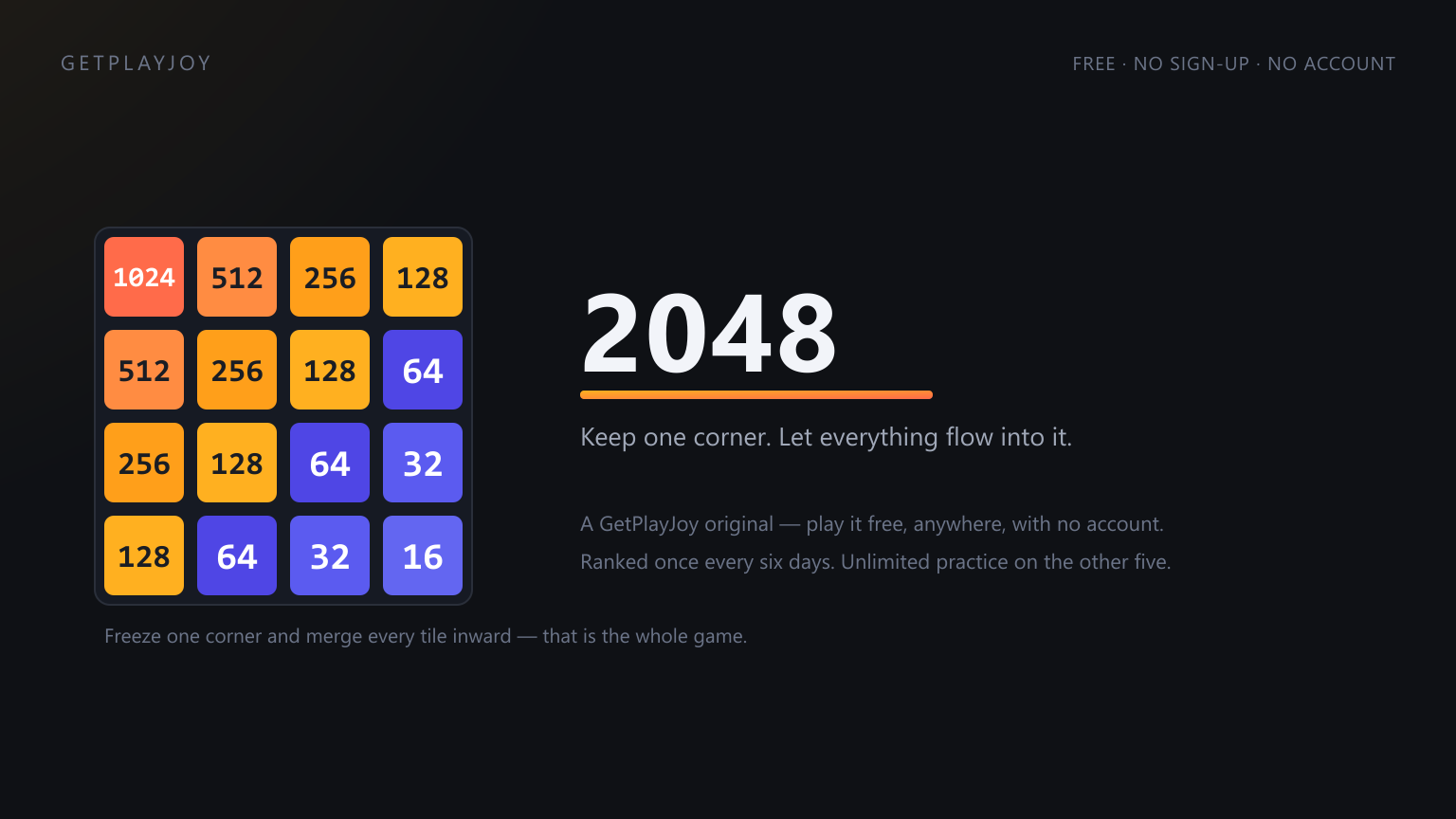
How to Play 2048: Rules, Scoring and Every Mode
2048 is a slide-and-merge puzzle on a four by four grid: every tile moves one direction at a time, two tiles that share a number fuse into their sum, and you keep going until no legal move is left. It is free to play here with no sign-up and no download, and the [2048 game page](/games/2048) hands you a practice board the moment you ask for one.
Mara Whitfield · 9 min read
How to Get Better at 2048: The Corner Strategy That Actually Works
Most players chase merges. The move that decides a board is the one you refuse to make: the swipe that pulls your largest tile out of its corner. Everything else in this guide is a consequence of that one refusal, and you can test every line of it for free on the [2048 game page](/games/2048), no sign-up, unlimited practice boards.
Mara Whitfield · 11 min read
The 2048 Daily: Reset Times and the Six-Day Rotation
The 2048 board is not random in the way the practice board is: it is generated from the calendar date, so everyone who plays it gets the same opening tiles in the same cells and the same new tiles in the same order. It is free, no sign-up, and the only thing you bring to it is your decisions.
Mara Whitfield · 8 min read
Where to Play the Official 2048 (And How to Spot a Copy)
The honest version of the question first. Nobody owns 2048: Gabriele Cirulli published it in March 2014 under the MIT licence, which explicitly permits anyone to copy, modify and rehost it, and hundreds of sites have taken him up on that. So "official" cannot mean "the only real one". What it can mean is a specific build you can verify line by line, running at getplayjoy.com with no sign-up and nothing to install.
The GetPlayJoy team · 8 min read
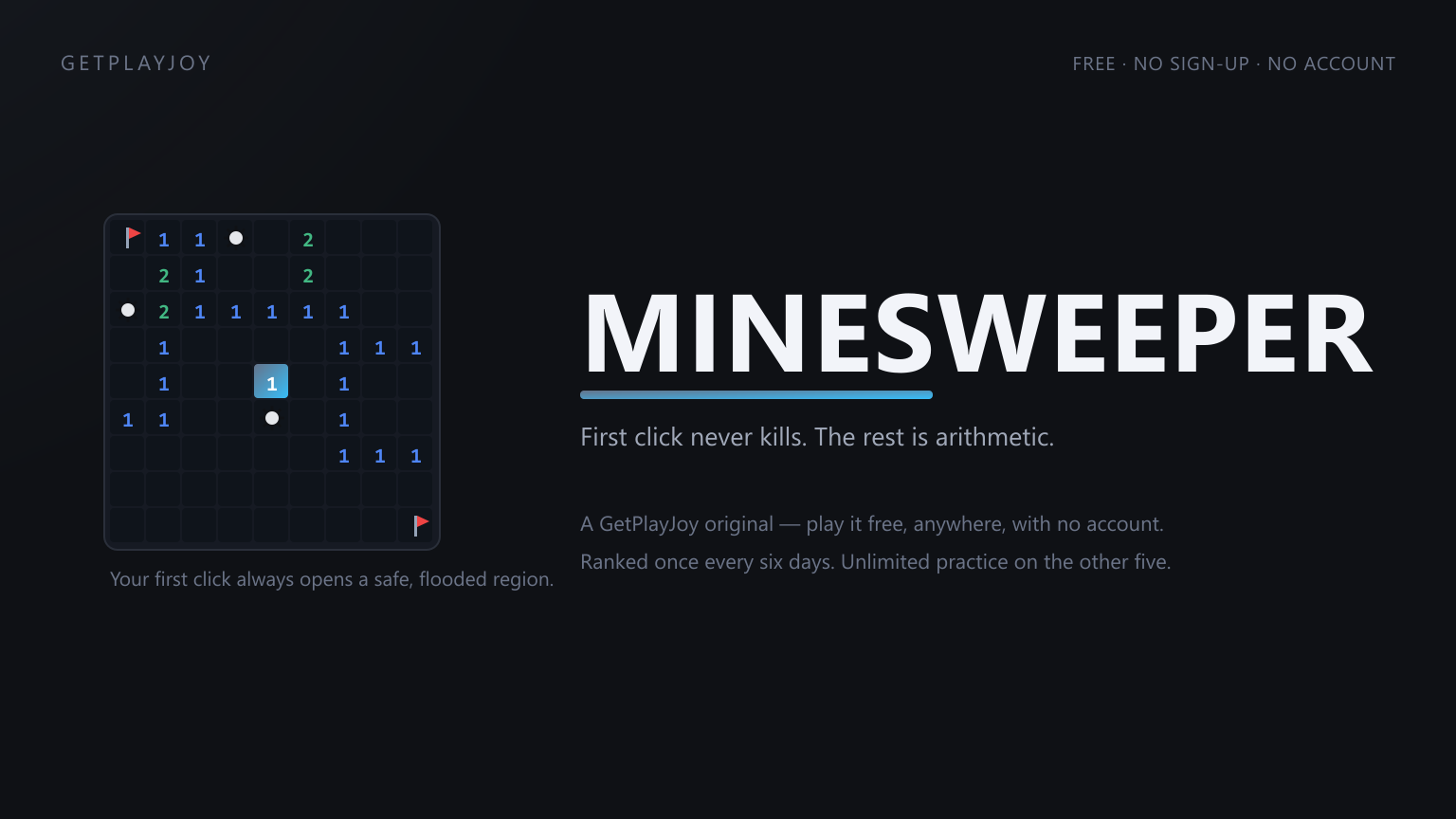
How to Play Minesweeper: Rules, Scoring and Every Mode
Minesweeper is a grid of covered tiles hiding a fixed number of mines, and every number you uncover is an exact count of the mines among its eight neighbours. Sweep every tile that is not a mine and the field is cleared. GetPlayJoy runs Minefield free in the browser with no sign-up, no account and no download, on the three classic board sizes. This guide covers the rules, the scoring formula line by line, what counts as a cleared field, what a mistake actually costs you, and the three ways to play.
Mara Whitfield · 11 min read
How to Get Better at Minesweeper: Read the Numbers, Not the Guess
Most players try to get better at Minesweeper by clicking faster. That is the third thing worth improving, and chasing it first is why intermediate players plateau at roughly the same time on Expert for years. The game scores you on clear time and wrong flags, and the [scoring formula](/resources/guides/minesweeper-how-to-play) rewards the second one far more predictably than the first. This guide is about decisions, not hands.
Mara Whitfield · 12 min read
The Minesweeper Daily: Reset Times and the Six-Day Rotation
The Minefield daily is three fields, 9×9 then 16×16 then 16×30, generated from the calendar date so that everyone who plays it on its day sweeps identical boards. Ranked play arrives once every six days; unlimited practice runs every day. It is free on GetPlayJoy with no sign-up and no account. This guide covers when the board rolls over, why Minefield gets the daily slot once every six days rather than every day, why today's mine layout is never published, and how to share your result without spoiling it for anyone else.
Mara Whitfield · 9 min read
Where to Play the Official Minesweeper (And How to Spot a Copy)
Minefield is GetPlayJoy's minesweeper, made by a two-person team, and it has been copied in the automatic way that happens when a rules set nobody owns meets a search term everybody types. Copies are not usually malicious; most are ad wrappers that swapped the rules without realising the rules were doing work. This page gives you eight things you can check inside thirty seconds, all of them observable in the game rather than claimed on a banner. Nothing here requires trusting us.
The GetPlayJoy team · 9 min read
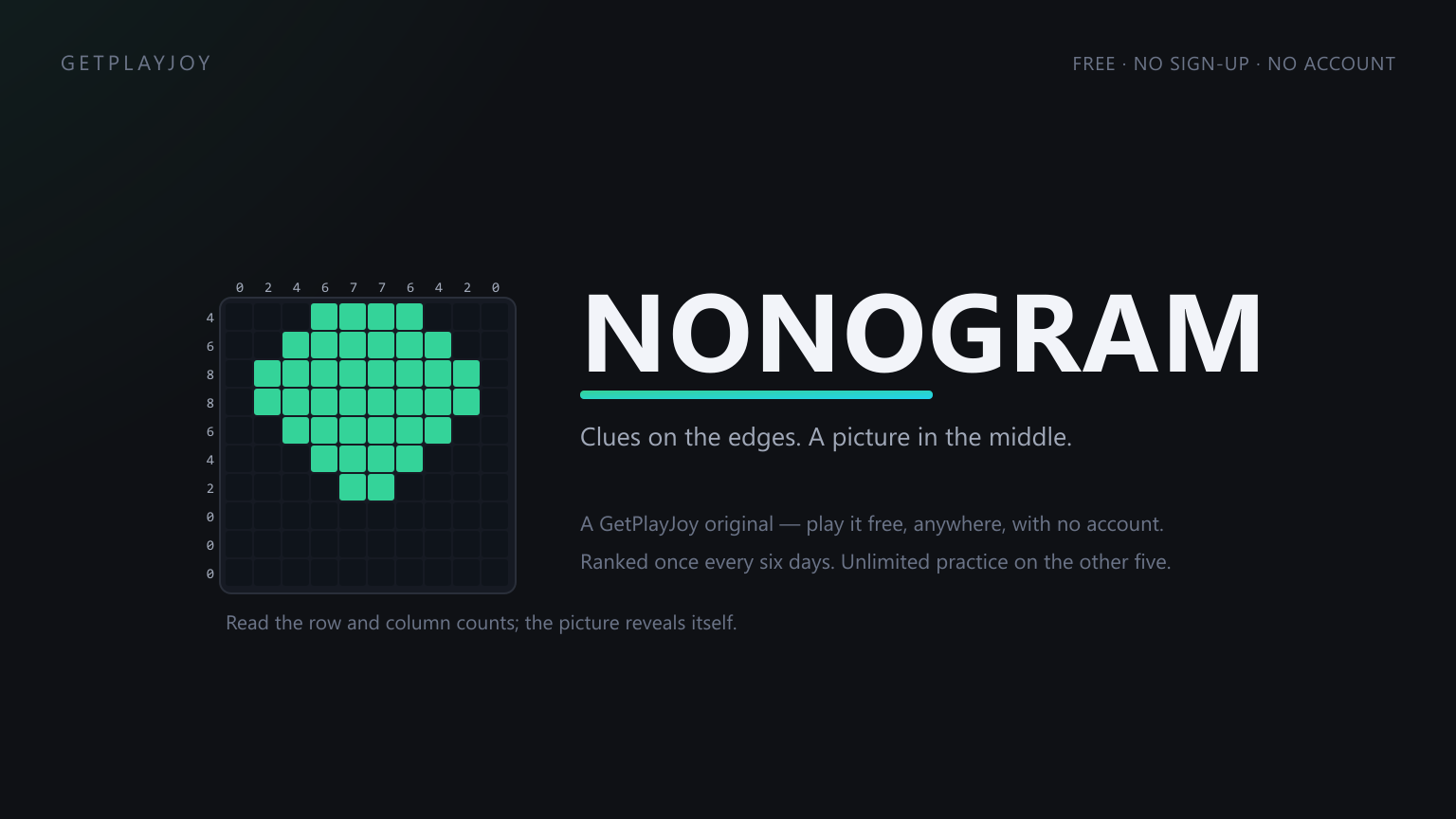
How to Play Nonograms: Rules, Scoring and Every Mode
A nonogram is a grid of empty cells with a list of numbers beside every row and above every column, and each number is the length of one unbroken run of filled cells in that line. Fill the grid so that every line matches its numbers and the hidden pattern appears. It is free on GetPlayJoy with no sign-up, no account and nothing to install. This guide covers how to read the clues, the three board sizes, the exact scoring formula, what a wrong cell really costs you, and the three ways to play.
Mara Whitfield · 11 min read
How to Get Better at Nonograms: From Guessing to Logic
Getting faster at nonograms is the second thing you should chase. The first is refusing to guess at all, because every board on GetPlayJoy is checked for a single solution before it is published, which means a guess is always a deduction you failed to spot. This guide is free to use and the boards it describes are free to play with no sign-up. It covers the two opening moves that crack most small grids, why marking blanks matters as much as painting fills, where the score actually stops rewarding speed, and a target run you can aim at.
Mara Whitfield · 11 min read
The Nonogram Daily: Reset Times and the Six-Day Rotation
The Nonogram daily is one shared board that the whole world solves on the same day, seeded from the date so every player gets identical clues. It is free on GetPlayJoy with no sign-up, and on the five days it is not the ranked game you can still play unlimited unranked practice at any size. This guide covers when the board resets in your timezone, why the finished picture is never sent to your browser, how the six-day rotation actually works, and what a wrong cell costs you.
Mara Whitfield · 10 min read
Where to Play the Official Nonogram (And How to Spot a Copy)
There is no single owner of the word nonogram, so "official" means something specific here: the board that runs on GetPlayJoy, with its clues generated from the date and its scores verified on the server. It is free with no sign-up, and this guide gives you the concrete tells that identify the genuine board so you can tell it apart from the look-alikes that borrow the name.
The GetPlayJoy team · 10 min read
- guide
Sudoku Scanning Technique: The First Ninety Seconds
A concrete order of operations for the opening of a Sudoku board — sweep, cross-hatch, then count — that removes most of the guessing from level one.
Mara Whitfield · 6 min read
- guide
Sudoku Pencil Marks: When to Add Them and When to Stop
Pencil marks are the difference between solving and stalling on harder Sudoku boards — but over-marking is its own trap. Here is the discipline.
Mara Whitfield · 5 min read
- guide
2048: Why Merge Order Matters More Than Merge Count
Two players can make the same number of merges in 2048 and end up hundreds of points apart. The difference is the order they merge in.
Mara Whitfield · 6 min read
- guide
Signal: How to Remember More Cards Without Trying Harder
Chunking, spatial anchoring and a fixed reveal order — three techniques that reliably raise your Signal percentile.
Dr. Owen Brackley · 6 min read
- guide
Minesweeper: Where to Click First and Why It Matters
Your first click decides how much of the board you get for free. Here is where to click, and how to read the opening that follows.
Mara Whitfield · 5 min read
- guide
Nonogram: Why You Should Always Start at the Edges
The overlap rule turns edge rows and columns into free information. Start there and the middle of the board solves itself.
Mara Whitfield · 5 min read
- guide
How to Read Your Streak and What It Actually Tells You
A streak is a habit metric, not a skill metric. Here is how to use it, and the three ways people read it wrong.
Dr. Owen Brackley · 5 min read
- guide
What Your Leaderboard Percentile Really Means
Percentile is not rank and it is not score. Here is how the number is computed and how to move it.
Mara Whitfield · 4 min read
- guide
A Five-Minute Puzzle Routine You Can Do Before Work
A short, repeatable morning routine built around one daily puzzle — designed to be sustainable rather than ambitious.
Mara Whitfield · 4 min read
- guide
How to Practise Puzzles Without Burning Out
Deliberate practice works on puzzles too — but only with the right dose. Here is how to structure it.
Dr. Owen Brackley · 5 min read
- guide
The Minesweeper 1-2-1 Pattern and Two Others Worth Knowing
Three recurring Minesweeper patterns that turn forced guesses into certainties. Learn these and most boards become solvable.
Mara Whitfield · 5 min read
- guide
The 2048 Snake Pattern, Explained Honestly
The snake pattern is the most reliable way to build a descending chain in 2048 — and it has one failure mode you need to know about.
Mara Whitfield · 5 min read
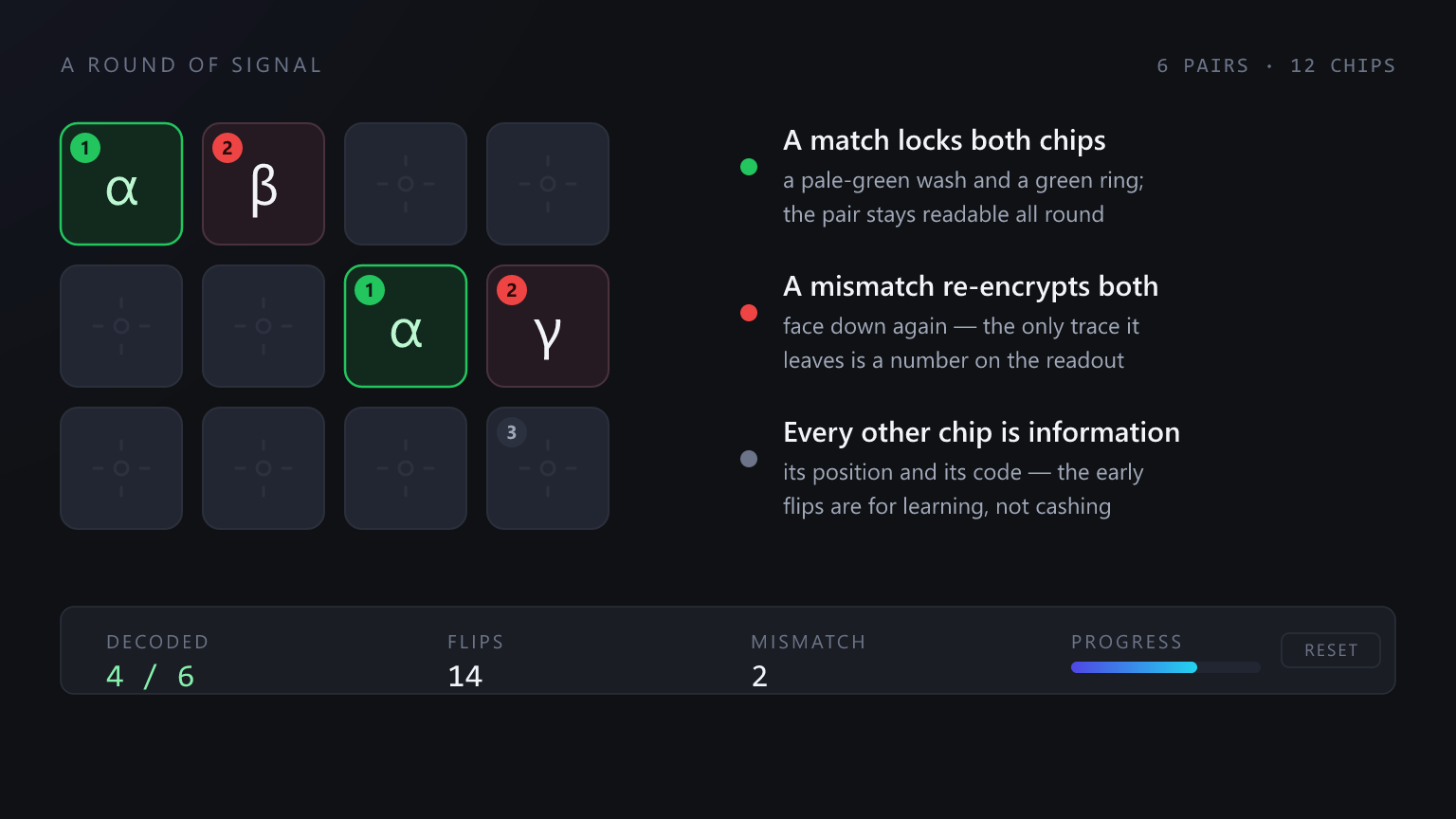
How to Play Signal: Rules, Scoring and Every Mode (2026)
How to play Signal: the rules, the scoring formula with the mismatch cost table, both modes, and what a mismatch actually costs you.
Mara Whitfield · 9 min read
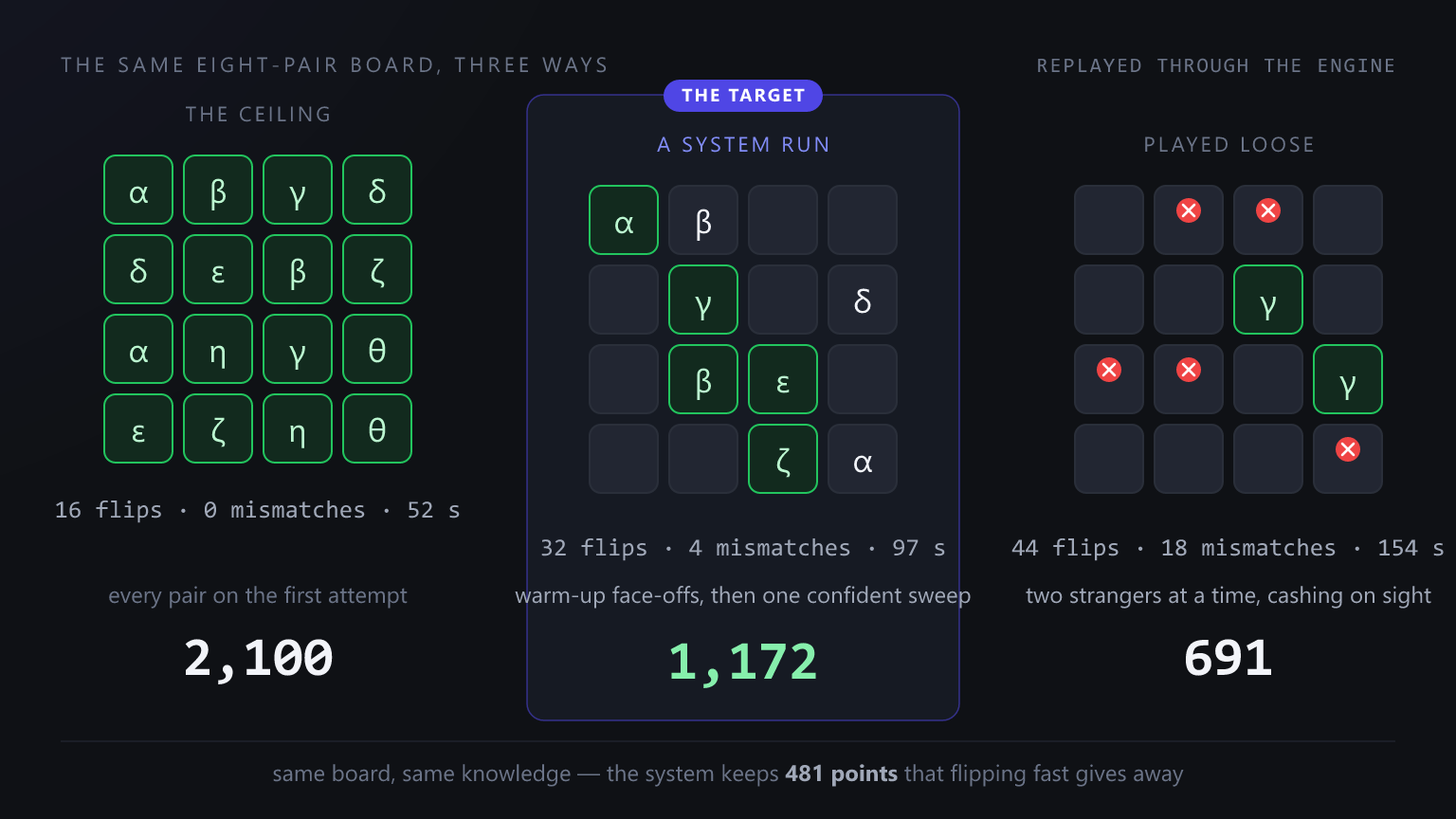
How to Get Better at Signal: Flip With a System, Not Faster
Why flipping faster does not raise your Signal score — and the five habits that do, with a worked example replayed through the real scoring engine.
Mara Whitfield · 10 min read
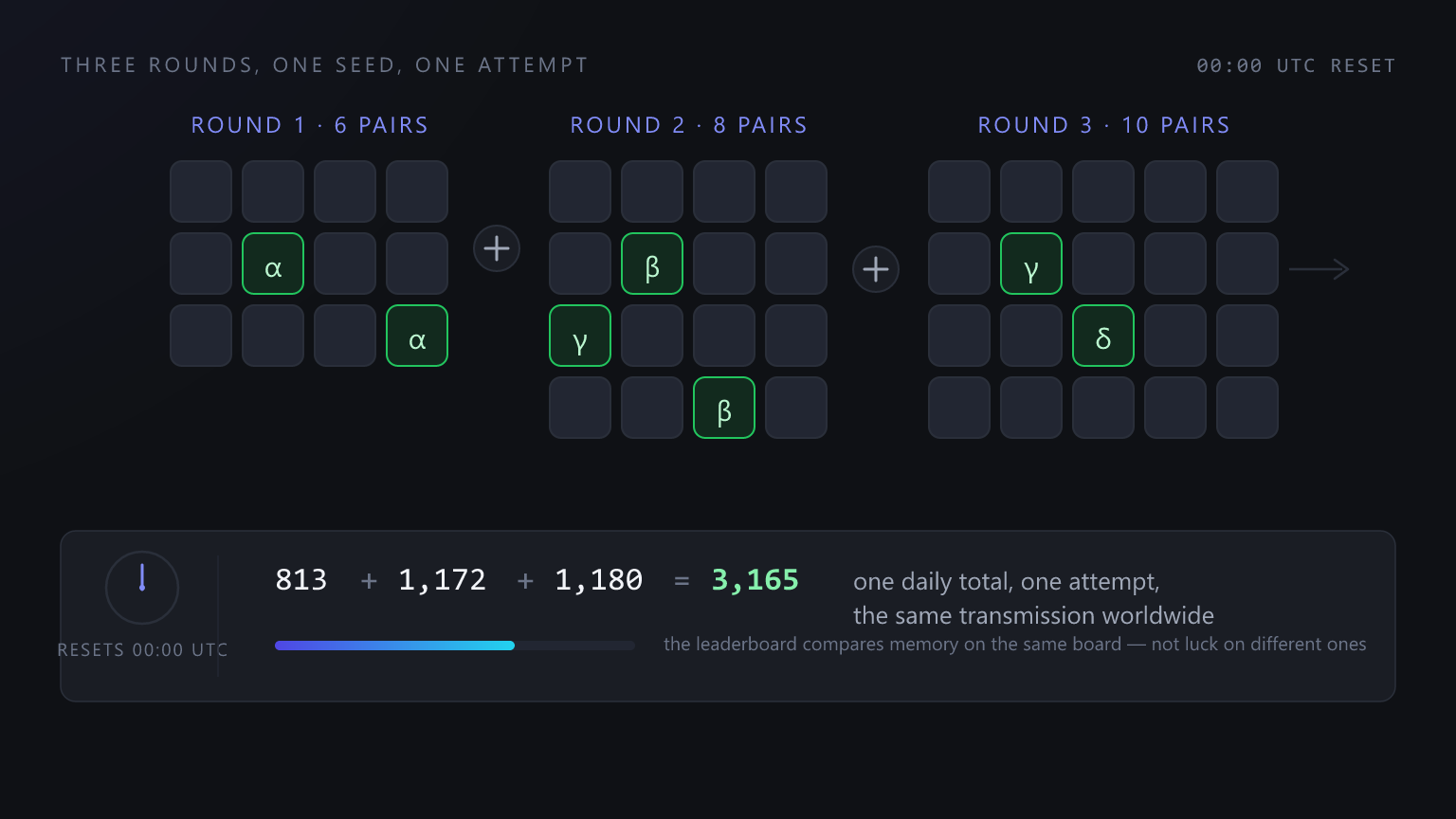
The Signal Daily: Three Rounds, One Shared Seed, and When It Resets
How the Signal daily works: three rounds on one shared seed, the reset time in five cities, the share format that does not spoil, and why archive replays are unranked.
Mara Whitfield · 8 min read
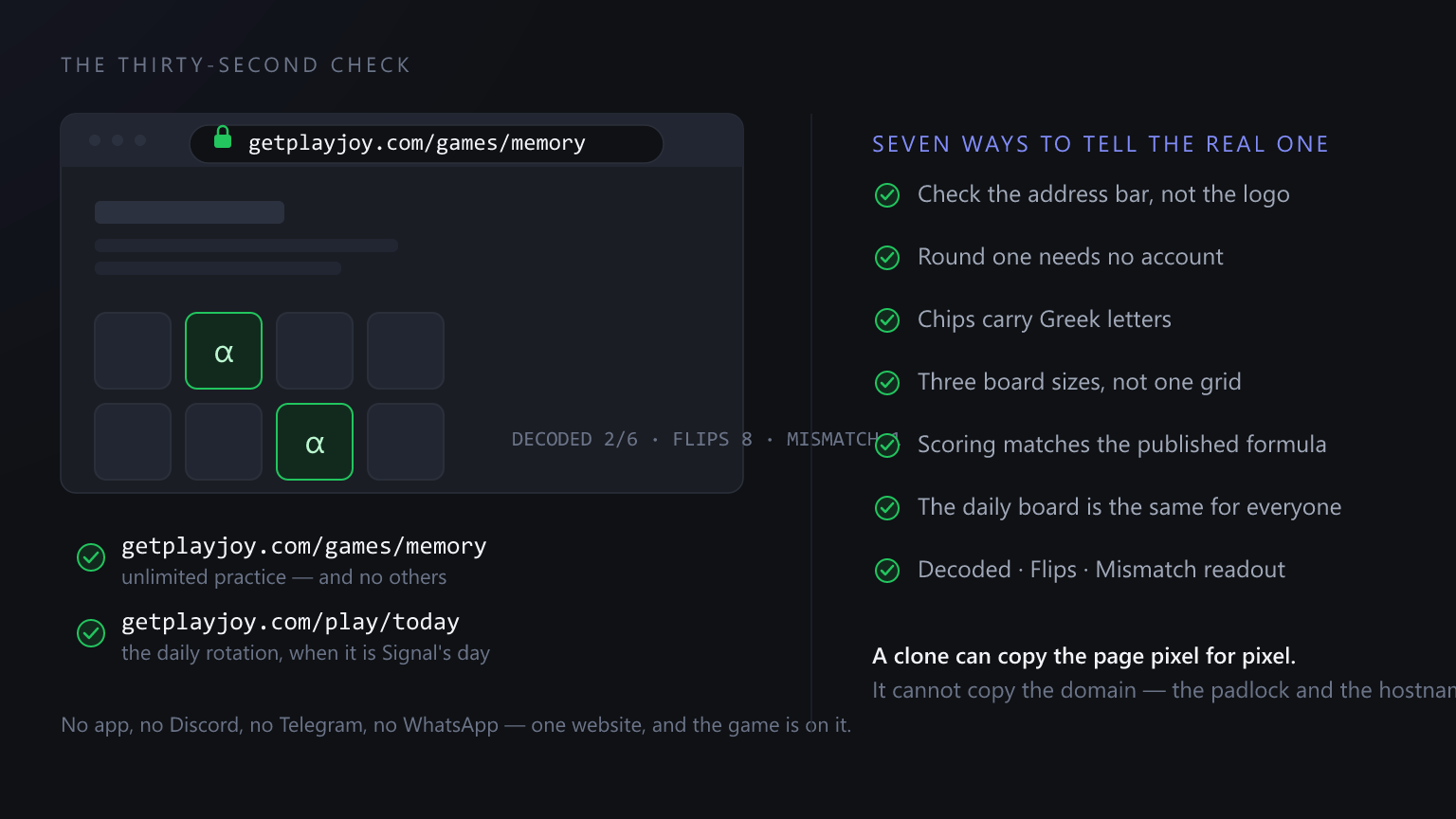
Where to Play the Official Signal (And How to Spot a Copy)
Signal is built and run by GetPlayJoy at getplayjoy.com. Seven thirty-second checks that prove you are on the real site, plus what to do about copycats.
Mara Whitfield · 6 min read