Signal's daily run is three boards, one seed, one shot. Here is exactly how the rounds are built, when the transmission changes, and what you can share without spoiling it for anyone else.
The daily exists for one reason: so the leaderboard compares memory on the same board rather than luck on different ones. Every mechanism below — the seed, the one-try rule, the unranked replays — is in service of that.
How to Play the Daily
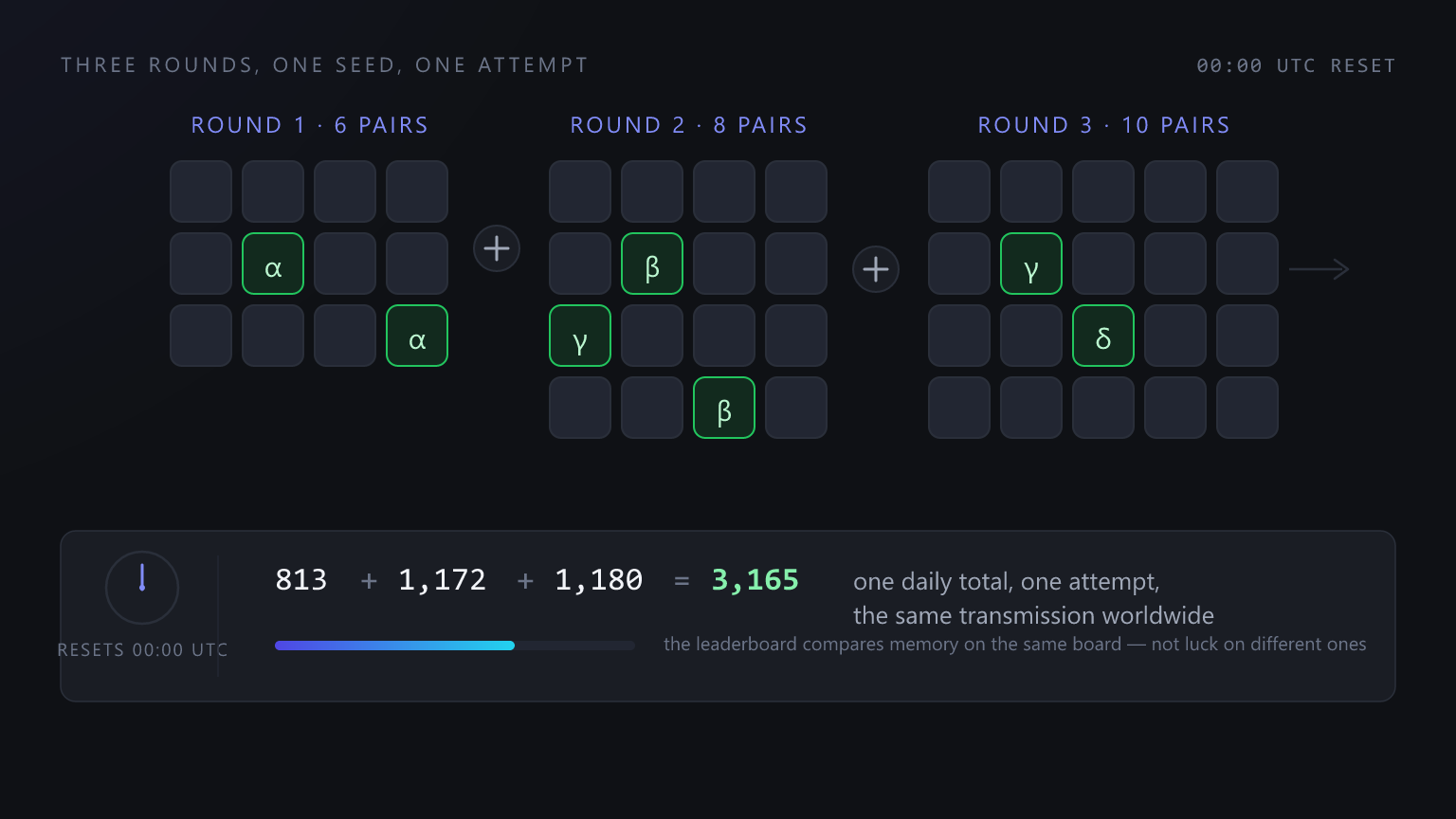
Open /play/today when Signal is the rotating game. Press Start — the timer begins then, not before — and play three rounds in a fixed order: 6 pairs, then 8, then 10. Between rounds a "round cleared" card settles the score before the next board appears; the run does not simply tumble from one grid into the next.
When the third board is decoded, the three round scores add into one daily total, and that total is what enters the leaderboard. One run per day is the whole attempt: there is no second submission to chase a better board.
One Try a Day, and Why
The three boards are generated from a seed derived from the date, the game and the round number, so every player on earth gets byte-for-byte identical grids. You can see the machinery in How Seeded Randomness Works; the consequence is what matters here: a score means something, because the board it was earned on is the same for everyone.
One try a day follows from that. If you could rerun the daily until the boards felt familiar, the leaderboard would measure who spent the most attempts, not who read the transmission best.
And the check that keeps it honest runs on the server. What your browser submits is not a score — it is the complete flip sequence, every chip you turned, in order. The server replays that sequence against the seeded board and recomputes matched pairs, mismatches and the score itself. Your client’s arithmetic is never trusted; How We Score Everything walks through the replay. That protects the leaderboard, and it protects you: a verified run cannot be argued down by someone who merely claims a higher one.
When Does It Reset
The daily transmission changes at 00:00 UTC. Local times below shift with daylight saving, so the local column moves twice a year even though the UTC line never does:
**New York** — 19:00 previous day (EST) / 20:00 previous day (EDT) · **Los Angeles** — 16:00 previous day (PST) / 17:00 previous day (PDT) · **London** — 00:00 (GMT) / 01:00 (BST) · **Mumbai** — 05:30 (IST, no DST) · **Sydney** — 10:00 (AEDT) / 11:00 (AEST)
The case that catches people out is the Americas. A New York player opening Signal at 20:00 on Thursday evening is playing Friday’s transmission, not Thursday’s — the board flipped at the moment the clock passed 20:00 EDT. If your evening habit and your "one run today" disagree, the evening wins: the date that counts is the UTC date.
Where Are Today's Answers
Nowhere, deliberately. The board is generated on the server from the seed, and the full layout is only revealed as you flip chips — there is no published solution, no answer key, and nothing to look up before you play.
This is the point of the seed. If today’s layout were published, the daily would reward whoever checked a website first instead of whoever remembered best. Every player meets the same transmission cold, once.
If you want to see a past board again — this time knowing what you know — that is exactly what archive replays are for, below.
Archive Replays vs the Daily
Past dailies stay playable at /play/archive/[date] for seven days, free; transmissions older than that are part of Pro. Replays re-deal the exact board from that date’s seed, which makes them the best practice tool on the site: you already know what you did wrong, and now you get to try again on the same grid.
They are also unranked, always, and the reason is technical rather than disciplinary. The server’s replay check is wired for a live daily submission — the flip sequence arrives, is replayed against the seed, and is verified in the same session. A replay from a past date does not feed the leaderboard or the ability radar because that live verification path does not apply to it. It is not a penalty and it does not mean anyone suspects you; it simply is not the ranked competition.
So the two modes divide cleanly: the daily is the exam, the replay is the practice paper. One is comparable worldwide, the other is yours.
Making the Most of One Try
**Give yourself ten seconds before the first flip.** Read the grid as a map — four columns, corners, centre — before you start spending face-offs. The board does not move; the only thing a rushed first chip buys you is a chip you had not planned for.
**Say every code out loud on the first sweep.** Alpha, beta, gamma — the verbal channel nearly doubles what sticks (the reasoning is in How to Get Better at Signal). One run a day is too few to waste on single-channel encoding.
**Read the Flips and Mismatch columns before the score.** The score is a summary; flips and mismatches are the diagnosis. A 1,122-point round with 4 mismatches is a different player from a 1,122-point round with 14, and only one of them is improving.
**Reset is a practice control, not a second attempt.** It re-deals your local view of the same board from the start. It does not open a fresh submission, and it cannot be used to farm a better total: the daily total comes from the completed run, verified by replay, and there is one of those per day. If you want to try a different approach to the same grid, that is what replays are for.
Where to Next
New to the game itself? How to Play Signal covers the rules, the formula and both modes. Ready to lower the flip count? How to Get Better at Signal is the system. And if you are wondering why a site would limit you to one puzzle a day at all, Why One Puzzle a Day is the argument from the other side.
The transmission resets at 00:00 UTC. It will still be there.