Most players try to flip faster. The score says otherwise: a clean ten-pair clear at a walking pace outscores a panicked fast one, because mismatches divide harder than seconds subtract.
Signal is not a reaction game. It is a test of how quickly you can learn a board — and the three numbers the formula reads are flips, seconds and mismatches, of which only one is really under your control.
Here is the system: five habits, the arithmetic behind them, and a worked example we replayed through the scoring engine so every number below can be checked.
The Only Arithmetic You Need
A round of Signal is a sequence of face-offs: two chips flipped, judged, and either locked or re-encrypted. If a board has P pairs and you make M mismatches, your flip count is fixed:
**flips = 2 × (P + M)**
Eight pairs with five mismatches is 26 flips, no matter how you play. Eight pairs with eighteen mismatches is 44 flips. Every technique below works by attacking M — the mismatches — because flips are just the receipt for them. The formula (set out in full in How to Play Signal) divides by the square root of M and by seconds, so a calm 26-flip round beats a frantic 44-flip round every time, even though the frantic one finished "faster".
Name Every Code Out Loud
The pool is thirty Greek letters, and the temptation is to describe a chip by its shape — "the triangle", "the squiggle". Do not. Say the name: alpha, beta, gamma.
This is dual coding, and it is one of the more robust findings in memory research: material encoded both visually and verbally is recalled better than material encoded either way alone (Paivio, 1971). The shape is one channel. The name is a second. It costs nothing — a muttered "delta" as the chip turns over — and it roughly doubles the handles your memory has on that position.
The same trick works for the spatial half: "alpha, middle row" is two encodings again. Chip and position, name and place.
Do Not Cash Pairs on the First Sweep
The instinct, the moment you flip the second alpha, is to cash it. Resist. Cashing a pair you have just discovered spends two flips to remove two chips from a board you have barely read; the same two flips, spent exploring, would have taught you four new positions.
The arithmetic is unforgiving. A player who cashes on discovery walks a sixteen-chip board in roughly 40 flips — every pair costs two flips plus the exploration that found it. A player who explores first, then cashes everything in one confident sweep, walks the same board in the low thirties, and the eight-pair tier in the mid-twenties.
The rule to hold onto: during the first pass, a pair you have just matched stays in your head, not on the board. Lock it when you have nothing left to learn.
Build a Spatial Map, Not a List
Working memory is not one buffer. The classic model splits it into a phonological loop for sounds and a visuospatial sketchpad for positions (Baddeley and Hitch, 1974), and the sketchpad is where a Signal board actually lives.
So encode spatially, not as a list. "Alpha at top-left, beta middle row, gamma bottom-right" is a map; "alpha, beta, gamma" is a list, and lists decay in order while maps do not. The board is already a map — four columns of chips — so use the geography you are given: corners, edges, centre, the chip next to the one you just locked.
A practical habit: when you flip a chip, say its position out loud with its name, not just the name. "Delta, bottom-right corner." You are filing the chip in two systems at once.
Clear the Frame Before the Middle
Chips on the edge of the grid have fewer visual neighbours, so they are harder to confuse with each other; chips in the centre sit in the densest part of the field and generate most of the "I could have sworn that was epsilon" moments.
Clear the corners and edges first. By the time eight or ten chips are left in the middle, your spatial map has room to hold all of them at once, and the endgame becomes a formality rather than a scramble. It is the same reason a jigsaw is assembled from the border inwards.
Flip Unknown Against Known
Every face-off has an information value, and it depends entirely on what you already know about the two chips:
**Unknown + Unknown → +2 positions learned, but a mismatch is likely** — you are spending a face-off to buy two lottery tickets.
**Unknown + Known → +1 position learned, and a match is possible** — you are spending a face-off to test a specific hypothesis. This is the workhorse flip of the whole game.
**Known + Known → 0 positions learned** — pure execution. This is what the endgame should be made of.
A first sweep made of unknown-against-unknown face-offs is a tour of the board, and it is the right tour. But once you have seen a chip, every later face-off should test it against something new, never against another stranger. Two unknowns facing off is the single most common reason a strong player posts 44 flips on a board that should take 26.
The Memory Palace Trick, Simplified
Memory athletes do not memorise decks by staring harder. They walk a familiar route — a palace — and place each item at a landmark along it. The technique is old enough to have a Latin name, the method of loci, and it has a respectable evidence base: brain imaging of memory champions shows the competition feats recruit the same spatial-navigation regions the rest of us use to find our way home (Maguire et al., 2003).
You do not need a palace. A Signal grid is already a building with sixteen or twenty rooms, and if you have been reading chips with position-and-name, you have been filing them into it all along. The grid is the landmark set; "delta, bottom-right" is the hook. The technique is not an extra skill bolted onto the game — it is a description of what good players are already doing.
A Worked Example, Replayed Through the Engine
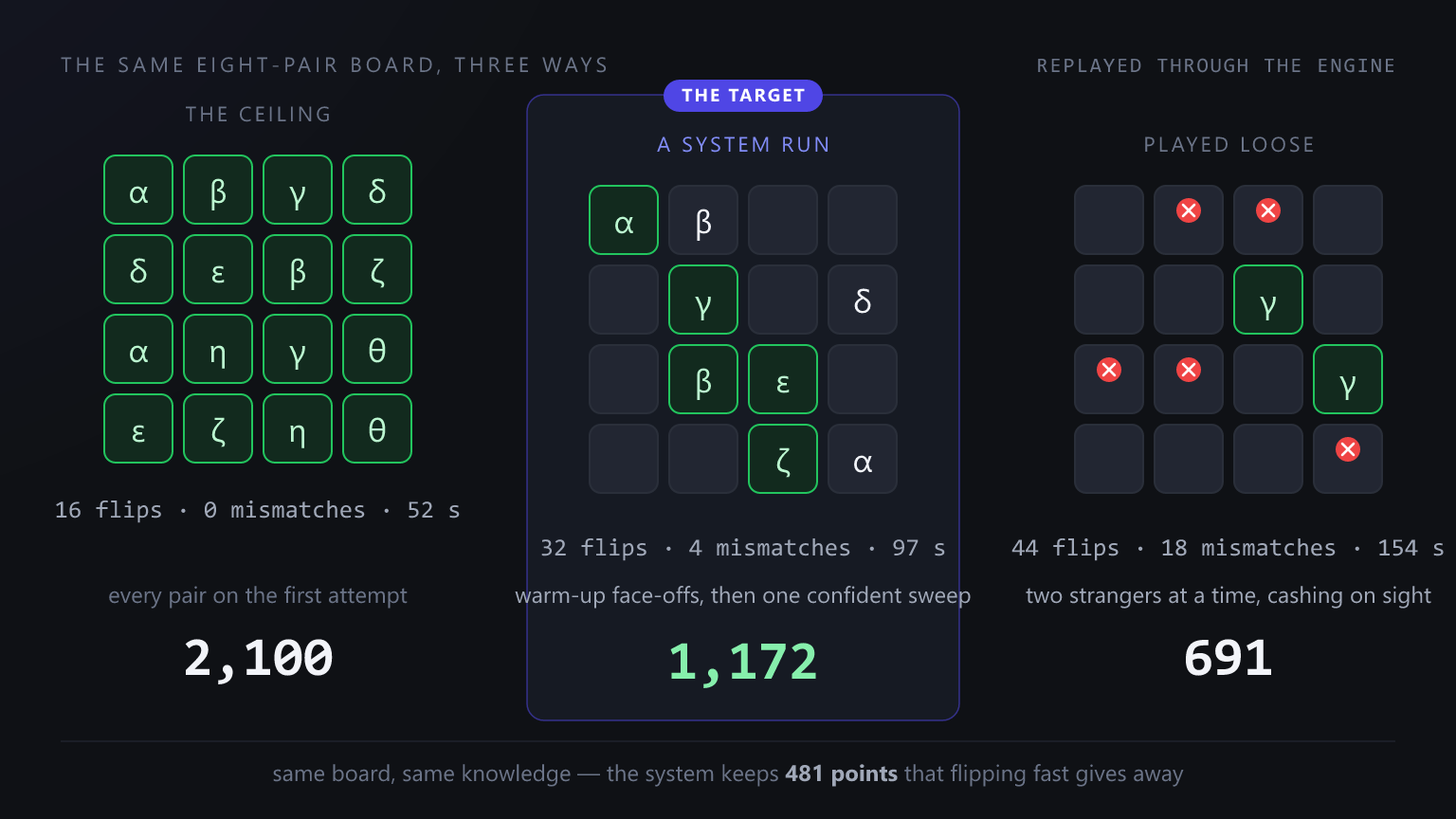
Numbers in this section are not estimates. We built an eight-pair board from a fixed seed, replayed three flip sequences through the same engine that scores your runs, and let it count. The flip sequences are real; the only thing chosen for them is the playing style.
**The theoretical ceiling: 16 flips, 0 mismatches, 52 seconds → 2,100.** Sixteen flips is every pair found on the first attempt — the perfect round. It is also unreachable by anyone who is not looking at the board, which is the point of listing it: it is the ceiling, not the target.
**A system run: 32 flips, 4 mismatches, 97 seconds → 1,172.** Four warm-up face-offs on unseen chips, then every remaining pair cashed with full recall. The flip sequence opens 0, 1, 2, 3, 4, 5 — five strangers meeting each other — and from flip seven onward there is not a single wasted face-off. That is what "flip with a system" looks like from the inside.
**The same board, played loose: 44 flips, 18 mismatches, 154 seconds → 691.** Two chips flipped at a time, cashing pairs the moment they appear, no map. Same board, same player knowledge, no system — and 481 points gone.
The honest gap: a system run does not reach 16 flips, and it never will. Working memory holds four or five chips comfortably, not sixteen; the warm-up mismatches are not carelessness, they are the cost of loading the board. What the system does is compress the other 28 flips of waste into 4. The target is the middle column, not the first one.
Where to Practise
The unlimited board at /games/memory is the practice room: three sizes, New round as often as you like, no leaderboard pressure. Run the five habits above for a week on eight pairs and watch the Mismatch column before you watch the score.
When the daily rotation comes back to Signal, the same boards are shared worldwide for one day — The Signal Daily explains the seed and the reset time — and that is when a low flip count turns into a leaderboard position. If you want the memory theory in more depth, Working Memory Drills That Actually Work covers the training side, and Signal chunking strategy is the companion piece on grouping chips into chunks.
Everything is free, with nothing to sign up for. The next board is one click away.