Signal is a free daily memory game: a grid of chips, each carrying a signal code that appears exactly twice, and one job — decode every pair from memory.
No account, no download. The daily grid is seeded by the date, so everyone on earth reads the same transmission, and the leaderboard means something because the board does.
This guide covers the rules, the scoring formula, both modes and what a mismatch actually costs — everything except the strategy, which has its own guide.
Introduction
You tap a chip. It shows a Greek letter — α, β, γ, one of thirty in the pool. You tap a second. If the two letters match, both chips lock in place with a pale-green wash; if they do not, they re-encrypt and turn face down again. Clear all eight pairs and the round is over.
That is the whole game. Everything around it — the scoring, the two modes, the sharing format — exists to make the comparison fair, and it is all below.
A Round, Step by Step
**1. Read a chip.** Tap it, or move the keyboard cursor with the arrow keys and press Enter. The chip stays face-up and waits for a partner.
**2. Read a second chip.** Once the second chip is flipped, the board pauses for 620 milliseconds before judging the pair. That window exists so you can see both codes; during it, a third tap is simply ignored rather than counted as a mistake.
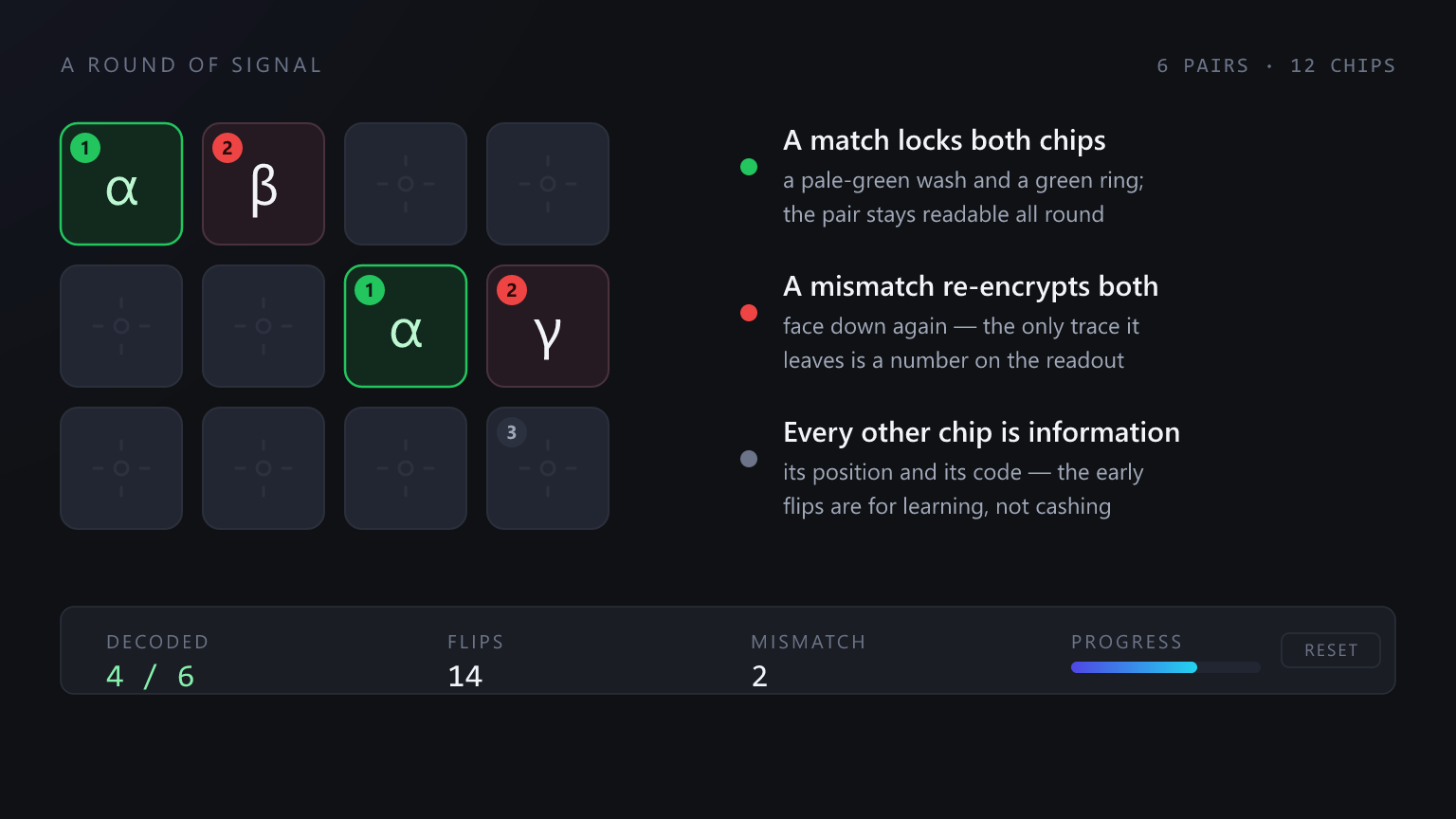
**3. Match or re-encrypt.** A match locks both chips — a pale-green background and a green ring — and they stay readable for the rest of the round. A mismatch flips both back, and the only trace it leaves is a number on the readout strip.
**4. Bank what you saw.** Every chip you have flipped is information: its position and its code. Good players spend the early flips learning the board rather than cashing the first pair they recognise. The full method is in How to Get Better at Signal.
**5. Clear the grid.** When every pair is locked the round ends and the board shows "Transmission decoded". The readout strip has been counting the whole time: Decoded x/N, Flips and Mismatch, with a progress bar and a Reset button.
The Board: Codes, Chips and Grids
Every code appears exactly twice. That single fact is what makes Signal solvable by pure memory: nothing is hidden behind guessing, deduction or luck, and a player with a perfect memory would never flip a third chip to find a pair.
There are three board sizes, and they map one-to-one onto the daily rounds: 6 pairs (12 chips, 4 columns), 8 pairs (16 chips, 4 columns) and 10 pairs (20 chips, 5 columns). Each round draws its codes from the same pool of thirty Greek letters, so the same grid never looks the same twice — but within one round, a code always looks the same.
The readout strip under the board carries three numbers — Decoded, Flips and Mismatch — plus a progress bar and Reset. Decoded counts locked pairs; Flips counts every chip you have turned, including the ones that re-encrypt; Mismatch counts pairs that did not match. Reset clears your local board and re-deals the same transmission from position one. It is a practice control, not a scoring lever.
From Flips to Score
The formula is published on the game page and it is the same one the server uses to re-check your run:
**score = round((clear bonus + min(80,000 ÷ seconds, clear bonus)) ÷ min(1 + 0.3 × √mismatches, 3))**
The clear bonus is the floor you clear the board with: 650 for six pairs, 1,050 for eight, 1,550 for ten. The speed bonus starts at 80,000 points divided by your seconds and is capped at the clear bonus itself — so a six-pair round maxes its speed bonus at 123 seconds, eight pairs at 76 seconds, and ten pairs at about 52 seconds. Past that point, going faster adds nothing. A ten-second board does not exist, and the formula is built so it cannot be rewarded if it did.
Mismatches divide the total, on a square-root curve with a hard cap:
**1 mismatch ÷1.30 (−23%) · 2 ÷1.42 (−30%) · 3 ÷1.52 (−34%) · 9 ÷1.90 (−47%) · 45 and above ÷3.00 (−67%)**
The curve matters more than the table. The first mismatch costs you a fifth of the round; the tenth costs a rounding error. That is deliberate: a memory game played honestly produces mismatches, and a formula that punished them linearly would score a normal round out of the band the leaderboard lives in. The full reasoning, including the cross-game calibration, is in How We Score Everything.
In practice a single round lands between the 650-point floor of the six-pair tier and a 3,100-point ceiling; a strong three-round daily — one round at each size — sits above 3,000.
What Counts as a Match
A match is two chips carrying the same code, in any order, flipped by any input — tap, click or keyboard all count identically. Nothing else does.
Two edge cases are worth knowing because you will hit both. First, tapping a chip that is already face-up and waiting for its partner does nothing: the second tap is ignored, and it does not appear in your flip count. Second, tapping a chip that is already locked does nothing at all — locked chips are readable, so there is never a reason to re-flip them, and the board will not let you.
One more case, and it is the honest one: if the server cannot reproduce your board from the daily seed — because the submission was incomplete, or the board belongs to a date whose verification path has closed — the run is marked unranked. It stays on your profile, it just does not enter the leaderboard. That is the whole meaning of the label; it is not an accusation.
What a Mismatch Actually Costs
This section exists because most timed puzzle games have trained players to read a mismatch as a failure. In Signal it is not. A mismatch does not end the round, does not lock the board, does not deduct points and does not break a streak. The two chips re-encrypt, you remember where they were, and you carry on.
The cost is exactly two things: the divisor in the formula grows, and you spent a flip learning two positions you already knew. That is it. Compared with a timer that punishes every wrong move with seconds you cannot get back, a recoverable mismatch is a mild tax — which is why the first mismatch costs 23% and the ninth costs almost nothing extra.
The right response to a mismatch is not to play safe. It is to note the two positions you just saw — that pair is now half-decoded — and keep flipping.
The Modes: The Daily
The daily run at /play/today is the ranked mode, and it only appears when Signal is the rotating game of the day. You play three rounds in order — 6 pairs, then 8, then 10 — with a "round cleared" card between them, and the three round scores add into one daily total that goes on the leaderboard.
Everyone gets the same three boards: the daily seed is derived from the date, the game and the round number, so the transmission is identical worldwide. That is what makes the leaderboard a comparison rather than a lottery. The reset time, the sharing format and the one-try rule are all in The Signal Daily.
The Modes: Unlimited Practice
At /games/memory the same game runs unranked and unlimited: pick any of the three board sizes, hit New round as often as you like, and play for as long as you want. Scores are stored on your profile but never enter the daily leaderboard — this is the mode for trying the system-flipping method on a board you have already seen, or for warming up before the daily.
If you are unsure which mode a page is running, the page says so: the practice board carries a note that it is casual, the daily board does not. The trade-offs of each are laid out in Practice vs Daily Mode.
The Modes: Archive Replays
Past dailies stay playable for seven days at /play/archive/[date], free; older transmissions are part of Pro. Replays are practice runs: they do not enter the leaderboard and do not feed the ability radar, because the server’s replay check is only wired for a live daily submission.
Where to Next
The rules above are enough to play your first round today. To play it well, read How to Get Better at Signal for the flip system, and The Signal Daily for the reset times and the three-round structure. If you want to check you are on the real site before you invest a streak in it, Where to Play the Official Signal takes thirty seconds to read.
Or just open the Signal game page and start flipping. It is free, there is nothing to sign up for, and the next transmission is already waiting.