Below is the corner strategy built out properly, with the six habits around it, one full board replayed move by move on a real daily seed, and the arithmetic that tells you what a target actually costs.
The rules themselves are in how to play 2048 if you need them beside you. Quick version: 16 cells, a merge pays the value of the tile it creates, every round with a target of 128, 256 or 512 scores your merge total halved, plus 600, 1,200 or 1,800 for reaching the target, plus a time reward worth 4,000, 8,000 or 12,000 divided by your seconds.
What the game is really measuring
Not arithmetic. Nobody has ever failed 2048 because they could not add. The board measures how much order you can hold in 16 squares while something random keeps throwing tiles into them, and the losing condition is purely spatial: no legal move left.
That reframes everything. You do not win by making clever merges; you win by never letting positions get clever. Order is cheap to maintain and expensive to rebuild, so the whole skill is early discipline.
Pick one corner and never remove your largest tile from it
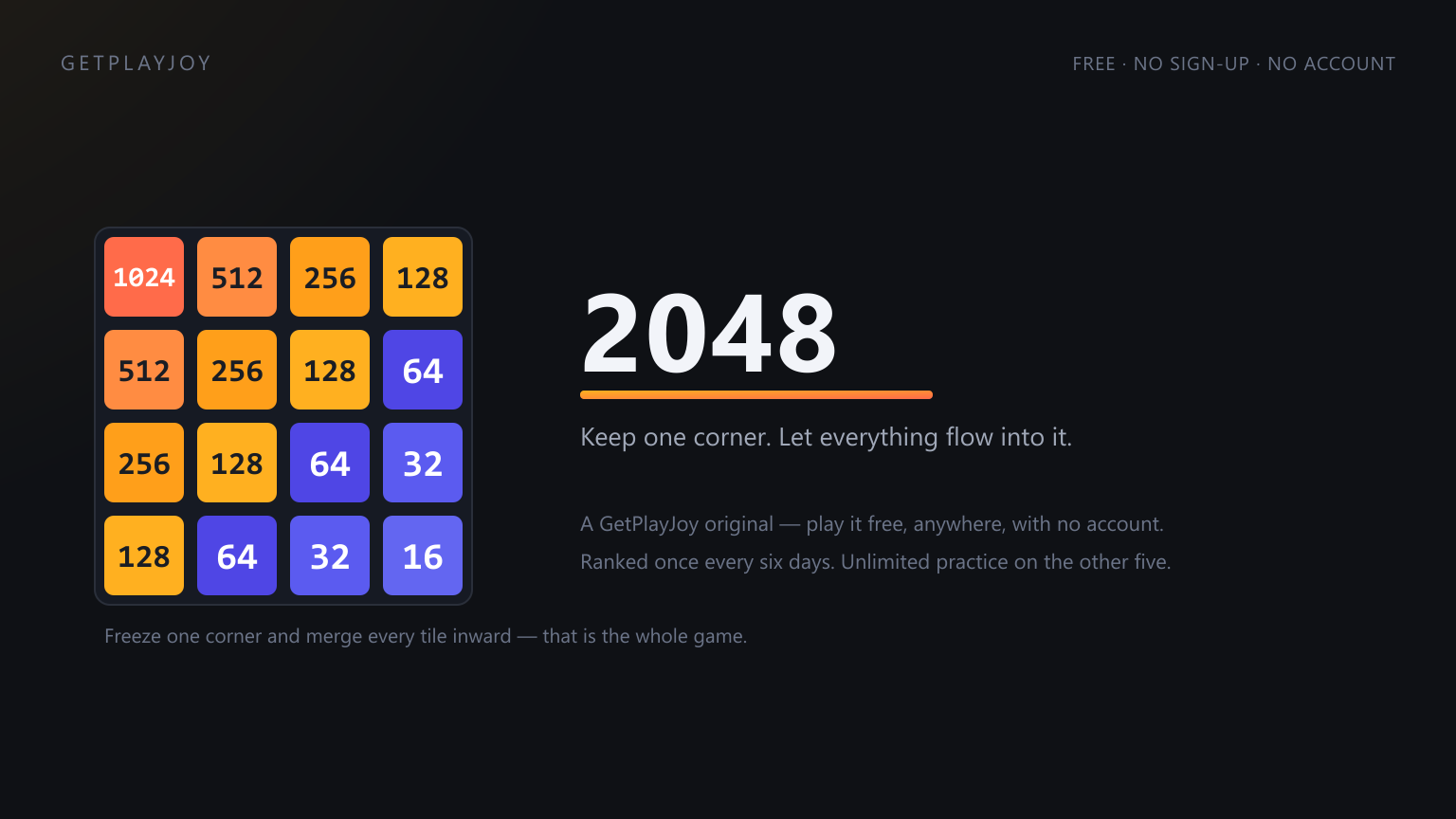
Choose bottom-left or bottom-right before move one and treat it as home for your biggest tile. Once a large tile sits there, you may swipe in the two directions that push toward it freely, and you touch the other two directions only when the useful ones are blocked. That is the entire anchor rule.
Picture a shopkeeper with one display case bolted to the floor. Everything else in the room can be rearranged all week. The case never moves, so customers always know where to look, and you always know where your largest tile is. Remove the bolt and every rearrangement has to rebuild its own reference frame.
The AI side agrees. Szubert and Jaskowski trained a learner in 2014 that reached a 32,768 tile, and the published expectimax solver by Lee reached far past any human. Neither does arithmetic tricks; both keep the high tile boxed in one corner and let everything else queue behind it.
What breaks the anchor:
Swiping toward the anchor's escape direction "just to see what happens".; Chasing two small tiles on the far edge while your largest drifts inward.; Keeping the second-largest tile stranded two rows away with tiles between.
Build a gradient, not a pile
Values should descend away from the corner, so the row out of the anchor reads something like 64, 32, 16, 8 and the rows behind continue the same slope. Every tile then has exactly one neighbour it can eventually combine with, which means no tile is ever orphaned.
A tidy staircase is a good mental model: you can walk it in the dark because each step is where you expect. A pile is not walkable. Piles also fail quietly, in that the score keeps climbing while structure rots, and you notice at six empty cells with nothing left to merge.
What piles look like:
A 64 in the middle with small tiles pinned either side of it.; Two equal tiles on opposite edges that cannot reach each other.; A bottom row reading 8, 64, 4, 2 because you took every merge offered.
Up is expensive, not banned
Beginner advice says never press up, and it is good advice for about your first fifty boards, because a single thoughtless up-swipe is the classic way to drag your anchor off the bottom edge. But the rule is not really about the key. It is about whether the direction you chose moves your largest tile out of its corner.
We checked this rather than repeating folklore. Replaying a real round 3 seed to its 512 target took 240 moves split as 53 left, 65 down, 69 right and 53 up. Up was 22% of the moves and the board still cleared, because each of those up-swipes left the anchor where it was. What sank none of these boards was direction, and what sank every board we ruined in testing was letting the big tile sit in the middle.
So: any direction is allowed if the corner tile keeps its seat. Any direction is wrong if it does not.
Count empty cells before you count points
Running out of space is the only real losing condition, so emptiness is your fuel gauge. Below three empty cells, stop hunting large merges and consolidate instead, even if a juicy 64 is one swipe away.
The checkpoints from a real cleared board make the point. On a 240-move run to 512, the board carried 12 empty cells at move 10, 9 at move 30, 6 at move 180 and finished with 9. It never went near one. A board that dips to one empty cell is not behind, it is dead, because the next spawn decides whether you play again.
Habits that drain it:
Holding an unmergeable small tile in the flow lane because it "might pair later".; Taking a merge that requires a second row rebuild.; Ignoring the top row entirely until the spawn fills it with junk.
Plan two moves ahead and no further
The random spawn caps how much planning can pay. Two moves is about the limit a human can hold without guesswork, and it is also why solver authors settle on a fixed search depth instead of solving to the end: the hidden tile wipes anything longer.
Concretely, plan "left to pair the 16s, then down to bring the new 32 home". Execute. Re-plan after the spawn lands. That is it. Players who try to map twelve moves ahead are the ones you see frozen at eight empty cells.
A real board, replayed move by move
Here is an actual run, not a reconstruction. The seed is the round 3 board for 2026-10-29, which any player could open on its day. We replayed it with a small expectimax policy using the engine's own rules, including the 90/10 spawn and the single-merge-per-tile rule, so every figure below is counted from the same code the site runs.
The board opens with two 2s:
. . . . . . . . . . . 2 2 . . .
The first 24 inputs were: left, down, right, down, down, right, down, down, right, up, left, up, down, down, up, left, left, down, down, left, up, left, down, up.
Checkpoints along the way, shown before each spawn:
move 10 . . 2 2 move 60 . . . 4 . . . 4 . . . 32 . . . 16 . . 2 64 . . . . . . 2 32 move 120 64 128 2 2 move 240 512 4 8 2 . . 64 8 8 16 . . . . . 2 2 . . . . . . 4 . . . .
The 120 reading is the shape to study: 128 and 64 running along the top edge in descending order, everything else small, eight empty cells in hand. Twenty moves later a 256 sat in that chain and the run was never in danger.
Final figures: 240 moves, 185 merges, a merge total of 4,040 and a 512 tile in the top-left cell. Scored by the site formula at 120 seconds, that is 4,040 ÷ 2 = 2,020, plus the 1,800 clear bonus, plus 12,000 ÷ 120 = 100 for time, giving 3,920 points. At 90 seconds it would be 3,953; at 180 seconds, 3,887. Time is worth 67 points across that whole range. Structure is worth thousands.
We ran the same six round-3 boards from consecutive rotation days under two policies. The ordered policy cleared 512 on six of six, averaging 256 moves, 203 merges and a merge total of 4,159. A policy that just picked a random legal direction cleared zero of six and averaged a best tile near 101 with a merge total around 960. Same seeds, spawns and rules. The only difference was order.
What a target costs, in merges you can count
If every tile that appeared were a 2, building a tile of value N would take N ÷ 2 tiles and therefore N ÷ 2 − 1 merges, and the points would add to (k − 1) × 2^k for a tile of value 2^k. That gives clean floors: 63 merges and 768 points for a 128, 127 merges and 1,792 for a 256, 255 merges and 4,096 for a 512, and 1,023 merges and 20,480 for a 2048.
Real runs come in slightly under those floors, and there is a reason. Our 512 board scored 4,040 rather than 4,096, a 56-point gap, and 56 ÷ 4 = 14 tiles arrived as free 4s instead of being built from two 2s. Same effect scaled up explains why scripted full games we ran past the daily target averaged 20,066 merge points on the way to a 2048 tile against the 20,480 ceiling. The 10% four-spawn is visible in the arithmetic.
None of this says you need 255 clean merges for the daily target. You need about 200, because the spawns help. What it does say is that every wasted tile you leave sitting unmergeable has to be paid for twice.
Where to climb
Drill anchor-plus-gradient on practice boards at the 256 tier until the corner feels boring, then go for round 3. It takes ten boards before the rule is automatic, and it is free to fail because practice touches neither the leaderboard nor your profile. If you want the date-level detail on when the ranked board opens, the 2048 daily guide has reset times by city and a copyable share line. If you want to know whether this 2048 is the real one, our official 2048 guide lists checks you can run inside the game.
And when the anchor clicks, spend it: open the 2048 game page and clear the daily 512 target.