This guide covers the board, the exact merge rule, the scoring formula the server uses, what counts as a legal move, what a mistake really costs, and both modes. It also gives you one run we replayed move by move on a real daily seed, so the numbers below are counted rather than guessed.
What the board asks you to do
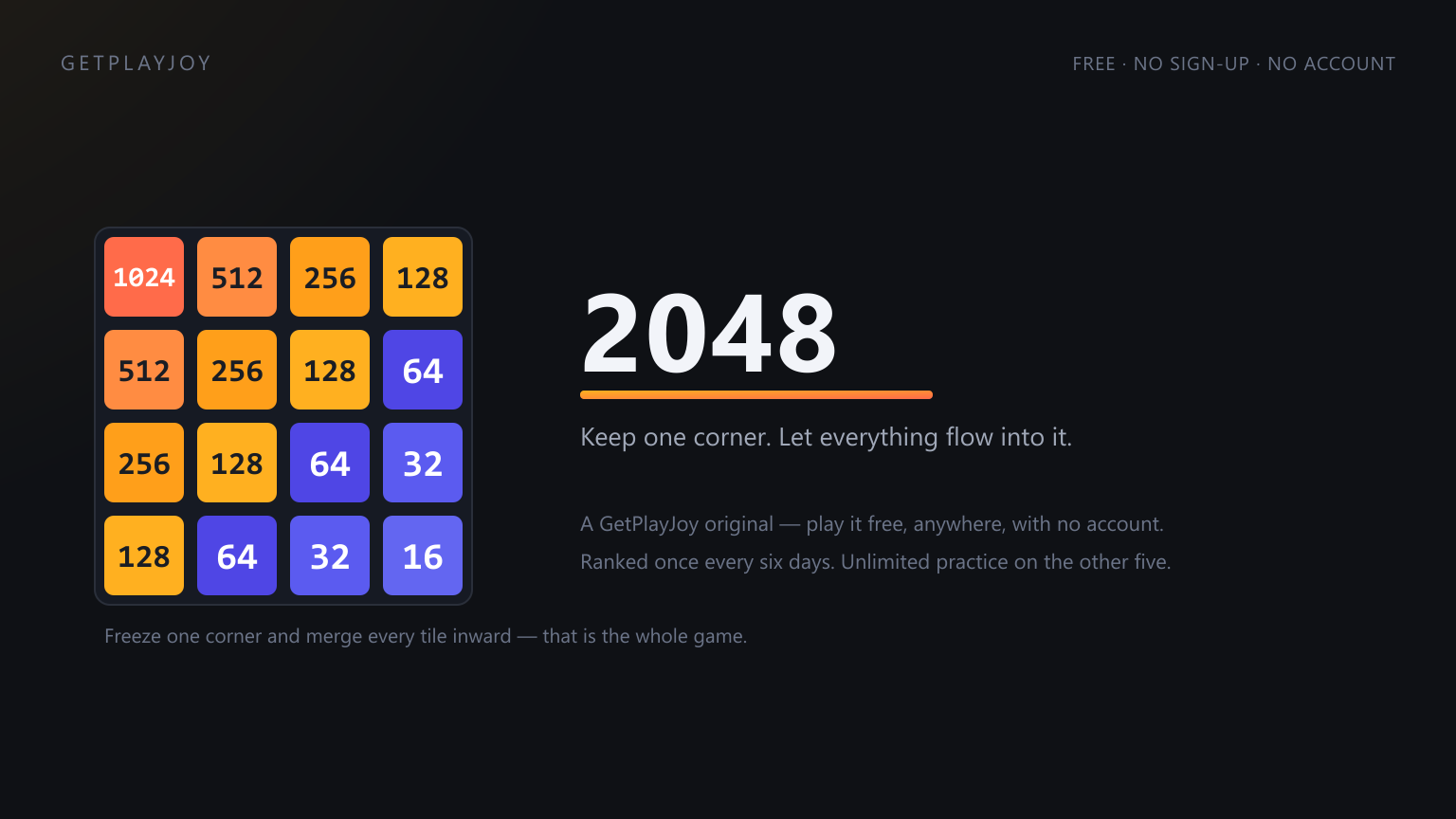
There is no timer running at you and no opponent. The board is 16 cells, every tile is a power of two, and after each move a new tile joins in a place you do not choose. Your job is to build a tile big enough to meet the level target before the grid fills with tiles that cannot combine.
On GetPlayJoy a run has three rounds. Round 1 asks for a 128 tile, round 2 for 256, round 3 for 512. Each round is scored on its own and the three are added for the day. This shape matters: a classic single-board game can run twenty minutes and end at 2,048, while this format asks for a decision every second and finishes in a few.
Depth comes from order, not from rules. Nothing here needs arithmetic. Adding happens whether you like it or not.
The round, move by move
1. The board opens with two tiles. Each one is a 2 with 90% probability, otherwise a 4. 2. Choose up, down, left or right. Every tile slides as far as it can in that direction. 3. Equal tiles that meet during the slide merge into double the value. A 2 meets a 2 and becomes a 4. 4. If something moved, one new tile appears in a random empty cell. Again a 2 nine times out of ten, otherwise a 4. 5. Your merge total rises by the value of each tile you created. Merging two 16s pays 32. 6. Keep going until your highest tile reaches the round target, or until no move changes anything. 7. The round banks its score. The next target loads, built from a different seed.
What the engine actually does, cell by cell
The grid is 16 numbers in a row, zeros meaning empty. A move takes each of the four lines in turn, squeezes the tiles toward the edge you chose, then walks that line once and merges equal neighbours. A tile can merge only once per move, which is why a row reading 2, 2, 2, 2 slides left into 4, 4, 0, 0 and never into 8, 0, 0, 0. Two merges, not one big one.
The spawn is blunt and honest: pick one empty cell at random, write a 2 with 90% chance or a 4 with 10%. Nothing else hides in there. Values never vary; only position does, and on a shared seed even that is fixed in advance.
A swipe that changes nothing is thrown away. No tile slides, nothing spawns, nothing scores. The only thing it costs you is time, and time turns into points a few paragraphs down.
Two controls sit under the board and both are legitimate. Undo rewinds the board, the merge total and the move log by one step, and the undone move never reaches the server. Cash Out ends the round early and submits what you have, which is how you bank a score instead of sliding into a wall for nothing.
From merges to points
Every round is scored by one line of arithmetic. Add your merge total for that round, halve it, add a clear bonus if you hit the target, add a time reward, round it off. Written out:
score = merge total ÷ 2 + clear bonus + time reward
The clear bonus is 600 times the round number, so 600, 1,200 and 1,800, and it is paid only when your highest tile meets the target. The time reward is 4,000 times the round number divided by your seconds, which is 4,000 divided by seconds in round 1, 8,000 in round 2 and 12,000 in round 3. A round that takes 120 seconds earns you 33 points from time in round 1 and 100 in round 3. Speed pays, but never more than the structure that lets you finish.
Here is what that produced on a real board. We replayed the round 3 seed for 2026-10-29 with a small search policy using the same rules the site runs: 240 moves, 185 merges, a merge total of 4,040 and a 512 tile. Scored at 120 seconds that is 4,040 ÷ 2 = 2,020, plus 1,800 clear bonus, plus 100 time, for 3,920 points. The same day's round 1 board took 62 moves and 49 merges for a merge total of 752, scoring 1,009 at 120 seconds, and round 2 took 137 moves for a total of 1,840, scoring 2,187. Three rounds, one daily total near 7,100 points.
Notice how small the time half is. Halving the merge total means a board that is clean and slow beats a board that is messy and fast every time, and the 90/10 spawn does the rest.
What counts as a move
Accepted:
Arrow keys, WASD, a swipe on touch, or the four buttons under the grid.; Any direction that shifts at least one tile or completes at least one merge.; Undo, which is unlimited and leaves no trace in what gets submitted.; Cash Out, which ends the round deliberately.
Rejected or ignored:
A direction that would move nothing. Nothing slides, nothing spawns, and your clock keeps running.; Anything else you might expect from other puzzles. There is no hint, no reveal, no second board, no reshuffle.
The server also has three blunt guards, and it is better to know them than to trip them. It accepts the first 4,000 moves of your log and ignores the rest. It needs at least 90 milliseconds per move it received, plus two seconds of grace, because no hand works a 16-cell board faster than that. And it will not accept a claimed score more than 40% above what its own replay produces plus 100 points of slack. Those guards exist so nobody can type a number into the leaderboard. Leaving the tab and coming back is recorded as a soft signal only and never invalidates a run, because a careful player should not be punished for checking a message.
What a mistake actually costs
Nothing. That is the honest answer, and it is the thing most guides skip.
There is no point penalty, no time penalty, no strike count. A bad swipe cannot subtract from your score or lock you out. The cost of a mistake is positional and delayed: a careless direction can drag your largest tile away from the corner you had reserved for it, and twenty moves later the board has no room left. Undo erases even that, right up to the moment you cash out or the board stalls.
What you lose when the board dies is the clear bonus for that round, which is 600, 1,200 or 1,800 depending on how far you got, plus every merge you had not made yet. Nothing else. No account is affected, no profile is docked, and the next board is free.
The modes
Ranked daily
The six daily games take turns in a fixed rotation: sudoku, 2048, memory, nonogram, minesweeper, tango. 2048 holds the slot for one day out of six, and a new board appears at 00:00 UTC on its day. Three rounds, targets 128, 256 and 512, all generated from the same day so every player alive faces the same tiles. Each round scores separately and the three are added into one daily entry. The 2048 daily guide covers reset times by city and how to share a result without giving the board away.
Practice
Unlimited boards, one target tier at a time, chosen from the same three targets. Practice runs use a random seed drawn from the clock, save only to your own local history, and never touch the leaderboard or your ability profile. This is where you drill a tactic before spending it on a ranked day, and it is the closest thing here to the classic endless board that gave the game its name. Every technique in the corner strategy guide can be tested here in under three minutes.
Where to next
You have the rules and the arithmetic now. The next thing to fix is board structure, which is what the 2048 corner strategy guide teaches with real move logs. If you came here from a friend's score and want to know when your own board arrives, the 2048 daily reset guide has the clock. And if you are wondering whether this is actually the real 2048 or one of the hundreds of clones, our where to play official 2048 guide answers that with facts you can check inside the game.
Play it now on the 2048 game page, free and no sign-up needed.
About the author: Mara Whitfield is the GetPlayJoy strategy editor. She writes the how-to guides and spends an unreasonable amount of time optimising her own daily streaks. If a routine on this site works, it usually went through her first.