Introduction
The whole game is one sentence: place digits so no row, column, or box repeats. Everything else is a consequence of that single constraint. This guide covers the board structure, the step-by-step play loop, the exact scoring formula the server runs, what counts as a valid move, what a mistake actually costs you, and the difference between the daily and unlimited modes. If you want the deeper strategy after this, our guide to getting better at Sudoku picks up where the rules leave off.
Sudoku Round by Round
Play a board in these steps. Each step is one action.
1. Open the Sudoku game page and pick a tier: 40 clues, 33 clues, or 27 clues. 2. Tap a cell, then tap a digit from 1 to 9 to place it. 3. Watch the cell. If your digit repeats in its row, column, or box, it turns red at once. 4. Press N to switch to notes mode and store pencil candidates instead of committing an answer. 5. Use Hint to light up one cell that has exactly one legal digit. Use Reveal to fill a digit outright. 6. Keep placing digits until all 81 cells are filled with no conflict. 7. Read the result card: time, mistakes, accuracy, and hints used.
That is the loop. A medium board clears in under five minutes once the basic patterns become automatic.
The Board: How the Constraint Works
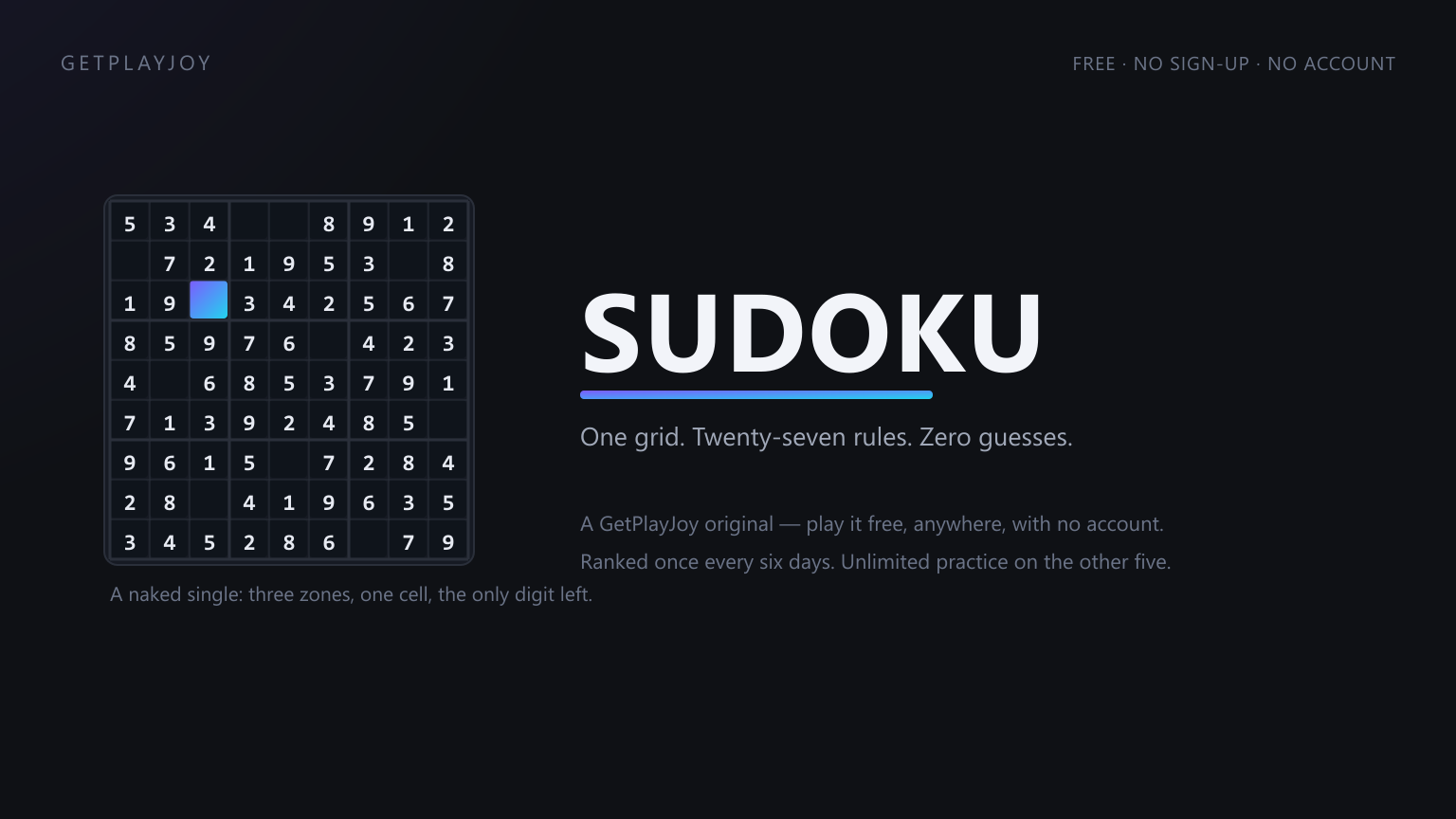
The board is 81 cells arranged in 9 rows, 9 columns, and 9 boxes of 3×3. Those twenty-seven units are the only things you ever satisfy. Every unit must contain 1 through 9 with no repeats. Nothing is added or multiplied.
The digits 1 to 9 are just symbols. They could be colors or letters and the puzzle would be identical, because the real task is placement, not arithmetic. A solved grid is one of 6,670,903,752,021,072,936,960 possible completions, a count Felgenhauer and Jarvis computed in 2005. A valid puzzle needs at least 17 clues to admit exactly one solution, a floor McGuire, Tugemann, and Civario proved in 2012. GetPlayJoy ships three tiers with 40, 33, and 27 givens, each comfortably above that 17-clue floor so the board always has a single answer.
From Board to Score
The server scores a solved board with this formula, read straight from the engine:
score = (round clear bonus + 80,000 ÷ seconds) ÷ min(1 + 0.3 × √mistakes, 3)
Three numbers drive it. The clear bonus is 650 on the 40-clue tier, 1,050 on the 33-clue tier, and 1,550 on the 27-clue tier, because a leaner grid is harder to crack. The speed reward is 80,000 divided by your solve time in seconds, but it is capped at the tier clear bonus, so a nine-second "solve" cannot bank thousands of phantom points. The mistake divisor is 1 plus 0.3 times the square root of your mistake count, capped at 3.
The square root is the part most players miss. Five mistakes divide your score by about 1 + 0.3 × 2.24 = 1.67. Twenty mistakes divide it by about 1 + 0.3 × 4.47 = 2.34, not by 7. The curve punishes early errors harder and then flattens, so a clean board is never unfairly crushed by a single late slip. Our explainer on Sudoku and your brain touches on why accuracy habits form faster than players expect.
What Counts as a Valid Move
Accepted:
Placing a digit 1 through 9 in any empty cell.; Storing a pencil candidate in notes mode.; Erasing a cell with Backspace, Delete, or 0.; Using Hint or Reveal, both of which the engine records.
Rejected:
A digit that repeats in its row, column, or box. The cell turns red and the move is flagged.; A solve time under 40 percent of the tier minimum. That is under 8 seconds on 40 clues, under 18 on 33 clues, and under 36 on 27 clues.; A submission whose claimed score exceeds 1.5 times the server-recomputed score plus 50 points.
What a Mistake Actually Costs
This is the trust section, so read it plainly. A mistake never ends your run. The board flags the conflict in red, counts it, and you keep playing. The cost is mathematical, not punitive: each wrong entry pulls your final score down through the square-root divisor described above.
A clean 27-clue grid solved in five minutes scores about 1,817 points. The same grid with four mistakes scores about 1,135, a drop of roughly 682 points. Ten mistakes on that grid drop it to about 906. You are never locked out, never penalized with a game-over, and never scored zero for a finished board. The divisor is capped at 3, so even a very messy solve stays in a comparable band instead of collapsing to nothing. That cap is deliberate: it keeps Sudoku scores in the same range as the site's other daily games.
The Modes
Daily
The ranked board is generated from the UTC calendar date plus your chosen level, so everyone in the world opens the identical grid. Sudoku holds the ranked slot once in the six-game rotation, so that scored run per tier comes round every six days rather than every day. When it is done, the board locks for scoring but the unlimited mode stays open. Our daily guide covers the rotation and the 00:00 UTC rollover.
Unlimited practice
Open the game page and ask for a fresh board at any moment, on any day of the week, whether or not Sudoku is the featured game. These boards use a random seed, are not shared worldwide, never enter a leaderboard, and are perfect for the patterns in our getting-better guide. Unlimited play builds the perceptual habits that make the daily feel calm.
Assist mode
Hint and Reveal are always available. Hint is free of score penalty beyond your attention. Reveal fills the correct digit but is recorded as a mistake, so it costs points through the divisor. Use Reveal to learn, not to win.
Saving and Your Progress
There is no account required, so progress lives in your browser between sessions for the radar and personal bests. The daily board itself is regenerated from the date seed, so it is the same puzzle tomorrow as it is today for anyone on the same UTC date. Your personal best at each difficulty is tracked locally and shown on the result card. If you clear your browser storage, the local best resets, but the daily board is never lost because it is computed from the date, not from your device.
Reading the result card is worth a moment. It shows time, mistakes, accuracy, and hints used, and those four numbers tell you more than the score. Accuracy is your correct placements as a share of all placements; a 100 percent board means zero corrections. Hints used tells you how much of the solve was handed to you. When the same tier stops showing Reveal in your history, your pattern recognition has quietly taken over, which is the whole point of the daily.
Where to Next
You now know the rules and the scoring. The next step is to actually play a board on the Sudoku game page, then read how to get better at Sudoku for the techniques that turn a 20-minute scramble into a 4-minute solve. When you are ready for the once-a-day habit, our Sudoku daily guide explains reset times and sharing without spoilers.
One last practical tip: the daily and unlimited boards share the same engine, so a technique that works on one works on the other. Use the unlimited board to test a new habit, then bring it to the daily where the score actually counts. The getting-better guide is where those habits are spelled out in order.
FAQ
Do I need an account to play Sudoku on GetPlayJoy?
No. The daily and unlimited boards are free with no sign-up. An optional account only adds archive replay and cross-device stats.
What do the three clue tiers mean?
They are 40, 33, and 27 givens. Fewer givens means a harder board, and the engine pays a larger clear bonus of 650, 1,050, or 1,550 points respectively.
How is the score calculated?
Score equals the clear bonus plus 80,000 divided by your seconds, all divided by a square-root mistake divisor capped at 3. The speed reward is capped at the clear bonus.
Does a mistake end the game?
Never. The cell turns red and the mistake is counted, which lowers your score through the divisor, but you keep playing to a finished board.
Can I use pencil marks?
Yes. Press N to enter notes mode and store candidate digits without committing them. This is the single most useful habit for harder tiers.
What is the fastest possible solve?
The server rejects solves under 40 percent of the tier minimum: under 8 seconds on 40 clues, under 18 on 33, and under 36 on 27. Anything faster is flagged too fast.
Is the daily board the same for everyone?
Yes. It is built from the UTC date and the level, so a player in London and one in Los Angeles open the identical grid.
What do Hint and Reveal do to my score?
Hint costs nothing but attention. Reveal fills the correct digit and is recorded as a mistake, lowering your score through the divisor.
How many Sudoku games are there if I finish the daily?
Unlimited. The practice mode generates a fresh board on demand from a random seed whenever you want one.
Why is the mistake penalty a square root?
A linear penalty would crush a 15-mistake solve by 4.5 times and a 40-mistake game by 13 times, throwing the round out of the site-wide band. The square root keeps messy solves comparable to clean ones.