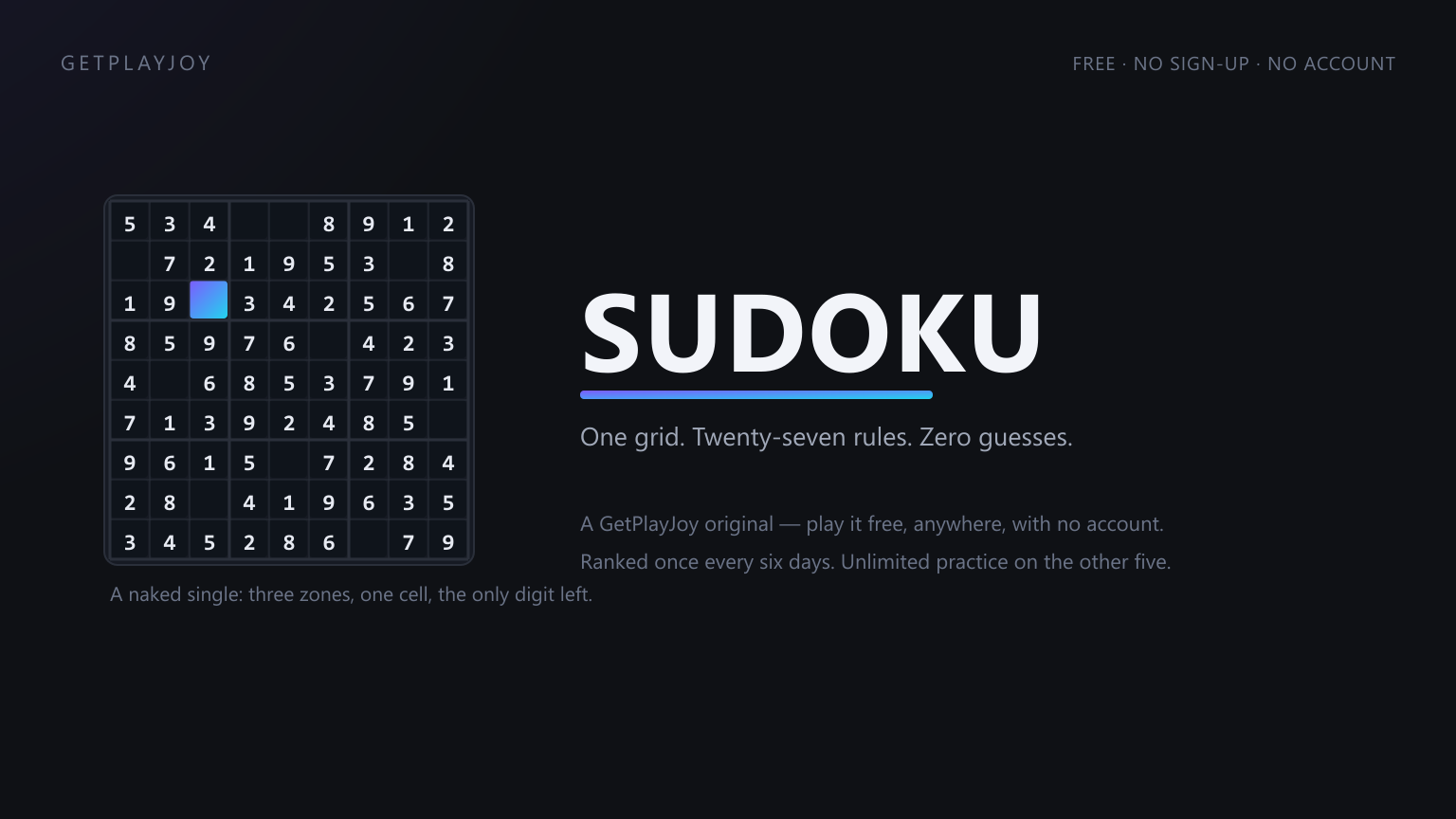
What Sudoku Actually Trains
Sudoku is a constraint-satisfaction task. You hold a mental board, update it as digits land, and plan two or three steps ahead. That load falls on working memory, the system that keeps information active while you manipulate it. GetPlayJoy's ability model reflects this: of the six tracked axes, Sudoku loads Logical Reasoning and Working Memory heavily and barely touches Verbal Reasoning or Creative Thinking.
A useful number: working memory has a known capacity ceiling. The classic estimate is about four items we can hold and rotate at once, a figure from Cowan's 2001 review. A 27-clue board asks you to juggle far more than four candidates, which is exactly why pencil marks help — they move the load from memory to the page. The puzzle trains you to manage that overflow, not to expand the ceiling itself.
Why It Matters for Play
The skills Sudoku exercises are the ones a daily solver feels improving. Players describe the board "slowing down," which is another way of saying their working-memory buffer handles more at a glance. The rules guide shows how scoring rewards accuracy; the accuracy comes from a working memory that does not drop candidates under pressure.
A Note on the Ceiling
Working memory has a documented capacity limit of about four items we can hold and rotate at once, a figure from Cowan's 2001 review. A 27-clue board asks you to track far more candidates than four, which is exactly why pencil marks help: they move the load from memory to the page. Sudoku trains you to manage that overflow, not to expand the ceiling itself. That distinction matters for honest claims, because no puzzle has been shown to raise the underlying capacity, only to make better use of the one you have.
What the Research Shows
Near transfer is real. Working-memory training improves performance on tasks that look like the training task. Jaeggi and colleagues reported in 2008 that n-back training improved scores on untrained fluid-intelligence tests, though the effect size is debated and the gain is modest. Sudoku is not an n-back, but it shares the core demand of holding and updating constraints, so the same near-transfer logic applies: you get better at constraint problems by doing constraint problems.
Far transfer is the part the big studies pour cold water on. Adrian Owen and colleagues ran the largest brain-training trial of its era in 2010, putting 11,430 people through six weeks of online training across a battery of tasks. Every trained task improved — and none of the gain carried over to untrained tasks. Daniel Simons and a wide team reached the same verdict in a 2016 review in Psychological Science in the Public Interest: the evidence that commercial brain training lifts general cognition is thin. Melby-Lervåg and Hulme's 2013 meta-analysis of working-memory training reached a similar, careful conclusion — gains are real but narrow.
So the claim "Sudoku makes you smarter" is too broad. The claim "Sudoku makes you better at Sudoku and at nearby constraint tasks" is what the evidence supports.
What the Research Does Not Promise
The studies are specific about limits. Owen's 2010 trial found no carryover to untrained tasks, so do not expect Sudoku to improve your math grades or your reaction time at the wheel. Simons' 2016 review found the commercial brain-training industry's broad claims unsupported, which covers most 'train your brain' slogans on app-store screenshots. The honest line is narrow: better at constraint problems, not broadly smarter. Saying less is what keeps the claim true.
What Dedicated Drills Cannot Do
A puzzle cannot replace sleep, aerobic fitness, or a calm attention span, and it cannot diagnose or treat a cognitive condition. Working-memory training is a sharpening stone, not a medicine. The 2010 Nature study is the cleanest warning: trained tasks improved, untrained ones did not, which means the training is specific by nature. Anyone selling a puzzle as a defense against dementia is selling past the data.
Measuring Is Not Training
This distinction matters and is easy to confuse. A puzzle gives you a score, a streak, and a radar — those are measurements. They tell you how this specific skill moved today. They are not the training itself, and watching the number is not the same as doing the reps. The GetPlayJoy radar, described in the cognitive-benefits piece, is a measurement of where your Logical Reasoning and Working Memory sit; it grows because you solved boards, not because you looked at it. Treat the score as a compass, not as the workout.
Why measure at all, then? Because a visible score turns a vague 'I feel sharper' into a checkable trend. The radar is not therapy, but it is feedback, and feedback is what sustains a habit better than mood. The cognitive-benefits piece covers the habit side; here the point is only that measurement, separate from training, is still useful.
How GetPlayJoy Tracks This Score
Each finished board feeds your time, accuracy, and move sequence into a percentile against that day's global distribution, then maps onto the six axes. Sudoku's weight lands on Logical Reasoning and Working Memory, so a month of play shows as a shape — those two axes rising while Verbal and Creative stay flat. The output is a 0-to-100 score per axis. It is a measurement of a narrow, real skill, and the honesty is in the flat axes: the game does not pretend to move what it does not train.
Practical Takeaways
The non-puzzle advice is where the stronger evidence sits, and it is worth saying plainly.
Move your body. Colcombe and Kramer's 2003 meta-analysis found aerobic fitness associated with better cognitive control in older adults. A walk beats a second puzzle for general sharpness.; Sleep. Consolidation happens at night; a tired working memory drops candidates it would hold when rested.; Cut multitasking. Every switch taxes the same buffer Sudoku trains, so constant tab-switching undoes part of the gain.; Play the puzzle for the narrow win. Better constraint reasoning is real and useful. Just do not bill it as more.
One more honest point: the non-puzzle habits above rest on stronger evidence than the puzzle itself. Colcombe and Kramer's 2003 meta-analysis linked aerobic fitness to better cognitive control, and sleep research is unambiguous that a rested working memory holds more candidates. If you want the largest available gain, the walk and the early night move the needle more than a second grid. The puzzle is the pleasant part, not the strongest part.
Bottom Line
Sudoku trains working memory and logical deduction, and the gains are real but near, not general. It is not a clinical assessment and it is not a cure for cognitive decline. Play it because the narrow skill is worth having and the daily habit is pleasant — not because a grid will raise your IQ. The research is consistent on that line, and we would rather hand you the line than sell you past it.
The takeaway is narrow and defensible: play for the near gain, sleep and move for the broad gain, and ignore any product that promises the second while selling the first.
FAQ
Does Sudoku raise IQ?
The large studies say no. Owen's 2010 trial of 11,430 people found trained tasks improved but untrained ones did not, and Simons' 2016 review reached the same verdict.
What does Sudoku actually improve?
Working memory and logical deduction, the near skills the puzzle uses directly. Transfer to unrelated tasks is not supported by the evidence.
Is brain training a scam?
Not exactly. It trains what it trains. The overclaim is that the gain generalizes, which the meta-analyses by Melby-Lervåg and Hulme (2013) and others dispute.
How much Sudoku is useful?
One board a day is enough to maintain the narrow habit. More boards mostly add practice on the same skill, not new transfer.
Can Sudoku prevent dementia?
No. It is a logic exercise, not a medical intervention, and no study supports a preventive claim.
Why does my radar only move on two axes?
Sudoku loads Logical Reasoning and Working Memory. The other four axes are not engaged by the puzzle, so they stay near baseline.
Is the score a test of intelligence?
No. It is a measurement of a specific skill on a specific day, recomputed by the server. It is not a clinical or diagnostic assessment.