What Specimen actually is
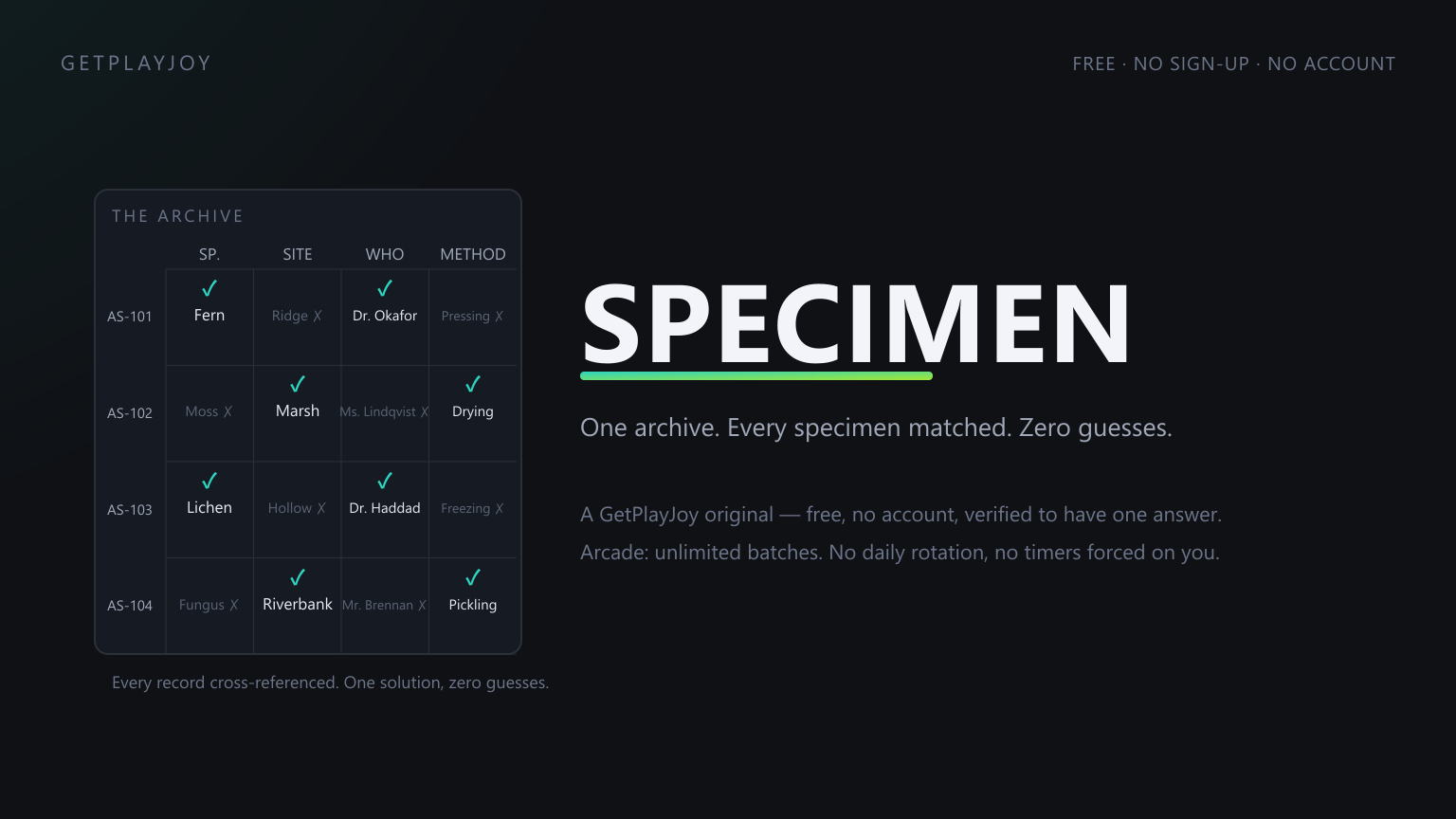
A Specimen batch is a table. Each row is one specimen, filed under a catalog number that starts at AS-101. Each column is a property — catalog order, species, collection site, collector, preservation method. One value per column belongs to each specimen, and most columns are a strict one-to-one match: no species is used twice in a batch of four.
The puzzle is the gap in that table. You get the rows and the column headers. You get a numbered list of records, the kind a field archivist scribbles in the margin: "AS-101 is filed as Fern." "AS-103 was catalogued before AS-104." "Exactly two specimens are dried." From those records alone, exactly one full table exists. Your job is to file it.
If you have played a zebra puzzle or an Einstein riddle, you already know the shape. This one adds a stricter rulebook. Specimen ships with a mode that refuses any mark the records do not force, so the board cannot hold a guess even if you want to make one.
The archive desk, step by step
Every batch follows the same loop.
1. **Read the columns.** Note which columns are one-to-one and which can repeat. Catalog order is always a strict sequence. Preservation is the exception: a method can be shared by two specimens, so it is pinned by relational records instead of by elimination. 2. **Read the records once, in order.** Do not try to solve yet. Just register what each numbered record constrains. 3. **File the free reads first.** When a record states a value outright, or when a cell has only one candidate left, file it. That single confirmation collapses a whole row and column. 4. **Let eliminations cascade.** Confirming a value rules out every other value in that cell, and in a one-to-one column it also rules that value out everywhere else in the column. 5. **Combine records when nothing falls out.** When no cell has one candidate left, the remaining cells need two or more records held together. That step is the puzzle. 6. **Finish when every cell is confirmed.** The batch is catalogued the moment every specimen holds one confirmed value in every column. Then the server checks it.
That last line is not a formality. GetPlayJoy does not trust the score your browser reports. It re-solves the batch from the records on the server and compares your marks against the one true table. A wrong table does not pass, whatever the client says. The scoring guide walks through exactly what that check accepts.
Confirmed, ruled out, and the strict rule
Each cell holds one of three states: empty, confirmed (✓), or ruled out (✗). A ✓ says "this specimen holds this value." A ✗ says "it does not." Both are information; a normal solve leaves dozens of ✗ marks on the desk alongside the ✓ marks that complete the batch.
Strict logic mode is on by default, and it changes what a click is allowed to do. When you tap a value chip, the game asks the solver one question: do the records, plus everything you have already filed, force this mark? If a ✓ is forced, you get a ✓. If a ✗ is forced, you get a ✗. If neither is forced, nothing is filed and the board tells you so. You cannot accidentally write a wrong fact onto the desk. The cost of that safety is that an unsure tap does nothing — which is the point.
You can switch strict mode off and mark freely. Then the board behaves like a pencil: you may file any mark that keeps the desk consistent, and the Audit button reports how many of your marks now conflict with the records. Most players leave strict mode on and treat the refusal as a hint that they have not read the records carefully enough yet.
Reading a record
Records come in six shapes, and each one constrains the table differently. A **direct** record states a value. A **negative** record rules one value out. An **either** record narrows a cell to two candidates. An **order** record puts two specimens in catalog sequence. A **count** record says how many specimens share a value — the only honest way to pin a repeatable column like Preservation. A **cross-negative** record says two specimens are "not both" a value, which sounds weak until one side is pinned and the other collapses.
Two buttons turn that list into a teacher. **Cross-reference** reveals one cell the records currently force and explains the reasoning in a sentence — "Record 4 says it outright," or "the records leave only one possibility." **Audit** scans your marks and highlights the ones that contradict the records, latest first. Together they let you learn the propagation rule without ever being handed the answer to the whole batch.
From seconds to a score
Solving earns a score built from one formula, and every number in it comes straight from the engine:
`score = (clear bonus + 70,000 ÷ seconds) ÷ min(1 + 0.3 × √mistakes, 3)`
**Clear bonus** by size: 500 for 3×3, 900 for 4×4, 1,500 for 5×5.; **Speed bonus** is 70,000 divided by your finish time in seconds. It is not capped, so speed matters a great deal on the small grids.; **Mistake penalty** follows a square-root curve, not a straight line: each mistake adds `0.3 × √mistakes` to the divisor. One mistake barely moves the number. Twenty-five mistakes add `0.3 × 5 = 1.5`, multiplying the divisor by 2.5.; The whole divisor is **capped at 3**, so even a messy batch divides by no more than three.
A few worked examples make the curve concrete. A clean 4×4 finished in 40 seconds scores `(900 + 1,750) ÷ 1 = 2,650`. The same 4×4 in 40 seconds with 4 mistakes divides by `1 + 0.3 × 2 = 1.6`, giving `2,650 ÷ 1.6 ≈ 1,656`. With 25 mistakes it divides by `2.5` and lands near `1,060`. Push to 100 mistakes and the divisor hits its ceiling of 3, so the score bottoms out near `883` — a bad number, never a zero. A clean 3×3 in 20 seconds is `500 + 3,500 = 4,000`; a clean 5×5 in 90 seconds is `1,500 + 778 = 2,278`.
The pattern is worth holding onto: the small grids reward speed hardest, the big grids reward finishing at all, and the mistake curve only bites after the count gets real.
What a mistake actually costs
This is the part new players worry about, and they should not. In Specimen a mistake is a mark the records contradict — a ✓ on a value that is not true, or a ✗ on the value that is. Under strict logic mode it mostly cannot happen, because the board refuses unforced marks. With strict mode off, a bad mark turns up red on Audit and lowers your score through the curve above. That is the entire penalty. No life is lost, no streak is wiped, the clock does not stop, and there is no game-over screen. You clear the mark, read the record you missed, and keep going.
That is a deliberate design choice, not softness. Deduction puzzles are learned by making a wrong inference and then finding the record that corrects it. Punishing that learning with a lost run teaches fear, not logic. Specimen taxes mistakes in the score and nowhere else, which is why the square-root curve exists: it lets a beginner finish a 5×5 with 30 honest mistakes and still walk away with a four-figure number.
The three grid sizes
**3×3** — two attribute columns, clear bonus 500. One or two records do most of the work. This is the size to learn the marking rhythm on.; **4×4** — three attribute columns, clear bonus 900. The default challenge, and the size the engine tends to build its deepest batches on. Expect a few cells that need two records combined.; **5×5** — four attribute columns, clear bonus 1,500. A wider desk, more records, and the size where a repeatable Preservation column earns its keep. Twenty to fifty ruled-out marks per solve is normal here.
You can open any size at any time. Specimen is an arcade game, not a daily one: there is no ranked slot and no once-a-day lock, so you can play a hundred 3×3 batches in a row if that is what you feel like. The trade-off is that scores are your own; there is no leaderboard hanging over the desk. If you want the daily-rotation experience, the site runs it on other games and keeps Specimen open for unlimited practice.
Where to Next
You have the rules and the number. The useful next steps:
How to get better at Specimen — the propagation system that turns records into a solve order.; How Specimen scoring works — the full formula, with a worked 5×5 and the ability profile behind it.; Where the official Specimen lives — and how to spot a copy that skips the unique-solution check.
Then open Specimen on GetPlayJoy and catalogue your first 3×3. No account needed.
FAQ
Do I need an account to play Specimen?
No. Specimen is free to play on GetPlayJoy with no sign-up and no account. Nothing is gated behind a login.
Is Specimen the same as Sudoku?
No. Sudoku fills a 9×9 grid of digits under row, column and box rules. Specimen matches specimens to attributes using cross-referenced records — it is a logic-grid (zebra) puzzle, not a number-placement one.
Can a batch have more than one solution?
No. Every batch is generated and checked with a solver until exactly one table satisfies all records, so it is all logic and no guessing.
What does strict logic mode do?
It accepts a mark only when the records force it. An unforced tap is refused, so the desk cannot hold a wrong fact.
What happens if I make a mistake?
With strict mode on, you mostly cannot file one. With it off, the bad mark shows up in Audit and lowers your score through the penalty curve. It never ends the run.
Why is Preservation different from the other columns?
Preservation can repeat — two specimens may share a method — so it is pinned by count and cross-negative records instead of by one-to-one elimination.
Is there a daily ranked Specimen?
No. Specimen is an arcade game with unlimited batches. The site's ranked daily rotation runs on six other games; Specimen stays open for practice.