The generation loop, step by step
Generation starts from a seed and a level. The same (seed, level) pair always yields the same batch, which keeps results reproducible for testing and support. The builder then tries up to 200 attempts to find a board worth shipping.
The engine counts the genuine steps — the cells that need two or more records combined before they lock. This measure is called `deepSteps`, and it is the heart of the quality pick. A puzzle that falls open in one read is dull; a puzzle where you must chain several records is the goal.
After 200 tries the builder keeps the batch with the most `deepSteps`. A board that solves itself in a single pass is rejected in favour of the one that demanded real deduction. The final archive is therefore the most demanding board the seed produced, not the first that happened to parse.
Inside one generation pass
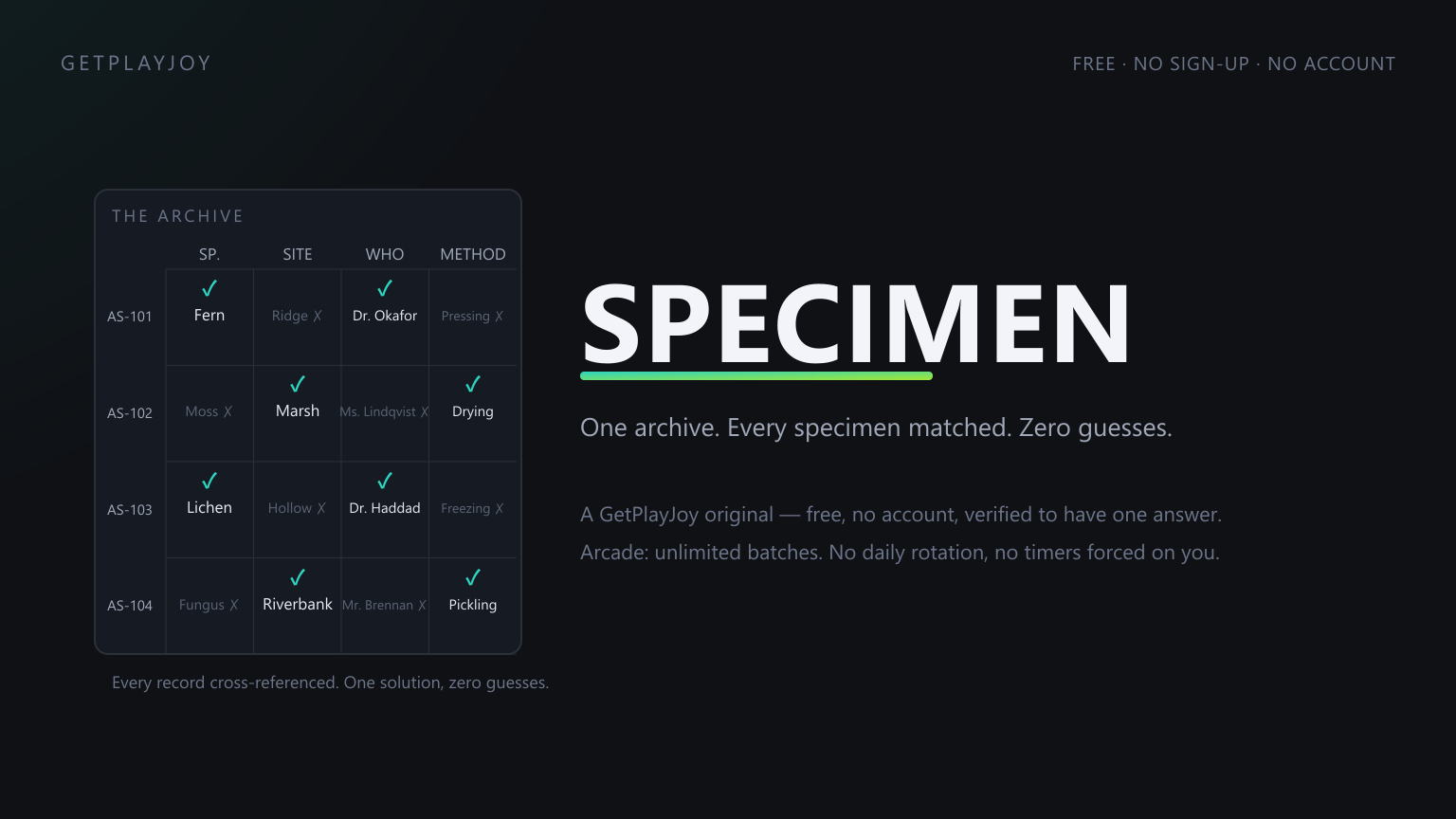
To see the loop concretely, follow a 4×4. The builder first lays down a complete solution: four specimens, each holding one value in every column, with all columns one-to-one except Preservation. It then writes a generous set of records drawn from all six types — direct, negative, either, order, count, and crossneg — enough that the solution is over-determined and several records are redundant.
Next it counts solutions. The solver walks the record set and enumerates every layout that satisfies them. If the count is one, the batch is solvable by logic alone. If it is more than one, at least one cell could go either way and guessing would creep in. If it is zero, the records contradict and the batch is broken. Only a count of exactly one survives this gate.
Finally it prunes. Each record is tested in turn: if removing it still leaves exactly one solution, that record was surplus and is cut. The desk you receive is the leanest set that still proves a single answer — no padding, no filler clues. That tightness is why a Specimen batch feels precise rather than cluttered, and why the get-better guide can teach you to read those few records quickly.
Why "one solution" is a promise
A batch is published only when `countSolutions` returns exactly 1. If a candidate has zero solutions it is broken; if it has two or more, guessing would be required. Both are rejected. We explain the play loop in our how-to guide, and you can open Specimen on GetPlayJoy to watch the rule hold live.
Once a single solution exists, the generator prunes redundant records. A record that the others already force adds nothing, so it is cut. The result is a minimal archive: the shortest set of records that still proves exactly one layout. Fewer records means a cleaner desk, not an easier board.
This is a quality promise, not a marketing feature. The guarantee is mathematical, because the solver verifies it before the batch ships. You are never asked to guess, since the data cannot support a guess.
The 0–100 grade
Every batch carries a `grade` from 0 to 100 that estimates complexity. Three things drive it: the grid size, the record density (records per cell), and the entailment depth (`deepSteps`). A 3×3 board tops out low; a 5×5 with dense, deeply chained records can approach 100.
The grade is a hint, not a score. It tells you roughly how much cross-referencing to expect, and it lets the builder prefer harder boards when the seed allows. Two batches at the same size can sit 30 points apart on grade alone.
The three sizes at a glance
| Size | Base clear bonus | Min time | Attribute columns |
|---|---|---|---|
| 3×3 | 500 | 8s | 2 |
| 4×4 | 900 | 20s | 3 |
| 5×5 | 1,500 | 40s | 4 |
The base clear bonus is the floor your score starts from, and the min time is the fastest a clean solve can realistically post. The column count is the number of attribute categories in play: 2 on the small board, up to 4 on the largest.
How the record bank is weighted
The generator does not pick record types at random. It knows which columns are one-to-one and which can repeat, and it biases the record pool toward the types a given board actually needs. A 3×3 with two attribute columns leans on direct and negative records plus the occasional order record. A 5×5 with a Preservation column leans hard on count and crossneg, because those are the only types that can pin a repeatable column without contradiction.
This weighting is why the same engine produces three clearly different feels across sizes. The small board is a fast read; the large board is a relational puzzle where two records must be held together to fire. The scoring page shows how that size difference lands in the final number.
The repeatable Preservation column
Most attribute columns are one-to-one: each value appears once. Preservation is different. The same method, say "Fluid", can apply to several specimens, so it is not pinned by all-different elimination. The record bank therefore leans on two relational types: `count` (how many specimens share a value) and `crossneg` (which values a specimen cannot hold given another's).
These two types are the only tools that can fix a repeatable column without contradiction. Direct and negative records still describe single cells, but they cannot order a column where duplicates are legal. The generator knows this and weights its record pool toward the relational pair when Preservation is in scope.
Determinism, and why it matters
The same (seed, level) pair always builds the identical batch. That is not a quirk; it is a feature for fairness and support. A reproducible board means a score dispute can be re-run, a shared seed lets two players compare the exact same puzzle, and regression tests can pin a board that exposed a bug.
It also makes practice honest. You are not facing a secretly different board each attempt; you are facing the same shape until you click for a new seed. If you want to drill one size, open that size repeatedly and the generator hands you different seeds of the same dimensions, never the same instance twice in a row without a new click.
A batch is not made by hand
Here is the honest part. A Specimen batch is generated, not authored by a person. No editor wrote your records manually, and no curator picked the specimens for charm. The builder is a loop that values deduction depth over narrative. If you want to read records faster, our get-better guide breaks the process down.
The trade-off is real. You get endless variety and a guaranteed single solution, but you lose the hand-tuned flavor a human setter brings. If you want a board that feels composed, this is not that. If you want a fair, reproducible logic test every time, the machine delivers it. The score those batches produce is covered in the scoring deep dive.
Bottom Line
Specimen batches are solver-built, single-solution, and graded 0–100 by size, density, and entailment depth. The repeatable Preservation column is held only by count and crossneg records, and the whole archive is pruned to its minimum. It is a generated product, not a human-made one: fair and endless, but never set by a person.
FAQ
Are Specimen batches hand-made by people?
No. They are generated from a seed and a level, then checked by a solver. A human does not write each puzzle by hand.
Can a batch have more than one solution?
No. The generator requires `countSolutions` to equal exactly 1, so guessing is never needed.
What does the grade number mean?
It is a 0–100 estimate of complexity from grid size, record density, and how deeply records must be chained.
Why are some records removed?
Redundant records that the rest already force are pruned, leaving the smallest archive that still proves one solution.
How is the repeatable column pinned?
Only `count` and `crossneg` records can fix Preservation, since duplicates are allowed there.
Is the same batch reproducible?
Yes. The same (seed, level) pair always builds the identical batch.