The Short Answer
Play it on the Nonogram game page. That is the only place where the board is generated from the date seed, scored by the exact formula below, and checked by a server that replays your moves instead of trusting the number your browser sends. Everything else that calls itself a nonogram is either a different host with its own rules or a clone that lifted the look without the verification.
The useful part is that you do not need to know who owns what. You can identify the real board by what it does, and the rest of this guide is a checklist.
Tell One: The Board Sizes and the Clue Rule
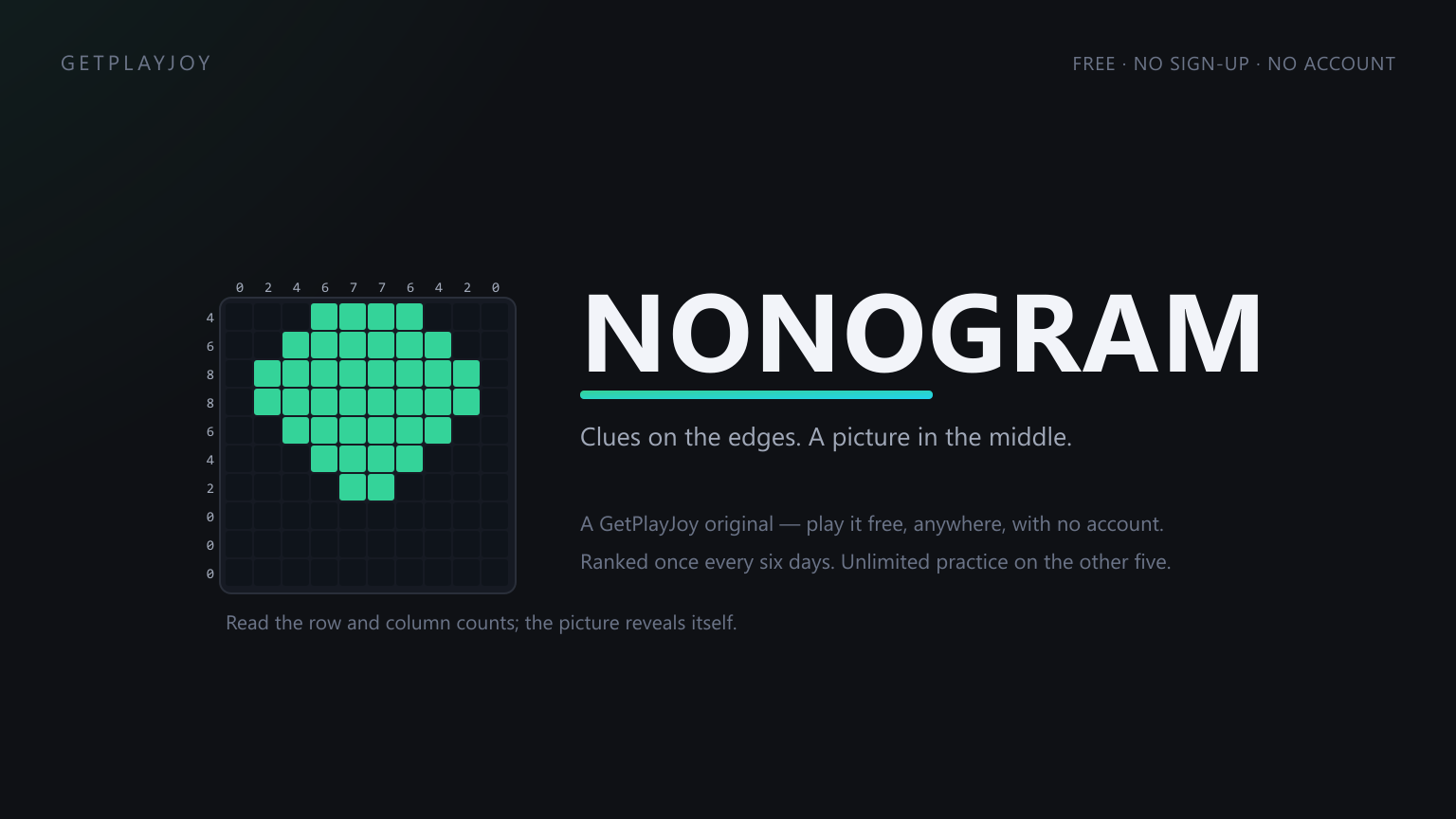
The genuine board publishes exactly three square sizes: 5×5, 8×8, and 10×10, labelled in the picker as `5×5 grid`, `8×8 grid`, and `10×10 grid`. Every line carries a list of numbers, each number the length of one run of filled cells, and two runs must be separated by at least one blank. A line whose clue is a lone `0` is empty by definition.
That separation rule is the whole game. If a board you are looking at lets runs touch with no gap, or uses triangle or hexagonal cells, it is not this puzzle. The clue rule is the cheapest tell there is, because it is visible before you fill a single cell.
Tell Two: The Controls Have No Fill or Erase Mode
The genuine board has one button above the grid, Mark, and nothing else in the way of mode switches. You fill a cell with a left-click or a left-drag, you erase with a right-drag, and you flag a cell as certainly blank with the X or M key. There is no Fill mode and no Erase mode to toggle between.
A clone that makes you pick "pencil" versus "paint" before every move is running a different control scheme. The check is fast: open the board, left-drag across a row, and see whether it paints a run in one motion. If it does, you are on the real thing.
Tell Three: The Scoring Is a Square Root, Not a Straight Line
The genuine scoring formula, character for character as it runs in the engine, is:
`score = (round clear bonus + 70,000 ÷ seconds) ÷ min(1 + 0.3 × √mistakes, 3)`
Each size carries its own clear bonus: 600 on the 5×5, 950 on the 8×8, and 1,450 on the 10×10. The speed reward is 70,000 divided by your clear time in seconds, capped at the clear bonus, so a fast small board cannot bank a five-figure score. The mistake term is a square root, so one error divides by about 1.3, nine by 1.9, and the divisor stops at 3.0.
If a site shows you a score that climbs linearly with speed or punishes a single mistake by wiping the board, it is not using this engine. The square-root curve is the tell, because it is the one design choice that keeps a clean board and a sloppy one in the same band instead of miles apart.
Tell Four: The Board Is Verified Unique Before You See It
The genuine board is not published until a constraint solver has confirmed it has exactly one solution. The generator draws a candidate pattern, computes its clues, and runs a propagation solver; if the grid resolves to a single answer it goes live, otherwise the candidate is discarded and a new one drawn, up to 400 attempts per size.
A board that can be solved two ways is a guessing trap, and you can often smell the difference: if you reach a point where no line forces a cell and the puzzle expects a guess, the board was probably never checked. The genuine board never puts you there, because uniqueness is a publishing requirement, not a hope.
Tell Five: The Daily Is Seeded, Not Hand-Picked
The ranked daily is built from four inputs: the string `playjoy`, the date, the game name, and the level. That is why everyone on earth gets the same clues on the same day, and why yesterday's board is gone the instant the UTC date rolls.
It is also why the ranked slot rotates. GetPlayJoy runs one ranked daily across six games, sudoku, 2048, memory, nonogram, minesweeper, and tango, and Nonogram sits fourth, so its ranked day comes once every six days. A site that claims a fresh ranked nonogram every single day is not running this rotation. On the other five days the daily guide explains how unlimited practice works instead.
A Thirty-Second Authenticity Check
If you want the shortest version of the test, do four things in order. Open the board and confirm there is one Mark button and no Fill or Erase toggle. Note the sizes on offer and check they are 5×5, 8×8, and 10×10. Watch your first score and confirm a single mistake barely moved it, which only the square-root curve produces. Finally, ask whether today's daily is the same for everyone, which only a date-seeded board can promise. Four checks, under a minute, and you will know whether you are on the genuine board or a look-alike wearing the name.
What "Official" Does Not Mean
We should be plain about this. Nonogram is a generic name coined by James Dalgety in 1990 from Non Ishida's name and the word diagram. Picross is the Nintendo trademark for the same puzzle. GetPlayJoy is one host of the generic puzzle, not the registrar of it. So "official" here is a statement about the board's behaviour and verification, not a claim that we own the word.
That distinction protects you. When a site leans on "official" to mean "the only real one," it is usually selling something the name does not back. The real test is the behaviour: seed-generated clues, the square-root score, the Mark-only controls, and the server replay.
What a Wrong Cell Actually Costs
A wrong cell on the genuine board costs you time, not status. You clear it and carry on; the run does not end, the board does not lock, and nothing is tallied against you while you solve. The board will not even finish while a line disagrees with its clues, because both the client and the server check every line.
The only place a mistake bites is the formula above, and gently: the divisor is a square root capped at 3, so the worst a sloppy board does is lose two thirds of its value. A clean board divides by 1.0 and keeps everything. Fear of mistakes is the main thing that slows new players, and on this board that fear is misplaced.
Where to Next
Open a free board on the Nonogram game page and confirm the tells for yourself: one Mark button, three square sizes, the seed-generated clues. For the full rule set, the rules guide walks through reading clues and scoring. To understand the rotation that decides when the ranked day lands, the daily guide has the reset times. And if the name confusion brought you here, Nonogram vs Picross settles which label belongs to whom.
FAQ
Is GetPlayJoy the official nonogram?
Nonogram is a generic name with no single owner. GetPlayJoy is one host, and "official" here means the board that is seed-generated, scored by the square-root formula, and server-verified.
How do I know a board is the real one?
Check the controls (one Mark button, no Fill/Erase mode), the sizes (5×5, 8×8, 10×10), and the scoring (a square root mistake curve). Those are hard for a clone to fake exactly.
Why does the score use a square root?
A linear mistake penalty pushed high-mistake rounds out of the intended 600 to 2,900 band. The square root keeps a clean board and a sloppy one comparable.
Is the daily the same everywhere?
Yes, for a date and size. The seed mixes `playjoy`, the date, the game, and the level, so the clues match worldwide.
Does the daily run every day?
The ranked Nonogram daily runs once every six days in the six-game rotation. Unlimited unranked practice runs every day.
What is the highest score?
1,200 on the 5×5, 1,900 on the 8×8, and 2,900 on the 10×10, all with no mistakes and a fast enough time, for a 6,000 ceiling across the three.
Can I trust the leaderboard number?
The server replays your submission from the seed and recomputes the score, so the number is the one you earned, not the one your browser claimed.
Is picross the same puzzle?
Yes, picross is Nintendo's trademark for the identical rule set. The comparison guide covers the naming.