Introduction
The whole game comes down to one sentence: a number is a promise about eight tiles. A 1 means exactly one of the eight tiles touching it holds a mine. A 3 means three. Learn to read those promises against each other and the board solves itself, because most positions have exactly one arrangement that satisfies every number on the grid at once.
What makes Minesweeper different from a guessing game is that the numbers never lie. There is no random damage roll, no hidden modifier, no partial information beyond the tiles you have not opened yet. Every death is a deduction you had and did not make, which is a harsher truth than most puzzle games are willing to put in front of you.
The three sizes we ship are the ones Windows settled on decades ago, and they are worth knowing by heart before you read anything else. Beginner is 9 rows by 9 columns with 10 mines, leaving 71 safe tiles and a mine density of 12.3 per cent. Intermediate is 16 by 16 with 40 mines, leaving 216 safe tiles at 15.6 per cent. Expert is 16 rows by 30 columns with 99 mines, leaving 381 safe tiles at 20.6 per cent. Note the shape of Expert: wider than it is tall, 30 across and 16 down, which is why it fills a laptop screen sideways. If you want the full walkthrough of the board before you commit to a ranked run, the rules deep dive sits underneath the playable version.
Minefield Round by Round
A round is four moves repeated until the field is clear.
1. Sweep a tile. Left-click it, tap it, or move the cursor with the arrow keys and press Enter. 2. Read the number. It counts mines in the eight surrounding tiles, diagonals included, which is the only rule that ever matters. 3. Flag a tile you have proven is a mine. Right-click it, hold it for half a second on a phone, or press F on the keyboard. 4. Chord a finished number. Double-click a revealed number whose flag count already matches its value, or press C, and every unflagged neighbour opens at once.
That is the entire mechanical vocabulary. Everything past this is pattern recognition, which our strategy guide takes apart on its own.
The Board: Size, Neighbours and What Zero Means
Position changes the maths. An interior tile touches 8 neighbours, an edge tile on the border touches 5, and a corner touches 3. Fewer neighbours means fewer places a mine can hide, which is why edge work is usually where a stalled board opens up again.
A tile with no neighbouring mines shows nothing at all and cascades: the engine flood-fills from that tile through every connected zero and stops at the ring of numbers around it. One click can uncover 20 tiles or 200. Nothing you do later in the round will be as cheap as that first cascade, in clicked tiles per tile revealed.
The Expert board gives you the least generous version of this. At 20.6 per cent density the zero regions are smaller and more broken up than on Beginner, so a 30-second Expert clear and a 30-second Beginner clear are not the same achievement in any sense. Tim Kostka worked through all of them back in 2002 by generating every board the old Windows versions could produce, and the spread is instructive: an average Beginner opening runs 18 to 32 tiles, Intermediate 27 to 66, and Expert just 16 to 41. The probability that a given square even opens at all ranges from 0.19 to 0.60 on Beginner and 0.12 to 0.50 on Expert. Bigger openings cluster in the middle of the board; more frequent openings cluster at the edges. That tension is the opening decision in miniature, and it is worth choosing deliberately rather than clicking wherever your hand already is.
The First Click Is Always Safe, and So Are Its Neighbours
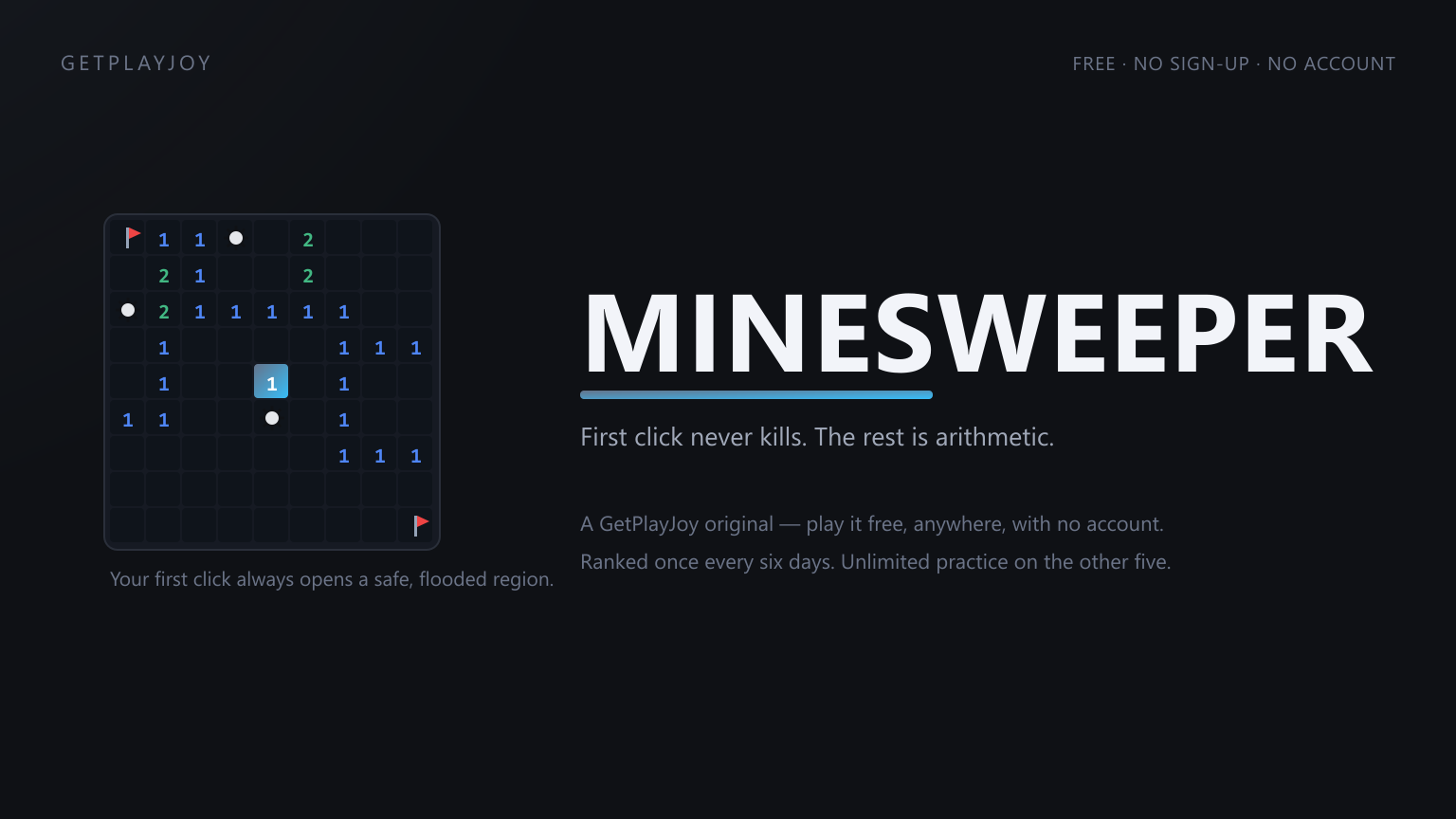
This is the guarantee that separates a playable daily from a slot machine. On Minefield, when you make your first sweep the engine checks the tile you clicked plus all eight neighbours. Any mine sitting in that 3×3 gets relocated to a free cell outside it, keeping the total mine count unchanged, and your first tile is therefore guaranteed to be a zero. A zero always cascades. So your opening move always throws open a region instead of handing you a single lonely number.
Two things follow. You cannot lose on move one, and you will never be handed a dead opening that gives you nothing to reason from. The old Windows behaviour was weaker: Windows Minesweeper made the first click safe by shifting a mine to the first empty square on the top row counting from the left corner, which guaranteed the tile but said nothing about its neighbours, so plenty of openings were a single number staring at eight walls. The "first click and its neighbours are always safe" standard that the reference implementations adopted later is the stronger one, and it is the one we ship.
There is a second consequence worth internalising, because it is easy to miss. The relocation happens on the client when you click, but the server re-derives it too. When your run is submitted, the server regenerates the field from the date seed, replays your recorded first move through the same relocation step, and gets the identical layout. The guarantee has to be deterministic on both sides or it would be worthless. It is, and you can verify it yourself by playing the same daily board twice in practice mode: same seed, same first click, same field.
From Sweeps to Score
The formula has three moving parts, and you can compute your own score before the result card appears.
Base values are keyed to the level rather than to the mine count: 700 for Beginner, 1,100 for Intermediate, 1,600 for Expert. An earlier pass at this made the base scale with the number of mines, which ballooned to roughly 35,000 on a 99-mine Expert board and dwarfed every other game on the site. The current numbers keep the three daily games comparable.
Speed adds a reward of 80,000 divided by your clear time in seconds, with one hard constraint: it is capped at the base value for the level. A clear faster than 50 seconds on Expert therefore earns the full 1,600 bonus and nothing more, because 80,000 divided by 50 is exactly 1,600. The same saturation points are 72.7 seconds on Intermediate (80,000 ÷ 1,100) and 114.3 seconds on Beginner (80,000 ÷ 700). Past those thresholds speed is worth nothing at all, which is the single most useful piece of arithmetic in this game. Clean play beats frantic play once you are inside the cap.
Wrong flags are the last term, and they follow a square-root curve rather than a straight line. The divisor is 1 plus 0.25 times the square root of your wrong-flag count, capped at 3. One wrong flag divides your total by 1.25. Four divide it by 1.5. Nine divide it by 1.75. You need 64 wrong flags before the cap binds, and there are not 64 wrong flags on most boards, so treat the cap as a safety rail rather than something you will hit.
Put together on an Expert field cleared in 60 seconds: 1,600 plus 1,333 points of speed is 2,933 before penalty. Zero wrong flags scores 2,933. One costs you 586 points and lands at 2,347. Nine flags leaves 1,676. The first mistake is expensive and each one after it is cheaper, which is the intent: a single lapse should sting, but a sloppy round should not become unplayable. Our science piece has a different view of the same principle, from the memory side rather than the scoring side.
Here is the ceiling, for anyone who likes targets. A flawless Beginner under 114 seconds scores 1,400. A flawless Intermediate under 72.7 seconds scores 2,200. A flawless Expert under 50 seconds scores 3,200. All three in one daily run is 6,800 points, and that is the maximum the "Minefield" scoring can return.
What Counts as a Cleared Field
The server accepts one thing and quietly rejects several others.
Accepted:
Every safe tile opened, which means 71 tiles on Beginner, 216 on Intermediate, 381 on Expert.; Any mix of flags you like. Flag all 99 mines on Expert, flag none, or leave one flag sitting on a tile you already opened; none of it changes the win condition.; A chord that opened a mine because your flags were wrong, up until the moment it opens that mine. The chord itself is legal. The mistaken flag is what killed you.
Rejected:
Claiming a cleared field while any safe tile is still covered. The server counts the union of your opens and their cascades, and if it does not equal the safe-cell total it refuses the run.; A submission whose op list opens a tile holding a mine. The replay would have ended the run there, so the claimed result cannot exist.; Running faster than 35 per cent of the level minimum without it being practice: under 2.8 seconds on Beginner, under 7 on Intermediate, under 14 on Expert.; A click rate faster than one open per 120 milliseconds, which no hand manages across a whole board.; A claimed score more than 1.4 times the recomputed value plus 50 points.; A seed that does not match today's date-derived seed for that level.
The last two are why nobody can post a fabricated Expert time to the board. The number on the leaderboard was computed in our infrastructure from your recorded clicks, and your browser never got a vote.
What Hitting a Mine Actually Costs
Less than players expect, and that is deliberate.
No lost progress. Cleared boards are banked before the next field opens, so a mine on Expert costs you Expert, not Beginner and Intermediate too.; No wasted clock. The timer starts on your first move, not when the board loads, so reading the HUD or thinking about an opening costs nothing.; No penalty for unflagging. The server only sees the flags standing when you finish. A guess you flagged and took back never existed.; Wrong flags are soft. Even nine of them only divide the score by 1.75, and the mistake curve keeps flattening after that.; Switching tabs is not cheating. The client notes it as a soft review signal, nothing more; the authoritative check is the server replay, and it does not care what else was on your screen.
The one thing a mine does cost you is the rest of that field. The run ends, you see everything, and the submission is recorded as incomplete. Nothing is deleted, no streak breaks for finishing the three fields, and there is no second-offence rule for trying again tomorrow. Practice mode exists precisely so you can lose Expert fifty times without consequence before you stake an attempt on it.
The Modes
Unlimited practice
Open the Minefield game page and a fresh 9×9 field lands immediately, with a tier switcher above the board for the other two sizes and a New round button that deals another whenever you want it. This page is always casual. Scores land in your own browser history and never touch a leaderboard, and because it is practice it also skips the anti-cheat time floor, so a genuinely fast clear of a small board will not get refused.
Today's ranked board
Minefield takes the daily slot once every six days, since the site rotates through six games. On its day the competitive board opens with three consecutive levels, Beginner then Intermediate then Expert, each one a fresh field seeded from that date and that level. Everybody in the world who plays it gets the identical three fields, which is the whole point: the daily mechanics guide covers the reset time, the one-ranked-attempt rule and the spoiler-free share format in detail.
Archive replays
Past boards stay available through the puzzle archive, so you can work through a Minefield field from three weeks ago at your own pace. Archive runs are always unranked. The live verification path is wired for a same-day submission, and a replay from an earlier date does not feed the leaderboard or the ability profile.
Where to Next
Play a free field on the Minefield game page, then read how to get better at Minesweeper for the pattern vocabulary that turns a ten-minute board into a two-minute one. If you are deciding between this and the version Google serves in its search results, our comparison of Minefield and Google Minesweeper sets the two side by side.
FAQ
How do you win Minesweeper?
Open every tile that does not hold a mine: 71 tiles on Beginner, 216 on Intermediate, 381 on Expert. Flagging is optional and does not affect the win condition.
What do the numbers mean?
A count of mines among the eight tiles touching that number, diagonals included. Nothing more, and never an estimate.
Is the first click always safe?
Yes, and beyond that: the clicked tile plus its eight neighbours are all cleared of mines before the field appears, so the first sweep always opens a cascade rather than a single tile.
How many mines are on each board?
10 on the 9×9 Beginner field, 40 on the 16×16 Intermediate field, and 99 on the Expert field, which is 16 rows by 30 columns.
How is the score calculated?
Base is 700, 1,100 or 1,600 by level, plus a speed reward of 80,000 divided by your seconds, capped at the base. That total is then divided by 1 plus 0.25 times the square root of your wrong-flag count, capped at 3.
Do wrong flags cost points?
Yes, but on a curve rather than linearly. One divides by 1.25, four by 1.5, nine by 1.75, and the divisor never exceeds 3 however sloppy the round.
What is chording?
Opening every unflagged neighbour of a revealed number at once, once your flags around it already match its value. Double-click, or select the tile and press C.
How do I flag on a phone?
Press and hold a tile for half a second. It is tuned so a quick tap still sweeps.
What is 3BV?
The Bechtel board benchmark, the minimum number of left clicks an optimal solver needs: one per zero-region plus one per safe tile no cascade ever reaches. The HUD shows it next to your actual click count and the ratio between them.
Can I play with a keyboard only?
Yes. Arrow keys move the cursor, Enter or Space sweeps, F flags, C chords. The board never requires a mouse.
What happens if I hit a mine?
The field ends, reveals itself, and is recorded as incomplete. Earlier levels in the run are already banked, your streak survives, and practice mode lets you retry any size immediately.
Why does my score not increase when I go faster?
You have passed the speed cap. Below 50 seconds on Expert the speed reward is already pinned at its maximum of 1,600, so more haste earns nothing and only raises your risk of a wrong flag.