If you have searched for a memory game, you have seen Lumosity’s ads. Here is what the two actually are, side by side — including the things Lumosity does better.
One is a subscription platform with forty-plus games and a training programme; the other is a single free game with one daily board shared worldwide. They are not the same product, and the honest comparison is about which shape fits which person.
The Short Answer
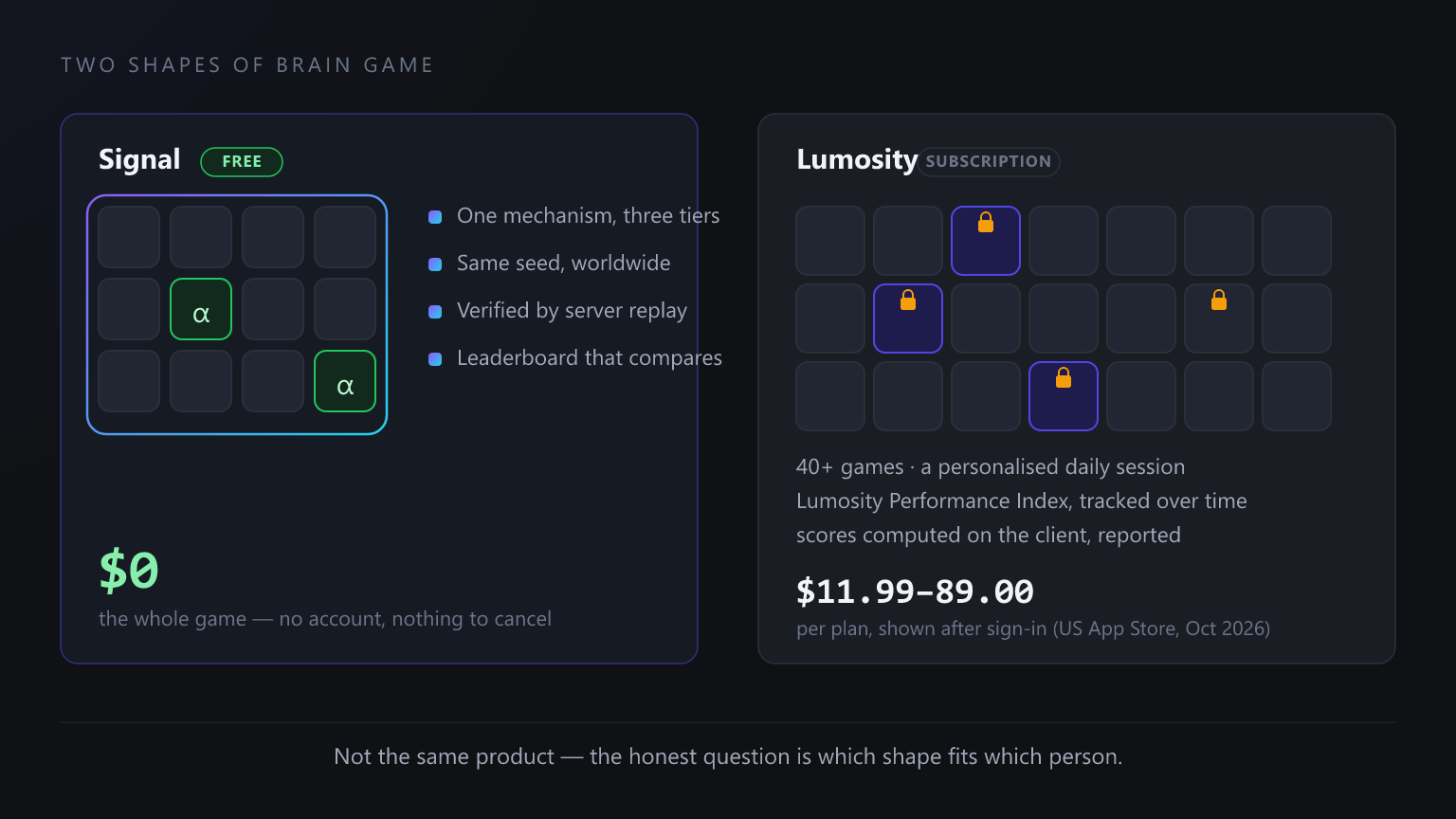
Lumosity is a subscription brain-training platform: a large library of short cognitive games, a personalised daily workout, and a proprietary performance index that tracks you over time. Signal is one game — match the pairs, decode the grid — free, with a daily board that is identical for every player on earth and a leaderboard that means something because of it.
Choose Lumosity if you want variety and a structured programme. Choose Signal if you want one mechanism taken to a comparable depth, at no cost, with no account. The rest of this piece is the evidence for those two sentences.
Product Model
Lumosity’s free tier is real but narrow: three rotating games a day, a baseline Fit Test, and basic stats. The full library sits behind a subscription, and the pricing has become harder to summarise — Lumosity no longer publishes a single price list, its website shows prices after sign-in, and its US App Store listings currently span $11.99 to $89.00 depending on plan and promotion (checked October 2026).
Signal’s model is the inverse. The entire game is free with no account: unlimited practice, the full daily rotation, the leaderboard, the ability profile. Pro sells archive access beyond seven days, an ad-free experience and permanent records — the game itself is never the paywall.
This is the structural difference that shapes everything below. Lumosity’s category convention is a free taste and a subscription wall; Signal’s is a free product with a storage-and-comfort upsell. Neither is dishonest, but they produce very different relationships with a player who just wants to play.
Game Lineup
On variety, Lumosity wins and it is not close. The library runs to forty-plus games across memory, attention, speed, flexibility, problem-solving, math and language, arranged into a personalised daily session. Two years of daily use would still surface games you have not played.
Signal offers one mechanism at three depths: 6, 8 and 10 pairs, on boards seeded from the date. There are five sister games in the daily rotation, but they are separate games, not a training programme.
On depth within the mechanism, the picture flips. Signal’s three tiers are a difficulty ladder you can climb for months, the daily seed makes every board a fresh instance of the same skill, and the scoring formula is published to four decimal places of intent. A single well-built game, played daily against a fixed board, is a sharper instrument than a fortieth mini-game you rotate past.
Competition
Lumosity has competition — leaderboards, age-group comparisons, challenges — but its boards are generated per session, so a score is comparable mostly to your own past scores. Signal’s daily is seeded from the date: everyone gets byte-identical boards, and the leaderboard is a genuine worldwide ranking on the same transmission.
There is a second layer. Signal verifies every submission by replaying your complete flip sequence on the server against the seeded board, so a score on the board is a score the engine recomputed. Lumosity’s scores are computed on the client and reported; there is no equivalent replay, which in a category with a long history of edited scores is a meaningful difference in what a leaderboard is worth.
Tracking and Feedback
Lumosity’s flagship metric is the Lumosity Performance Index — a single composite score with history, trends and age comparisons, and it is genuinely well made. Signal’s equivalent is percentile-based: each run is placed against the day’s global distribution, mapped onto a six-axis ability profile with Working Memory and Processing Speed lit by Signal itself, and accumulated into a long-term record.
Both dashboards answer the same question — am I improving? — and both are honest about the limits, because both sit on the same contested science, which is worth stating plainly: training improves performance on the trained tasks, the transfer to unrelated abilities is where the evidence thins out (Owen et al., 2010; Simons et al., 2016). Neither product is a clinical intervention, and neither should be bought as one.
Pricing and Access
Lumosity: a free tier of three games a day, with Premium prices shown after sign-in and currently ranging $11.99–$89.00 on the US App Store (October 2026). Signal: $0, with a seven-day free archive and Pro for the full archive, no ads and permanent records.
We are not going to tell you a $60-a-year subscription is never worth it. If a structured programme is what makes you actually train four times a week, the product has earned its fee. The decision framework is simpler than the marketing on both sides: what would you be paying for — variety, structure and a polished app — and is that worth more to you than a free, comparable, daily one-mechanism challenge?
Choose Lumosity If…
**You want variety.** Forty-plus games means the format never gets old, and a bad day on one game does not have to be a bad day.
**You want a programme.** The personalised session decides what you train today, which removes the daily "what should I do" friction that kills most self-directed routines.
**You value polish and platform.** Native apps, a mature dashboard, age-group comparisons, family plans — the product surface is broader and more finished than a single web game.
Choose Signal If…
**You want one mechanism, deeply.** The three-tier ladder and the daily seed make progress legible in a way a rotating game library cannot.
**You want zero cost and zero accounts.** No subscription to cancel, no payment method on file, nothing to sign up for.
**You care what a score means.** A verified replay on a shared board is the cleanest competitive format either product offers.
One Category Lumosity Does Not Cover
Server-side authority. Signal submits not a score but the flip sequence itself — every chip turned, in order — and the server replays it against the seeded board to recompute the result. The client’s arithmetic is never trusted. That is a design position the rest of the category has not taken, and it is not an accident of budget: it falls out of building a daily that is meant to be comparable worldwide.
To be fair to Lumosity, this is a difference in what each product is for, not a defect. A subscription platform reports client-side scores because its scores are personal progress metrics; a daily competition needs a source of truth. If a leaderboard matters to you, the difference matters.
Final Verdict
**If you are curious about brain training in general** — start with Lumosity’s free tier, three games a day, and see whether the format holds you for a month. The subscription question answers itself once you know.
**If you already know you like memory games** — Signal is the sharper instrument: one mechanism, three tiers, a worldwide board a day, verified scores, free. The depth is there if you are.
**If you just want five honest minutes a day** — Signal’s daily rotation covers that at no cost, and the archive replays mean a board you fumbled today is still there tomorrow. The Signal Daily explains how the run works.
And if you want the wider field before deciding, The Best Memory Games in 2026 covers six options including both of these.
Sources
Lumosity — official site and help centre (pricing and free-tier terms; accessed 25 October 2026, prices shown after sign-in) · US App Store listing, Lumosity: Brain Training Games (Premium in-app purchase range; accessed 25 October 2026)
Federal Trade Commission — "Lumosity to Pay $2 Million to Settle FTC Deceptive Advertising Charges" (2016)
Owen, A. M. et al., "Putting brain training to the test", Nature (2010) · Simons, D. J. et al., "Do Brain-Training Programs Work?", Psychological Science in the Public Interest (2016)