Brain-training subscriptions had a rough decade — the FTC fined Lumosity $2 million in 2016 over unproven claims, and the category never quite recovered its credibility. The memory games worth playing in 2026 are smaller, cheaper and more honest about what they train. Here are six.
Full disclosure up front: Signal is ours, and it is first on the list. The other five are real products we actually spent time with, with their trade-offs stated as plainly as ours. If you deleted our entry, this list would still be useful — that was the bar for writing it.
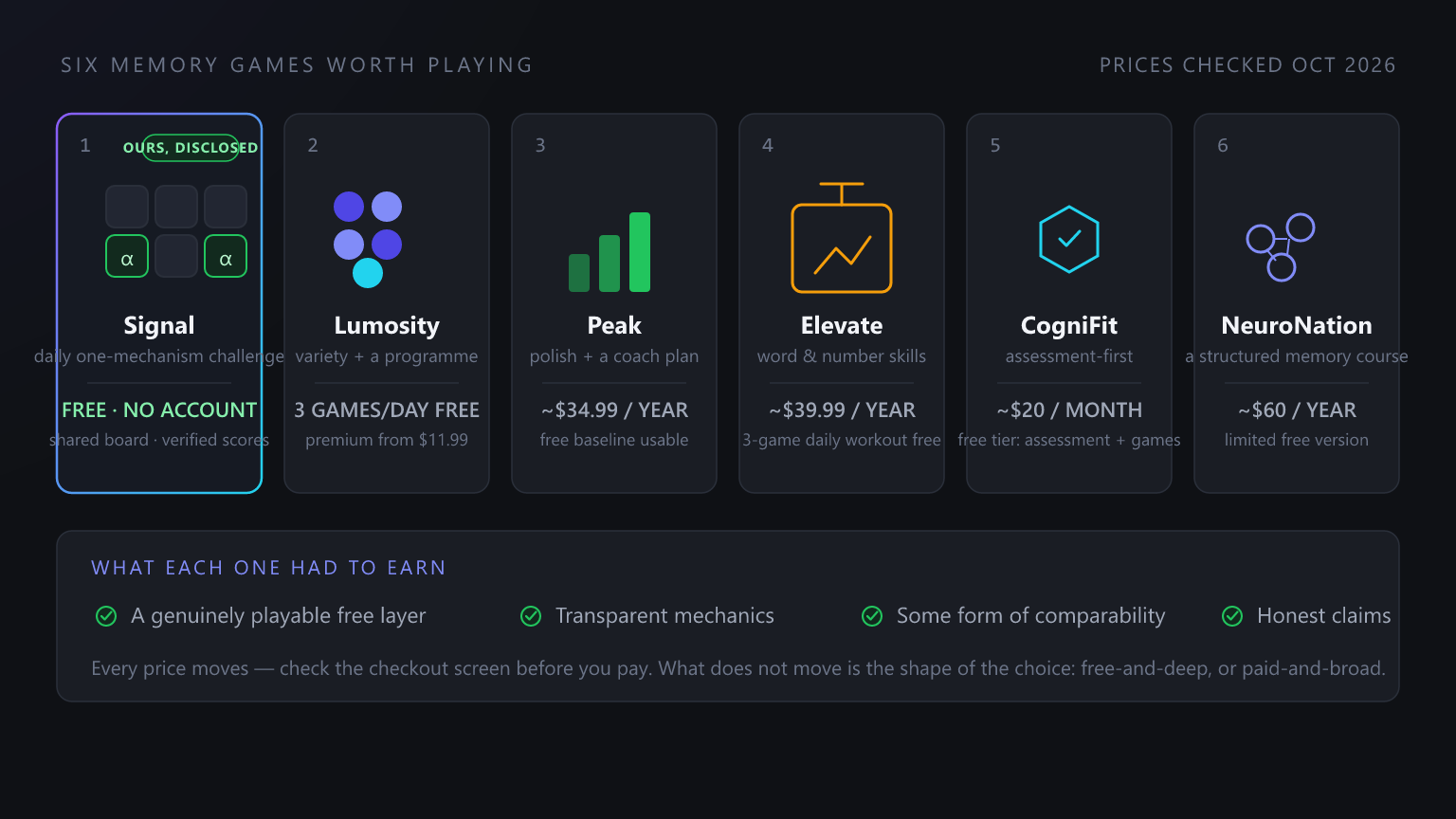
What a Memory Game Has to Earn in 2026
**A free layer that is genuinely playable.** Not a three-session trial with a payment wall — something you could keep using, at reduced scope, indefinitely.
**Transparent mechanics.** How scoring works, how difficulty rises, stated somewhere a player can find. A game that cannot explain its own numbers does not get recommended here.
**Some form of comparability.** A leaderboard, a seed, a percentile — anything that lets today’s score be compared with a real reference rather than a personal best only.
**Honest claims.** No "raise your IQ", no "prevent decline". The 2016 FTC settlement exists because a category leader made claims it could not support; the games that survived that lesson describe themselves more carefully.
1. Signal — Best for a Daily One-Mechanism Challenge
Match the pairs, decode the grid: three tiers of 6, 8 and 10 pairs on boards seeded from the date, so every player worldwide gets the same transmission and the leaderboard is a real ranking. Every submitted run is verified by replaying the flip sequence on the server, which keeps the board clean without accusing anyone of anything. Free, no account, with seven days of archive replays and an unlimited practice mode.
The trade-off is structural: it is one mechanism. If you want a different game every day, the sister rotation helps, but this is depth over breadth by design. Read the rules in How to Play Signal or the head-to-head with the category leader in Signal vs Lumosity.
2. Lumosity — Best for Variety and a Structured Programme
Still the broadest library in the category — forty-plus games across memory, attention, speed, flexibility, problem-solving, math and language — arranged into a personalised daily session, with a genuinely well-made dashboard (the Lumosity Performance Index) tracking your history. The free tier gives you three rotating games a day, permanently, which is a real free tier rather than a demo.
The trade-offs: Premium pricing is no longer published as a list — the site shows prices after sign-in and US App Store listings currently range $11.99–$89.00 by plan (checked October 2026) — and the daily session picks your games for you, which is either the feature (no decisions) or the limitation (no depth in any one mechanism). Scores are client-side and comparable mainly to your own history.
3. Peak — Best for Polish and a Coach-Style Plan
Thirty-plus mini-games across memory, language, mental agility and attention, with the most visually polished interface in the category and a "Coach" programme that assembles a personalised plan. Acquired by Hims & Hers in 2024, it has since added sleep and mood tracking alongside the cognitive games. The free baseline is usable on its own; Pro is around $34.99 a year.
The trade-offs: the library is finite and daily players report the rotation feeling familiar within a few weeks, and the cognitive profile is a relative display rather than a measured one.
4. Elevate — Best for Word-and-Number Skills
The most practical of the training apps: writing, reading comprehension, math and processing speed, delivered as a daily workout of short game-like exercises. Free gives you a real three-game workout each day; Pro is about $39.99 a year or $9.99 a month. If your goal is sharper emails and faster reading rather than memory per se, this is the one aimed at you.
The trade-offs: memory is one track among several rather than the focus, and the content is explicitly skill-practice, not cognitive assessment.
5. CogniFit — Best for Assessment-First Training
The clinical end of the category: it opens with a full cognitive assessment and builds the training programme from the results, and it is used alongside patient care by some providers (it is a training tool, not a diagnosis). Pricing is at the top of the field — roughly $20 a month, more for longer assessments — and the free tier includes the initial assessment plus limited games.
The trade-offs: it is the most expensive option here, the assessment framing invites over-reading of the results, and it is more instrument than game.
6. NeuroNation — Best for Targeted Memory and Concentration
Berlin-based and the most narrowly focused of the subscription apps: memory and concentration exercises, course-style, with a limited free version and Premium in the region of $9–14 a month or about $60 a year (prices vary by channel; check at checkout). If you want a structured memory course rather than a game library, it is the most direct route.
The trade-offs: narrower than Lumosity or Peak, the interface is utilitarian, and the course format assumes you will follow it in order.
What to Avoid
The patterns matter more than any individual site, so these are written as features to watch for:
**A "free" game that asks for an email or phone number at game three.** The gate is the product; the game is the bait.
**Scores with no explanation.** A proprietary index that cannot tell you what it measures, or how, is not tracking — it is decoration.
**Claims that were actionable in 2016.** "Improves IQ", "prevents decline", "clinically proven" without a citation you can read. The FTC settled with the category leader over exactly this, and in 2026 a game still saying it has not read the room.
**Four ad units and a background music track.** If the page is mostly advertising with a game embedded, the advertising is the product.
What Lumosity Got Right That Nobody Has Copied
Two things, genuinely, and they are the reason the category leader stayed the leader.
**Programmed sessions.** The app decides what you train today, from your history and recency. That single decision — removing "what should I do now" — is worth more than any individual game, and most competitors still hand you a library and hope.
**Readable long-term trends.** The dashboard makes months of progress legible at a glance, with age-group context. Signal’s percentile profile is our answer, and it is narrower by design; if trend readability is what you want, Lumosity’s is the better instrument.
The trade we made is deliberate: one mechanism, taken deep, with a comparable worldwide board, instead of a programme across many. Both are defensible products. Only one of them is free.
Do These Games Make You Smarter?
The honest answer is the boring one. Training improves performance on the trained tasks — reliably, and that is not nothing. The leap to unrelated abilities is where the evidence runs out: the largest controlled trial in the field (Owen et al., 2010, over 11,000 participants) found improvements on the trained tasks but no convincing transfer to general reasoning, and the field’s definitive review (Simons et al., 2016) reached the same conclusion for the marketing claims of the era.
What that leaves is still worth having: a measurable skill, a daily habit, and a score you can watch move. Buy a memory game for that and it is honest value. Buy it for a higher IQ and no product on this list will deliver.
If You Only Have Five Minutes a Day
One daily for the ritual — a shared board, one attempt, a score that means something. One unlimited mode for the days you want more, with no streak at stake. That is the whole routine, and it fits either Signal’s daily-and-arcade pair or any of the subscription apps above.
What does not work is installing five apps and rotating between them. The evidence on habits is unanimous and unglamorous: the routine you keep beats the routine that is optimal. Pick one mechanism, or one programme, and let it get boring enough to become a habit.
So Which One
**Zero budget, one mechanism, daily comparability → Signal.** Free, no account, verified scores on a shared board, with archive replays when you want a rematch.
**Variety and a programme that decides for you → Lumosity.** The free tier is a real trial of the format; Premium pricing is shown at checkout.
**Native app polish and a coach-style plan → Peak.** Practical skills, writing and reading → Elevate.
**Assessment-first or clinical context → CogniFit.** A structured memory course → NeuroNation.
Every price on this page was checked in October 2026 and every one of them moves; check the checkout screen before you pay. What does not move is the shape of the choice: free-and-deep, or paid-and-broad.
Sources
Federal Trade Commission — "Lumosity to Pay $2 Million to Settle FTC Deceptive Advertising Charges" (2016)
Owen, A. M. et al., "Putting brain training to the test", Nature (2010) · Simons, D. J. et al., "Do 'Brain-Training' Programs Work?", Psychological Science in the Public Interest (2016)
Product pages and App Store listings for Signal, Lumosity, Peak, Elevate, CogniFit and NeuroNation (pricing and free-tier terms; accessed 25 October 2026)