Dual n-back is the training task everyone cites when they claim brain games "work". The actual evidence is more nuanced than either side admits, and worth getting right.
What the original study claimed
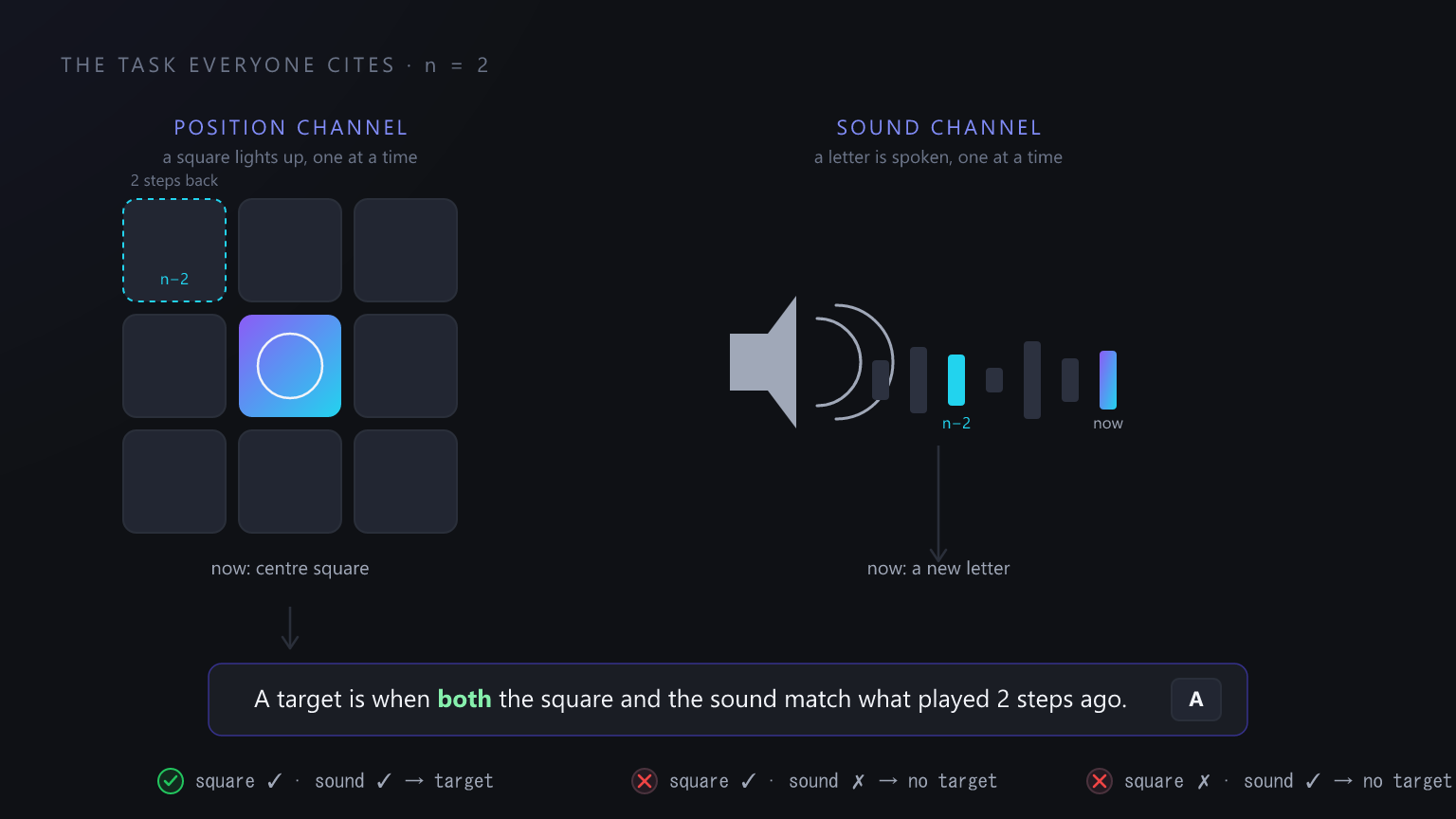
Jaeggi and colleagues (2008) reported that training on a dual n-back task improved performance on an untrained fluid-intelligence test, and that more training produced more gain. It was a striking result and it launched a decade of "brain training" marketing.
What later studies found
Replications were mixed. Some found near-transfer (improvement on similar tasks) but little far-transfer (improvement on unrelated reasoning). Others found the gains shrank once the test practice was controlled for. The honest summary is: working-memory training changes working memory, and the leap to "you will get smarter at everything" is not settled.
What a puzzle player should take from it
The defensible claim is narrower and still useful: repeated, varied practice on memory-loaded tasks (Signal, Sudoku, Minesweeper) moves your working-memory percentile. Treat the ability profile as a training signal, not a measure of innate intelligence. It responds to practice, which is the whole point.
FAQ
Will GetPlayJoy make me smarter?
We make no such claim. We show your percentile move as you practise — that is a game signal, not a clinical one.
Is the research cited real?
Yes — Jaeggi et al., 2008, "Short- and long-term memory training improves fluid intelligence", PNAS.