What a Sudoku App Has to Earn in 2026
We scored every option against four criteria, applied before any ranking.
1. **Free to start, no account.** The daily board should open without a password or a paywall. If a site asks for money before you have played once, it fails the first test. 2. **A real daily, fairly built.** A genuine daily is generated (or seeded) so players share a board, not a random one refreshed on every reload. Uniqueness of solution is non-negotiable. 3. **Honest scoring.** The score should be explainable and, ideally, checked rather than taken from the client. Hidden multipliers and fake "personal bests" count against a site. 4. **Real aids, not paywalled puzzles.** Notes, undo, and hints are table stakes. A site that locks the puzzle itself behind a subscription is not free; it is a demo.
Every app below is judged on these four. Where one wins, we say so. We weighted the first and fourth criteria most heavily, because the whole point of a daily puzzle is that it fits into a life without a contract. A beautiful board you cannot open without a credit card is worse than a plain board you can open in two taps.
Why a Seeded Daily Beats a Random Board
Most apps generate a fresh random board on every open, which means your Monday puzzle is nobody else's. A seeded daily instead derives the board from the calendar date, so everyone who plays on the same date gets the identical grid. GetPlayJoy seeds from the UTC date at three tiers and rolls the site over at 00:00 UTC, which moves the ranked slot to the next game in its six-game rotation, and the result is a leaderboard that compares like with like rather than luck of the draw. When we rank a daily, the presence of that shared seed is worth more than a prettier animation, because a board you cannot compare is just a solitaire. The daily guide explains the reset math in detail.
1. GetPlayJoy — best free, no-account daily
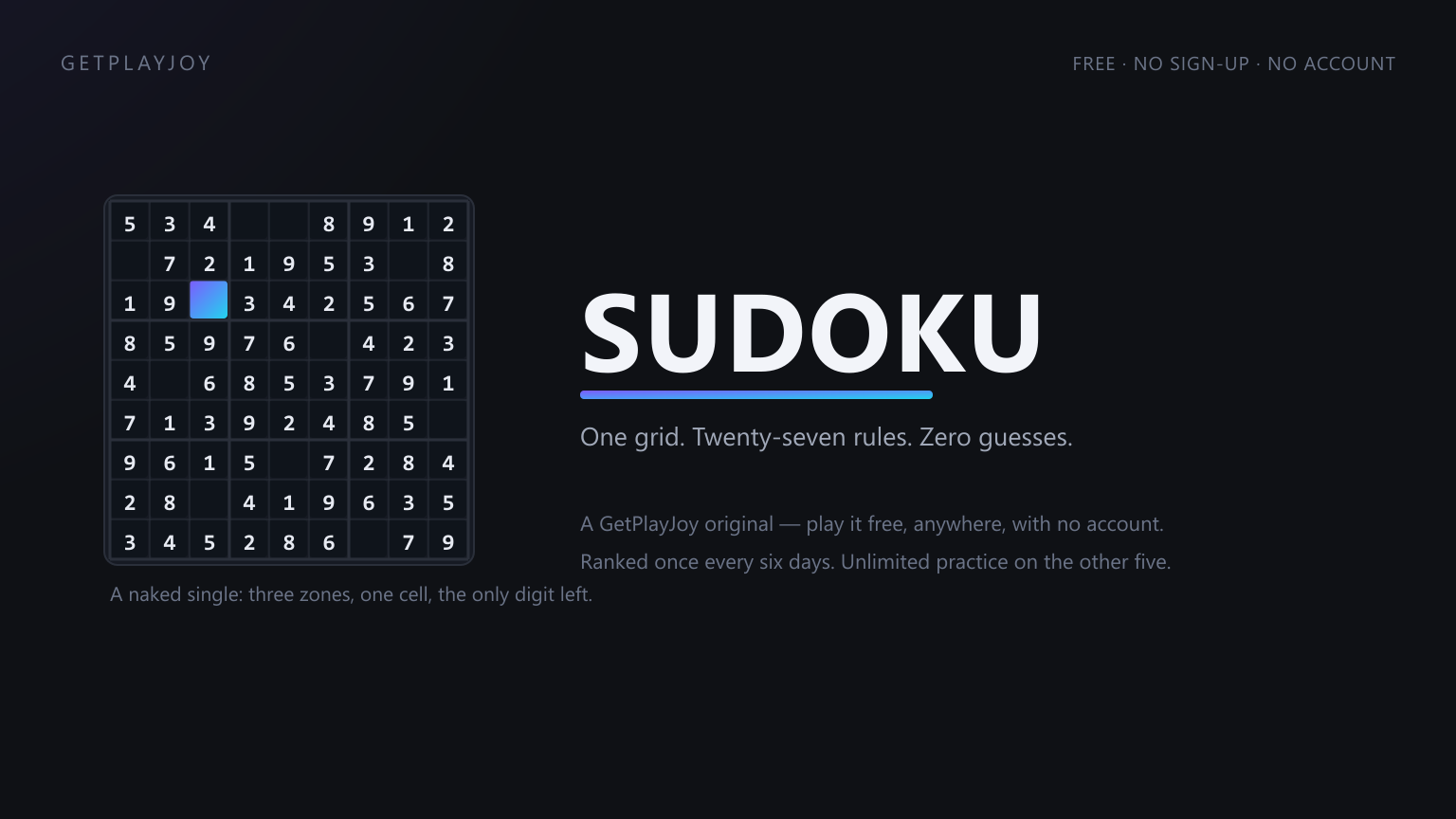
GetPlayJoy runs a Sudoku board seeded from the UTC date at three tiers of 40, 33, and 27 clues, identical for every player who picks that tier. Sudoku takes the ranked slot once in the six-game rotation, so that shared board arrives every six days; unlimited practice boards are free on every day in between. There is no sign-up for either. The score is recomputed by the server from your move log, using a clear bonus of 650, 1,050, or 1,550 plus a speed reward of 80,000 divided by your seconds, all divided by a square-root mistake divisor. The solution is never sent to the client, so the result cannot be faked.
Best for: players who want a fair, same-board-for-everyone daily with a verified score and zero account friction. The rules guide explains the scoring in full, and the daily guide covers the six-day rotation, reset times and spoiler-free sharing.
Tradeoff: it is one game in a six-game rotation, not a 40-title library, so Sudoku's ranked board lands every six days rather than every morning, and the harder tiers demand real deduction rather than casual tapping. For a player who wants breadth, that is a limitation; for a player who wants one honest daily, it is the point.
2. The New York Times Games — best for polish and trust
The NYT Sudoku sits inside the NYT Games subscription, which also covers the crossword and the daily mini. The board is clean, the hints are sensible, and the brand's editing standards mean the puzzles are well-formed. It is the default choice for players who already pay for the bundle.
Best for: subscribers who want one polished puzzle destination and trust the editing.
Tradeoff: it requires a paid account, so it fails the "free to start, no account" test. The daily is excellent but gated, and there is no free unlimited mode once the subscription lapses. You are renting access to a puzzle that is, mechanically, free to host.
3. Sudoku.com by Easybrain — best free reach on mobile
Sudoku.com is the most-downloaded Sudoku app on mobile, free with ads. It offers multiple difficulties, daily puzzles, notes, undo, and a hint system, and its onboarding is friendly to newcomers. The user base is enormous, which means active daily communities in the comments and a steady stream of fresh boards.
Best for: mobile players who want a free, smooth app and do not mind advertising.
Tradeoff: the ads are frequent and sometimes interstitial, and several convenience features nudge toward a subscription. The scoring is client-side and not server-verified, so it is a personal best rather than a comparable global rank. That is fine for casual play and misleading if you want to compare across players.
4. Good Sudoku (Zach Gage) — best paid iOS experience
Good Sudoku is a one-time-purchase iOS app from the designer Zach Gage. It is ad-free, beautifully made, and its hint system is the most educational in the category: a hint explains the technique, not just the digit. For a player who wants to learn, it is the strongest teacher.
Best for: iPhone and iPad owners willing to pay once for a calm, ad-free, pedagogically honest app.
Tradeoff: iOS only, and it costs money up front. There is no Android version and no web play, which limits it as a cross-device daily. If you live outside Apple's garden, this one is simply unavailable.
5. WebSudoku — best minimalist free web play
WebSudoku has been serving free Sudoku in the browser since the mid-2000s. It offers four difficulty levels, no account, and a famously plain interface. If you want a puzzle and nothing else, it delivers without persuasion, pop-ups, or a tutorial that won't end.
Best for: desktop players who want a no-frills board and no install.
Tradeoff: the interface is dated, there is no real daily community or leaderboard, and the experience has not evolved in years. It is a utility, not a habit engine, and it will not remind you to return tomorrow.
6. Brainium Sudoku — best free stats and undo
Brainium's Sudoku is free with a premium tier, and it stands out for clean stats, unlimited undo, and a gentle hint system. The controls are comfortable on both phone and tablet, and the progress tracking is clearer than most free apps. For players who like to see their own history, it is the most rewarding of the free mobile options.
Best for: players who care about their own history and want generous undo without paying.
Tradeoff: like most free apps it is ad-supported, and the deepest features sit behind the premium upgrade. Scoring is local, not server-checked, so your records stay on your device.
7. OpenSudoku — best open-source, offline
OpenSudoku is a free, open-source Android app with no account, no ads, and full offline play. It generates puzzles locally, supports notes and several input methods, and stores your progress on the device. For players who want control over their data and a puzzle that never phones home, it is the cleanest option on the list.
Best for: privacy-minded Android users who want a no-account, ad-free board they can play on a plane.
Tradeoff: the interface is functional rather than pretty, there is no global daily or leaderboard, and iPhone users are out of luck. It is a personal tool, not a community, and the puzzle quality depends on the generator rather than a hand-picked daily.
How We Weighed the List
We did not score these apps on features alone. A slick animation means little next to a board you can open without a password, and a huge library means little if the daily is not fairly built. We gave the most weight to free start and honest scoring, then to the quality of the aids, then to polish. That ordering is why a no-account, server-verified site outranks a prettier paid one in our ranking, and why a clone with a bigger ad budget did not make the list at all. The criteria are stated above so you can re-rank to your own taste: if offline play matters most, OpenSudoku climbs; if teaching matters most, Good Sudoku does. The order reflects our weighting, not an absolute truth.
What to Avoid
A few traits mark a site you should close.
**A password prompt before the first board.** The real puzzle needs no account; a site that demands one up front is collecting more than it solves.; **"Unlimited hints" that reveal the solution for a fee.** That is a paywall on the answer, not a puzzle.; **No visible difficulty or clue count.** If you cannot tell whether a board is 40 or 27 clues, the generator is not telling you how it works.; **Scores that look impossible.** A client that trusts its own number can show a 9-second "solve" as a record. Server-verified scores, like GetPlayJoy's, cannot.; **Cloned branding.** A page that copies another puzzle's name with a different domain is rarely the official build.; **Solver assist that auto-fills regions.** Some free apps quietly complete rows for you in exchange for watching an ad. That is not solving; it is a demo of a solver, and it teaches nothing.; **Leaderboards that mix difficulties.** A board ranked against both 40-clue and 27-clue players tells you nothing about skill. A fair board separates tiers, as GetPlayJoy's three-tier daily does.
What the Big Players Got Right That Nobody Has Copied
Credit where it is due. The New York Times earned trust through decades of careful editing, and that trust transfers to its Sudoku even though the puzzle is simple. Sudoku.com earned reach through a genuinely smooth mobile build and a huge daily audience, something no small site matches. Good Sudoku earned loyalty through hints that teach rather than spoil — a design choice the free ad-supported apps have not copied, because teaching does not monetize as fast as revealing.
None of them changes the core ranking for a player who values free, no-account, and a verified daily; they simply explain why the paid and ad-supported giants stay popular. The lesson for any new puzzle site is uncomfortable but useful: trust and reach beat features. A player returns to the app they already trust, not the one with the cleverest hint.
Do These Games Make You Smarter?
Short answer, with the evidence: not in the way the marketing implies. Adrian Owen and colleagues tested 11,430 people in a 2010 brain-training study and found that trained tasks improved while untrained tasks did not. Sudoku trains working memory and logical deduction, and those gains stay near the task. Play it for the narrow, real benefit and the daily calm, not for a higher IQ. The brain-science piece lays out the near-versus-far transfer distinction in detail.
If You Only Have N Minutes a Day
A routine that fits almost any schedule:
**5 minutes:** one daily board at your comfort tier, on GetPlayJoy or any seeded daily. The ritual is the point; the score is secondary.; **+10 minutes on good days:** one unlimited board at the next-hardest tier to build the pattern habit without waiting for tomorrow.; **0 minutes of guilt on bad days:** the streak is a habit signal, not a moral score. Resume tomorrow at the usual time.
The shape — one daily for the ritual, one unlimited for the days you want more — is the whole routine, and it fits either a no-account site or a subscription app.
So Which One
**You want free, no account, and a fair daily:** GetPlayJoy. The board is seeded, the score is verified, and nothing stands between you and the grid.; **You already pay for NYT Games:** play their Sudoku; the polish is real and the editing is trustworthy.; **You live on a phone and tolerate ads:** Sudoku.com by Easybrain. Huge, free, and smooth.; **You are on iPhone and hate ads:** Good Sudoku. One payment, no interruptions, the best hints.; **You want the plainest possible web board:** WebSudoku. No install, no account, no persuasion.; **You want your data on your device:** OpenSudoku. Free, open-source, offline, no account.; **You love your own stats:** Brainium Sudoku. Generous undo and clear progress, free to start.
If you try nothing else from this list, open a seeded daily once and notice the difference: a board everyone else is solving on the same day is a puzzle you can discuss, not a screen you quit the moment it loads. That shared board is the feature worth keeping.
FAQ
What is the best free Sudoku app with no sign-up?
GetPlayJoy and WebSudoku both open with no account. GetPlayJoy adds a date-seeded daily with a server-verified score; WebSudoku is the plainer option.
Is the NYT Sudoku worth paying for?
If you already subscribe to NYT Games, yes — the editing and polish are strong. As a standalone purchase it is hard to justify over free no-account options.
Do these apps make you smarter?
They train working memory and logic, but the 2010 Nature study (11,430 participants) found no transfer to untrained tasks. Treat the benefit as narrow and real.
Which app has the best hints?
Good Sudoku, whose hints teach the technique rather than just reveal the digit. GetPlayJoy's Hint highlights a forced cell without solving it for you.
Why prefer a server-verified score?
A client that trusts its own number can show impossible records. GetPlayJoy recomputes your score from the move log, so the leaderboard reflects real solves.
Can I play more than one Sudoku a day?
Yes. Unlimited practice modes on most of these apps generate fresh boards on demand. On GetPlayJoy that is the only Sudoku mode on the five days out of six when another game holds the ranked slot; the daily board itself is the one shared, ranked puzzle.
Which Sudoku app is best for beginners?
GetPlayJoy or Sudoku.com. Both open free with no account, offer a gentle 40-clue tier, and show notes and undo. Start there before paying for anything.
Are browser puzzles as good as apps?
For Sudoku they are equivalent. A seeded browser daily like GetPlayJoy needs no install and no update, and the score is verified server-side, which most apps do not do.