Read the two puzzles as cousins with one shared rule and one split. Both forbid repeating a digit inside a unit. Sudoku's unit is fixed and spatial; Kakuro's unit is a run defined by a sum. Hold that one sentence and the rest of this comparison is just working out what the split costs and what it buys.
How Kakuro Works
Kakuro, also called Cross Sums, is a grid of white and black cells. Each white cell holds a digit 1 through 9. A run — a horizontal or vertical line of consecutive white cells — carries a sum clue printed in the adjacent black cell, and the digits in that run must add up to the clue with no repeats. A cell at the corner of a down-run and an across-run must satisfy both sums at once. There are no givens; every digit is derived from the arithmetic and the no-repeat rule. Nikoli popularized it in Japan in the 1980s, and its name fuses "addition" with "crossword."
The 6 Differences That Matter
1. The constraint is placement vs arithmetic
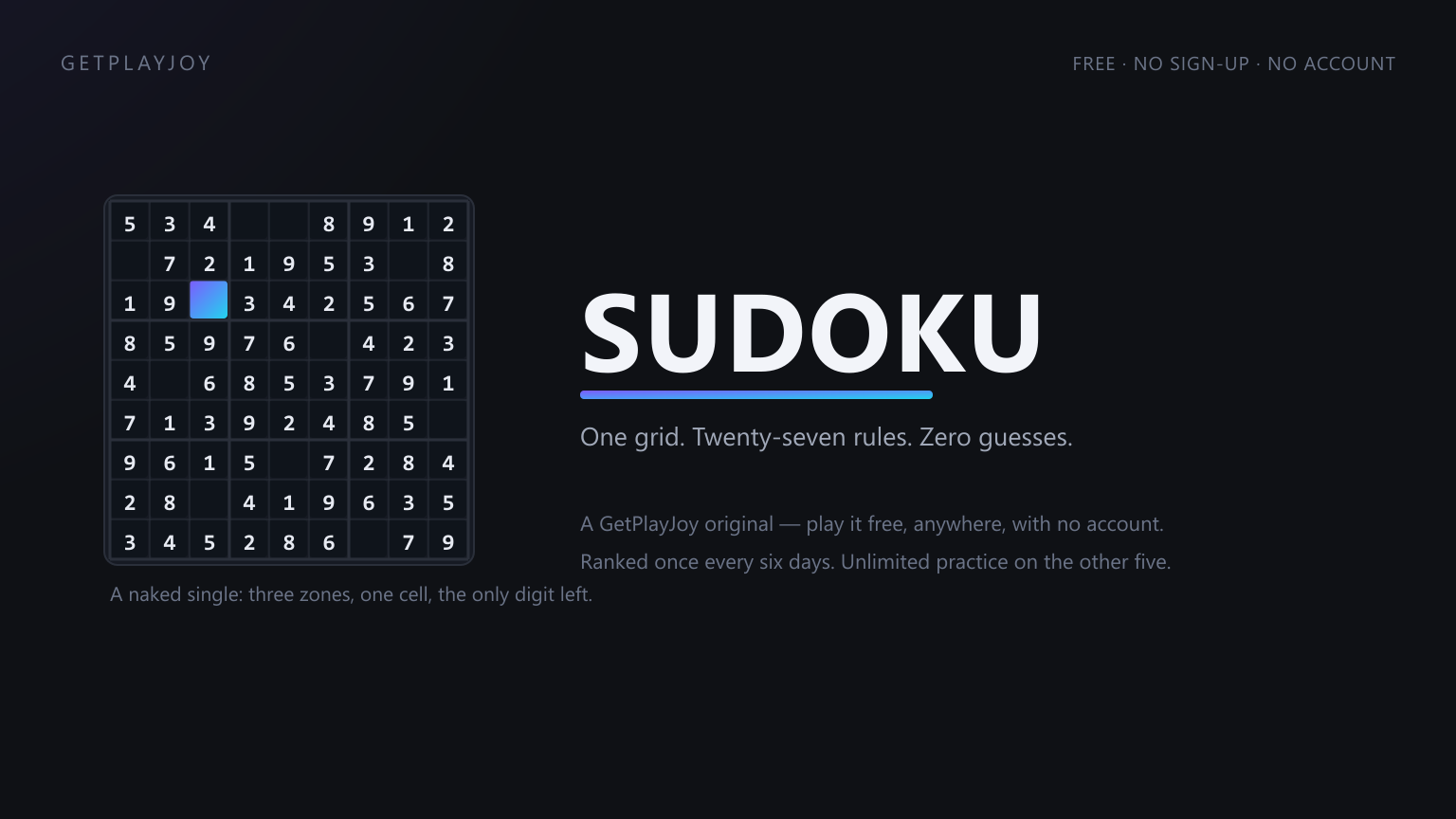
Sudoku's rule is purely relational: each unit holds 1 through 9 once. Kakuro's rule is arithmetical: each run sums to a target. A Sudoku cell resolves when its row, column, and box have already claimed eight digits; a Kakuro cell resolves when the two sums crossing it leave exactly one digit that fits both. The first is a logic of exclusion, the second a logic of combination.
2. What the puzzle gives you
Sudoku hands you 40, 33, or 27 givens — concrete digits already placed. Kakuro hands you sum clues and nothing else. That makes Kakuro a purer deduction from the first move: there is no digit to copy, only sums to satisfy. The Sudoku rules guide shows how givens seed the first naked singles; Kakuro has no such head start.
3. Arithmetic is in or out
Sudoku uses no arithmetic at all — the digits could be colors. Kakuro requires addition constantly: you estimate which partitions of a sum are legal, then prune by the no-repeat rule. Players who like math often prefer Kakuro for exactly this reason. Players who liked Sudoku to escape arithmetic will find Kakuro a different animal.
4. The memory load sits differently
In Sudoku you hold a candidate set per cell and cross it off as units fill. In Kakuro you hold both a candidate set and a running sense of which partitions of the sum remain legal. The working-memory load is heavier and more numerical, which is why Kakuro feels slower even on a small grid. The getting-better guide trains the placement habit; Kakuro would need a separate sum-partition habit.
5. How difficulty is tuned
Sudoku scales difficulty by clue count: 40, 33, or 27 givens, with a clear bonus of 650, 1,050, or 1,550 to match. Kakuro scales by run length and sum ambiguity — a long run with many legal partitions is harder than a short one, and tightly crossing runs raise the deduction. Neither puzzle scales by time pressure; both scale by how much the constraints leave open.
6. The board shape
Sudoku is a uniform 9×9 with nine identical 3×3 boxes. Kakuro is an irregular mosaic of black and white where the run shapes vary every puzzle. The visual variety is part of Kakuro's appeal; the uniform grid is part of Sudoku's approachability.
A Worked Contrast
Take one empty cell where a down-run and an across-run meet in Kakuro, and compare it with a corner cell in Sudoku. The Sudoku cell resolves when eight of the digits 1 through 9 already appear in its row, column, and 3x3 box; the ninth drops in by exclusion. The Kakuro cell resolves when the two crossing sums leave exactly one digit that fits both partitions without repeating inside either run. Same symbols, different mental move: exclusion versus small addition under a no-repeat filter. A player strong at one often finds the other oddly unfamiliar.
Scoring, Side by Side
Sudoku's scoring is published and server-verified. The exact formula the engine runs:
`score = (clear bonus + 80,000 ÷ seconds) ÷ min(1 + 0.3 × √mistakes, 3)`
with clear bonuses of 650 / 1,050 / 1,550 by tier. A clean 27-clue board in six minutes scores about 1,772; two mistakes drop it to about 1,245.
Kakuro has no single canonical formula, and GetPlayJoy does not run a Kakuro engine, so the numbers below are typical of commercial Kakuro apps, not a GetPlayJoy figure: a base of roughly 100 points per solved run, plus a time bonus such as 5,000 ÷ seconds capped at the base, minus a penalty per revealed hint. The shape is similar — reward completion and speed, charge for assistance — but the constants are set by each publisher, not by a shared daily seed. The honest contrast: Sudoku's score is recomputed by a server from a date seed, so it is comparable worldwide; a Kakuro score is comparable only against the same app's own board.
A Quick Difficulty Check
On a like-for-like grid Kakuro is usually the harder deduction because it gives no starting digits and adds arithmetic. But the gap is not fixed. A player drilled in mental addition will find Kakuro's sums friendly while a pure logician grinds; a Sudoku master used to scanning units may stall on Kakuro's partition lists. Treat difficulty as personal, not absolute, and pick the puzzle that matches the kind of thinking you want to practice that evening. The rules guide is a good place to test which thinking suits you.
Which Is Actually Harder
On a like-for-like grid, Kakuro is usually the harder deduction because it gives you no digits and asks for addition on top of exclusion. Sudoku's 27-clue tier is hard in a different way: few givens, but the rule is simpler to apply. A player strong at mental arithmetic will find Kakuro gentler than a pure logician will. Hardness here is personal, not absolute, which is the point of comparing mechanics rather than crowning a winner.
Difficulty also depends on the solver's schooling. A child drilled in addition will crack Kakuro sums faster than a logician will; a player who has never enjoyed arithmetic will find Sudoku the gentler door. Neither puzzle is objectively harder; they are hard in ways that match different minds, which is the most useful thing a comparison can tell you.
Who Each One Suits
Choose Sudoku if you want a uniform, no-account daily you can learn in a minute and improve by pattern recognition. The rules guide is enough to start. Choose Kakuro if you enjoy arithmetic as part of the puzzle and want a deduction with no given digits to lean on. Kakuro rewards a different kind of patient partitioning.
What Kakuro Did Better
Credit where it is due. Kakuro removes givens entirely, so every cell is earned from the constraints — there is no "copy this number" move, which some solvers find purer. Its sum clues create a richer early game than Sudoku's empty opening, because a single sum already restricts the partition. And for players who like math, Kakuro delivers arithmetic satisfaction that Sudoku deliberately omits. None of that makes Sudoku worse; it makes Kakuro a genuinely different object, not a reskin.
Kakuro also tunes difficulty without changing the grid. A 9x9 Sudoku must shed clues to get harder; a Kakuro simply lengthens runs and tightens sums, so one footprint spans gentle to brutal. That elasticity is a design win Sudoku cannot copy without leaving the uniform 9x9.
Which to Play
If your goal is a quick, fair, same-board-for-everyone daily with a verified score, Sudoku on GetPlayJoy is the cleaner habit. If you want a slower, math-flavored deduction with no starting digits, Kakuro is the better evening puzzle. They share a digit set and a no-repeat rule, and almost nothing else about the thinking.
If you only try one, let the evening decide: a calm night suits Sudoku's quiet exclusion, while a restless one suits Kakuro's arithmetic. Both are honest workouts for different minds, and neither is the other's inferior.
FAQ
Is Kakuro harder than Sudoku?
Usually, because it gives no starting digits and adds arithmetic. But the difficulty is personal; a mental-math fan may find Kakuro easier than a 27-clue Sudoku.
Do they share the same digits?
Yes, both use 1 through 9 with no repeats inside a unit. The similarity ends at the constraint that resolves a cell.
Why does Sudoku give givens and Kakuro does not?
Sudoku seeds the grid with placed digits; Kakuro seeds it with sum clues. The different seed changes the whole opening.
Is Kakuro scored like Sudoku?
No single canonical Kakuro formula exists. Typical apps score per solved run plus a time bonus minus hint penalties, but the constants vary by publisher.
Which is better for the brain?
Both load working memory. Sudoku is pure logic; Kakuro adds arithmetic. Neither is a cognitive cure — see the brain-science piece for the evidence.
Can I play Kakuro on GetPlayJoy?
This comparison covers mechanics. GetPlayJoy's sudoku builds on a date-seeded daily; Kakuro would need its own engine, which is a different build.
Are Sudoku and Kakuro from the same publisher?
Both reached the West via Nikoli, which named Sudoku in 1984 and popularized Kakuro that decade. They are related puzzles with different core constraints.
Can Kakuro use the same daily-seed idea as Sudoku?
Yes. Any puzzle with a deterministic generator can be seeded from the date; the fairness gain is identical. GetPlayJoy's Sudoku uses that method.