We went through the field in October 2026 and picked eight that are worth your minutes, ours included at number one, with the tradeoffs named for every entry. A list with only our own game in it would not be useful to anyone, including us.
What a 2048 has to earn in 2026
Four things, before any names.
Does it play honestly. Same 4×4 board, equal tiles merge into double, one tile per move, game over when nothing moves. Variants that change those rules are fine as variants, not as versions of this game, and they should say so.
Does it respect the session. No download prompt, no forced account, no interstitial every second swipe, and a board that loads in under a second on a phone.
Does the score mean anything. Either everyone plays the same tiles, or nothing compares. A leaderboard with no seed sharing is decoration.
Does it give you something back. Rules that explain their own scoring, a way to learn the corner strategy, or shared seeds you can discuss with a friend the next day.
How we tested
Slowly, and on a phone as much as a laptop. Every entry here was opened and played for at least three boards in October 2026, timed from click to first tile, and checked for whether it demanded an account before scoring. Sites that put advertising between every move were cut regardless of how good the board felt, because that one behaviour ruins the loop faster than any missing feature.
We also ran cheating checks where a site offered a leaderboard: whether scores are recomputed anywhere other than the browser, whether the same board is served to everyone, and whether its top entries are plausible. Several otherwise good sites failed the last test and are not listed.
For our own entry we did no checking at all, since we wrote the engine. Instead we published exactly what it does, including the parts that will not suit everyone. Where an entry above makes a claim about itself, such as published benchmark win rates, we repeated it as their claim rather than as ours.
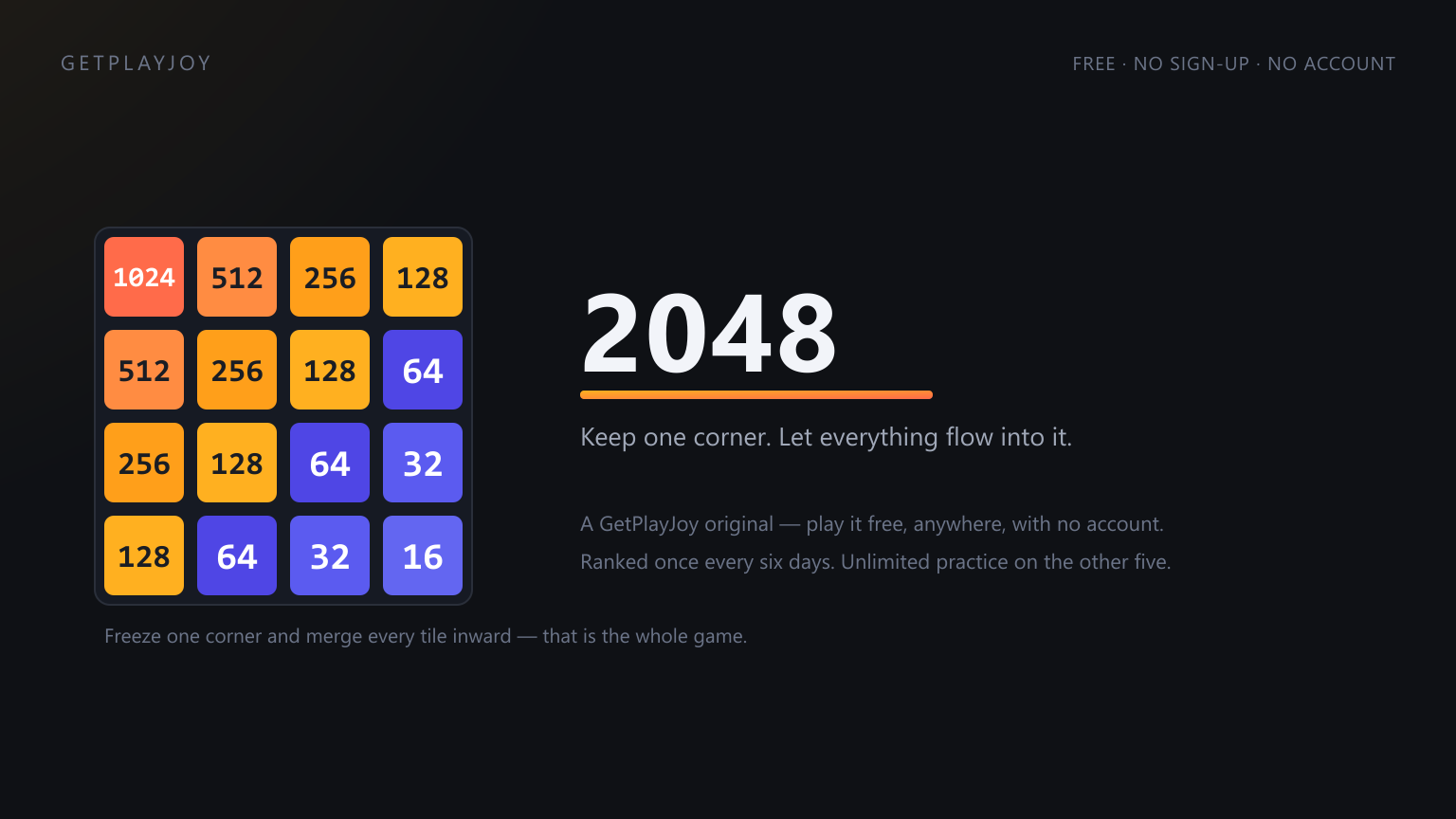
1. GetPlayJoy 2048 — best for comparable daily scores
Three rounds per session with targets of 128, 256 and 512, each generated from the date, so everyone playing that day faces identical tiles in identical order. That is the whole pitch, and it changes what the score means: comparing against other players compares decisions rather than luck.
Scoring is published rather than mysterious. Each round pays your merge total halved, plus 600, 1,200 or 1,800 for clearing the target, plus a time reward of 4,000, 8,000 or 12,000 divided by your seconds. The server rebuilds your board from the seed and replays your move list to recompute the total, rejecting anything more than 40% above that replay plus 100 points, more than 4,000 moves, or an average under 90 milliseconds per move.
Tradeoffs, stated plainly. It is not endless: the daily stops at 512, so players who want a twenty-minute grind toward 2,048 will find the rounds short. It takes one ranked board every six days, not every day, because it rotates with five other games. And it feeds only two of six profile axes, Logical Reasoning and Pattern Recognition, which is honest but means it was never going to be your whole brain plan. Practice boards are unlimited in between.
Free, no sign-up, no download: getplayjoy.com/games/2048. Best for: anyone who wants their score to be worth something.
2. Cirulli's original — best for the pure thing
The 2014 original is still online, free, MIT-licensed, one page of JavaScript and CSS with no tracking apparatus behind it. No leaderboard, no seed sharing, no modes, one endless board to 2,048 and beyond.
That minimalism is why it still loads instantly on anything and why you can save the page and play it offline for the rest of your life, which no hosted game can offer. The tradeoff is that the score is local to your browser and means nothing outside it, and there is no structure to stop a ten-minute session becoming an hour.
Best for: purists, classrooms with no accounts allowed, and anyone who wants the artefact rather than the service.
3. Threes! — best paid version, and the ancestor
Released 6 February 2014 by Vollmer, Wohlwend and Hinson at Sirvo, fourteen months in the making, Apple's iPhone game of 2014, and the reason this genre exists. 1 plus 2 makes 3, white tiles then double from 3 up to 6,144, new arrivals enter from the edge opposite your swipe, and the next tile is previewed before it lands. It came to Steam in February 2024 and had a free ad-supported version from 2015.
It is harder at the start and more forgiving of long-term planning, because you can see trouble coming. Scoring is by rarity rather than face value: a 192 pays 2,187 points and a 6,144 pays 531,441, so one late merge outweighs everything you did early.
Tradeoff: paid on mobile, and its ruleset is different enough that your 2048 instincts will partly mislead you. Worth it once, especially before you judge the clones. The full comparison lives in our 2048 vs Threes breakdown.
Best for: players who prefer information over surprise, and anyone curious where the mechanic came from.
4. 2048.now — best for verified leaderboards outside our own
A browser version that publishes an all-time board and validates finished games server-side, which puts it in the small group of sites where a posted number can be trusted. It also runs larger grids, including a six-by-six expert board, which lengthens every merge chain considerably and changes the strategy from "keep the corner" to something closer to crowd control.
Tradeoff: six-by-six boards take real time, and the emphasis on leaderboard chasing will not suit someone after a three-minute coffee break.
Best for: players who want a verified ladder more than a daily ritual.
5. play-2048.io — best written reference
A clean browser build whose real value is documentation. It publishes a table showing exactly how many base tiles each value costs and how many points building it yields, with 128 at 768 points, 512 at 4,096 and 2,048 at 20,480, alongside a straight explanation of the corner strategy and an honest note that 2,048 cannot be won every time because the spawns are random.
Tradeoff: guide-heavy rather than feature-heavy. Do not expect seed sharing or a verified board.
Best for: players who want to understand the arithmetic of a target before chasing it. Our own corner strategy guide takes the same numbers and applies them to the daily rounds.
6. LK Forge 2048 — best for watching a solver think
A browser version with a built-in expectimax solver that can suggest, or take, moves. Its own 250-game benchmark reports reaching the 2,048 tile about 70% of the time and 4,096 in roughly 30%, which is a good reality check on how good a decent search policy is compared with a human having a good day.
Tradeoff: the interesting part is the machine watching the board, not you doing it. Use it to learn rather than to win.
Best for: anyone who has ever wondered what the correct move was.
7. 2048merge.com — best guide library
Another browser build with a deep article set covering the highest reachable tile, board management and common mistakes. Light on features, useful on explanation, and one of the few sites that states plainly that 2,048 is a milestone rather than a ceiling.
Tradeoff: the reference material is better than the game around it.
Best for: reading between games.
8. Cupcake 2048 — best for classrooms
Built explicitly around the maths rather than the leaderboard: powers of two, binary growth, and the counting argument behind how many merges a target needs (their own page states 1,023 merges to build a single 2,048 tile from 2s). Teachers who want a five-minute demonstration of exponential growth do not need ranked scoring.
Tradeoff: aimed at lessons, so it is not where you would chase a personal best.
Best for: teachers and parents explaining why doubling gets out of hand quickly.
What to avoid
Characteristics rather than names, since naming them helps them rank.
A download required to play a grid of numbers. There is no version of this mechanic that needs installing.; Advertisements that reappear after every single move, particularly ones timed to the animation.; A leaderboard with no explanation of validation, or scores that look uniformly suspicious.; Copy that promises cognitive benefits in six different areas from one tile game. The evidence does not support that, as our brain-training research piece sets out.; A missing rules page. If a site will not tell you how it scores, it is not a game you can improve at.; Requests for permissions, notifications or an email address before the first board.
What Cirulli's original got right that nobody has copied
One page. No account, no cookie wall, no build step, no dependency updates, and no business model at all. He also declined to monetise it and credited the games that came before.
Every entry on this list, ours included, has added something since: seeds, verification, profiles, rounds, boards. Very few of us have matched the original's restraint, and a decade later his version still loads on a school Chromebook in half a second while several clones from 2015 no longer load at all.
Do these games make you smarter
No, and this is the question we get asked most. You will improve at them, which is measurable and real, and that improvement does not travel far. Owen and colleagues tested 11,430 people through six weeks of training in 2010 and found gains on the trained tasks with no transfer to untrained reasoning; the 2016 review by Simons and colleagues reached the same conclusion across the field.
Play them because a clean board is satisfying and a shared seed makes bragging legitimate. Treat advertised cognitive benefits as advertising.
If you only have ten minutes a day
One ritual, one filler. Take the ranked board on 2048's rotation day, three rounds, targets 128, 256 and 512, which our own replay cleared in 240 moves for the last round at about two minutes of play. Then stop, or spend the remainder on a practice board drilling one habit: anchor discipline one day, empty-cell counting the next. Rotation details are in the daily reset guide, and the rules and scoring formula line by line are in how to play 2048.
So which one
You want your score to mean something and ten minutes to be enough: GetPlayJoy 2048, free at getplayjoy.com/games/2048.; You want the artefact with nothing attached: Cirulli's original.; You want the best-designed version and will pay once: Threes.; You want long verified sessions on bigger grids: 2048.now.; You want to understand the arithmetic first: play-2048.io or the guide library at 2048merge.; You want to see what optimal play looks like: LK Forge's solver.; You are teaching: Cupcake 2048.
Sources
1. Cirulli, G. (2014). 2048 [Computer software]. GitHub. https://github.com/gabrielecirulli/2048 2. Vollmer, A., Wohlwend, G., and Hinson, J. (2014). Threes! [Video game]. Sirvo LLC. 3. Threes (video game). (2026). Wikipedia. https://en.wikipedia.org/wiki/Threes_(video_game) 4. Owen, A. M., Hampshire, A., Grahn, J. A., Stenton, R., Dajani, S., Burns, A. S., Howard, R. J., and Ballard, C. G. (2010). Putting brain training to the test. Nature, 465(7299), 775-778. 5. Simons, D. J., Boot, W. R., Charness, N., Gathercole, S. E., Chabris, C. F., Hambrick, D. Z., and Stine-Morrow, E. A. L. (2016). Do brain-training programs work? Psychological Science in the Public Interest, 17(3), 103-186. 6. GetPlayJoy scoring engine for 2048 (2026). Targets 128/256/512, merge total halved, clear bonus 600/1,200/1,800, time reward 4,000/8,000/12,000 per second, server-side replay verification.
About the author: The GetPlayJoy team is a very small team shipping one free puzzle a day for the whole world. We write the product notes and the occasional post-mortem.