How We Picked
We scored each entry on four traits that matter for reasoning, not for twitch speed.
1. Depth of reasoning: does the game make you infer, or just react? 2. A gentle onboarding curve, so a beginner is not lost in minute one. 3. An option to play without a timer, because pressure changes the thinking. 4. Honest scoring that reflects your actual moves, not a vanity number.
That fourth point is the one most sites fail. A score you cannot verify teaches nothing. Specimen replays your marks against its records on the server, so the number means something. The other three keep a game useful for the person who wants to think slowly. A 5×5 Specimen board, for instance, gives you room to reason across 25 cells without a clock forcing your hand.
Specimen
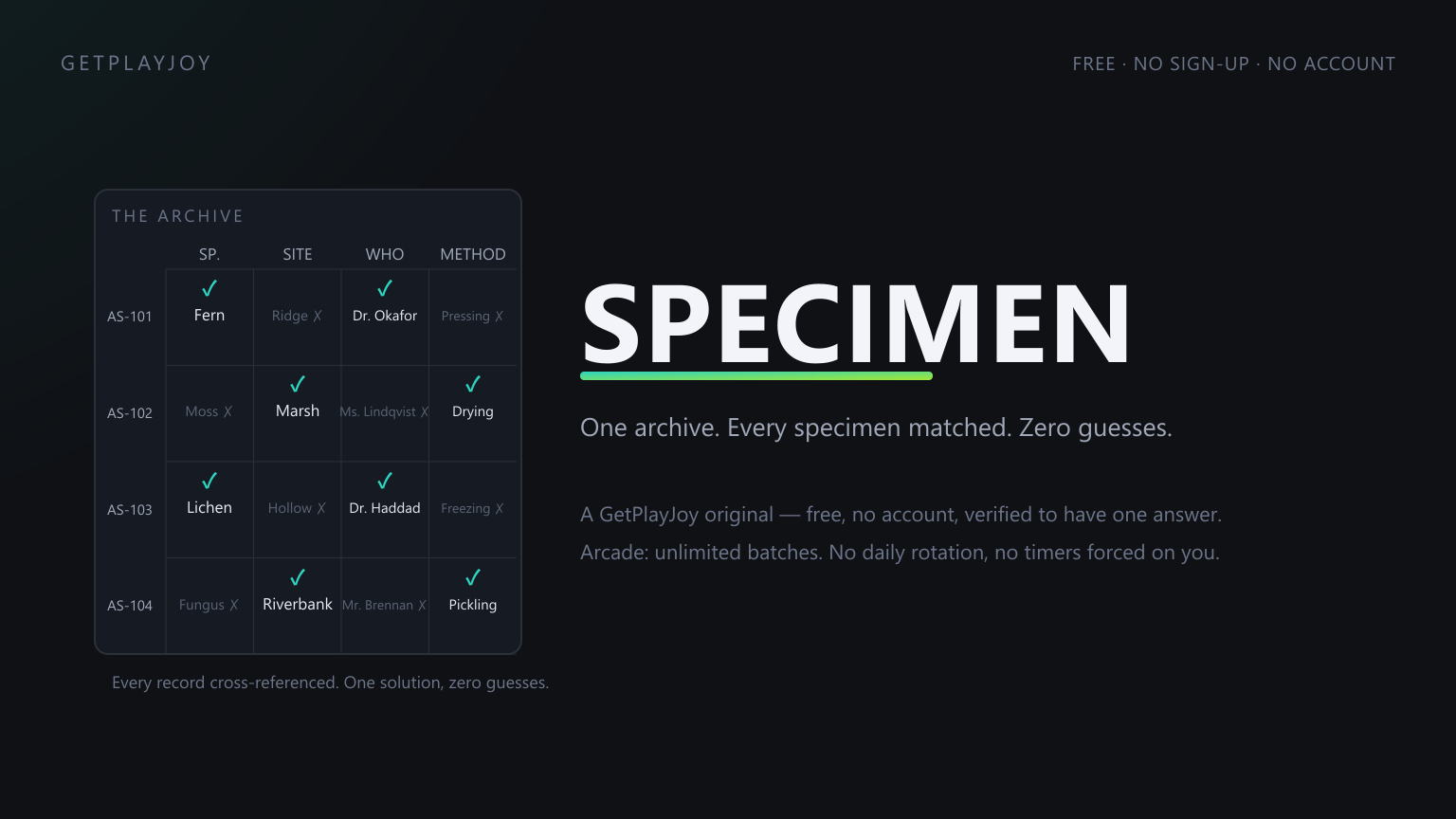
Specimen is the logic-grid entry: match each specimen (AS-101 and up) to its catalog number, species, collection site, collector, and preservation record through pure deduction.
**Best for:** daily deduction you can finish in one sitting.
The board has three sizes. The 3×3 base is 500, the 4×4 is 900, and the 5×5 is 1500, with minimum times of 8, 20, and 40 seconds. A clean 4×4 in 40 seconds returns 2650 points, and the speed bonus is uncapped. Strict logic is the default, so a guess that the records do not force is rejected on the spot. There is no timer pressure in casual batches, and the server guarantees one solution. Start a board at the game page, or read how the method works.
A deductive-reasoning app
Deductive-reasoning apps, the kind built around syllogisms and sequenced inference, train the same muscle Specimen uses: given premises, what must be true?
**Best for:** players who want explicit logic drills with a visible progress curve.
These apps tend to start trivial and ramp slowly, which is exactly the gentle curve we wanted. The tradeoff is that many are subscription-backed and the puzzles can feel repetitive after a week. The reasoning is real, though, and a good one explains why each step follows. They pair well with a grid game, because the grid forces you to hold several constraints at once while the drill forces you to state each inference cleanly.
A math or number puzzle
Number puzzles such as KenKen or killer Sudoku ask you to satisfy arithmetic constraints inside a grid, which is reasoning with a numeric accent.
**Best for:** people who like logic but want a sum or a product in the loop.
The deduction here is concrete: a cage that must total 12 with three cells rules out whole branches immediately. That is constraint reasoning in a friendlier costume. The downside is the arithmetic load, which some find tiring rather than relaxing. Still, a single 6×6 cage puzzle can hold your attention for 15 minutes and leave you with the same satisfied closure a logic grid gives. Our science write-up explains why that closure is its own reward.
A strategy or tactics game
Turn-based strategy games, from chess puzzles to tactical board problems, build reasoning about sequences and opponents' replies.
**Best for:** thinkers who want reasoning aimed at a moving target rather than a fixed board.
The skill transfers oddly well to grids: you learn to ask what must happen two steps ahead, which is the same habit a 4×4 Specimen solve rewards. The catch is time. A full strategy match is a commitment, where a logic grid is a coffee break. We include it because pure reasoning about consequences is the core of both, even if the frame is competitive. Pick a tactics trainer over a full match if your goal is the thinking, not the ladder.
A word-logic hybrid
Word-logic hybrids, such as deduction games built on statements and contradictions, blend language and inference.
**Best for:** solvers who like a clue written in prose and the satisfaction of catching a contradiction.
These lean on the same either/or reasoning a logic grid uses, just wrapped in sentences instead of a table. The gentle curve is usually good, and a timer-free mode is common. The weak spot is scoring honesty: many grade you loosely. Used alongside a verified game like Specimen, they round out a week of mixed reasoning practice without feeling like homework.
What to Avoid
Two categories do not belong on a reasoning list.
Speed-only games with no inference, where the win is reaction time and nothing else. They are fun; they are not logic training.; Paywalled "IQ" tests that promise a permanent intelligence boost from a few sessions. The claims are pseudo-scientific.
The research is clear on the second point. Owen et al. (2010) ran a brain-training trial with 11,430 participants and found improvement on the trained task but no broad transfer to untrained cognition. Simons et al. (2016) reached the same conclusion across the literature. Near transfer, getting better at the puzzle itself, is real. A general IQ lift is not established. Our brain-training piece lays out the evidence without the hype.
Which to Play
Want a pure grid you can finish fast? Specimen. Want explicit drills? A deductive app. Want numbers? A math puzzle. Want consequence-thinking? A tactics trainer. Want prose clues? A word-logic hybrid. For honest, verified, no-account reasoning, open Specimen on GetPlayJoy and solve a 4×4 in under a minute.
FAQ
Do brain games raise IQ?
No broad gain is proven. Owen et al. (2010, n = 11,430) found no transfer to untrained tasks.
Is Specimen a brain game?
It is a reasoning puzzle; it builds skill at deduction, not a measured intelligence score.
Can I play Specimen without a timer?
Yes. Casual batches have no clock pressure; only the score formula rewards speed.
What grid sizes does Specimen offer?
Three: 3×3, 4×4, 5×5, with base scores 500, 900, 1500.
Which pick is best for beginners?
Specimen's 3×3, base 500, is the gentlest on-ramp in this list.
Are word-logic hybrids real reasoning?
Yes. They use the same contradiction and either/or logic as a grid, just in sentence form.