The honest verdict
If you train a specific reasoning task, you get better at that task. The benefit rarely reaches unrelated skills. That is the settled finding across large samples and meta-analyses published since 2010.
The rest of this piece is the evidence behind that sentence. The short version is that the brain-training industry promised more than the data supported, and regulators noticed.
Owen et al. (2010): 11,430 participants
Owen and colleagues ran the largest test of its kind, with 11,430 participants, reported in Nature in 2010. They found improvement on the trained tasks but no reliable gain on untrained reasoning or memory measures.
The scale matters. A study with 11,430 people is hard to dismiss as a fluke. The conclusion was direct: practised tasks improved, broader cognition did not.
Melby-Lervåg & Hulme (2013): the meta-analysis
A 2013 meta-analysis by Melby-Lervåg and Hulme looked across many working-memory training studies. Their finding: gains on trained tasks did not transfer broadly to other cognitive abilities.
Working memory is the skill people most hope will spread. The meta-analysis suggests it mostly stays put. Training memory tasks makes you better at memory tasks, not at life in general.
Simons et al. (2016): the review
Simons and co-authors reviewed the field in 2016 and reached the same conclusion. Far transfer from brain-training programs is not supported by solid evidence.
They also noted that many claims rested on weak designs. A few studies showed narrow gains; almost none showed the broad upgrade the marketing implied.
FTC (2016): the Lumosity settlement
The US Federal Trade Commission acted in 2016. It settled with Lumosity over claims that its games could improve real-world cognition, protect against decline, or help conditions like Alzheimer's. The FTC called those claims unsubstantiated.
This is the cautionary tale. When a brain game sells general intelligence, the claim is not just unsupported; it can be illegal. The measurement trap is the same one puzzle makers must avoid.
What near transfer actually buys
The verdict is narrow, not empty. Practising a reasoning task makes you better at that task, and some of that gain leaks to closely related ones — reading a constraint list, holding a small set of premises, checking a new fact against them. Owen et al. (2010) found the trained-task gain solid; the missing piece was the broad leap, not the local one.
So the useful frame is: expect to get better at deduction, and at tasks that look like deduction, and little beyond that. That is still a real, repeatable benefit for anyone who wants sharper categorical reasoning.
What good training actually looks like
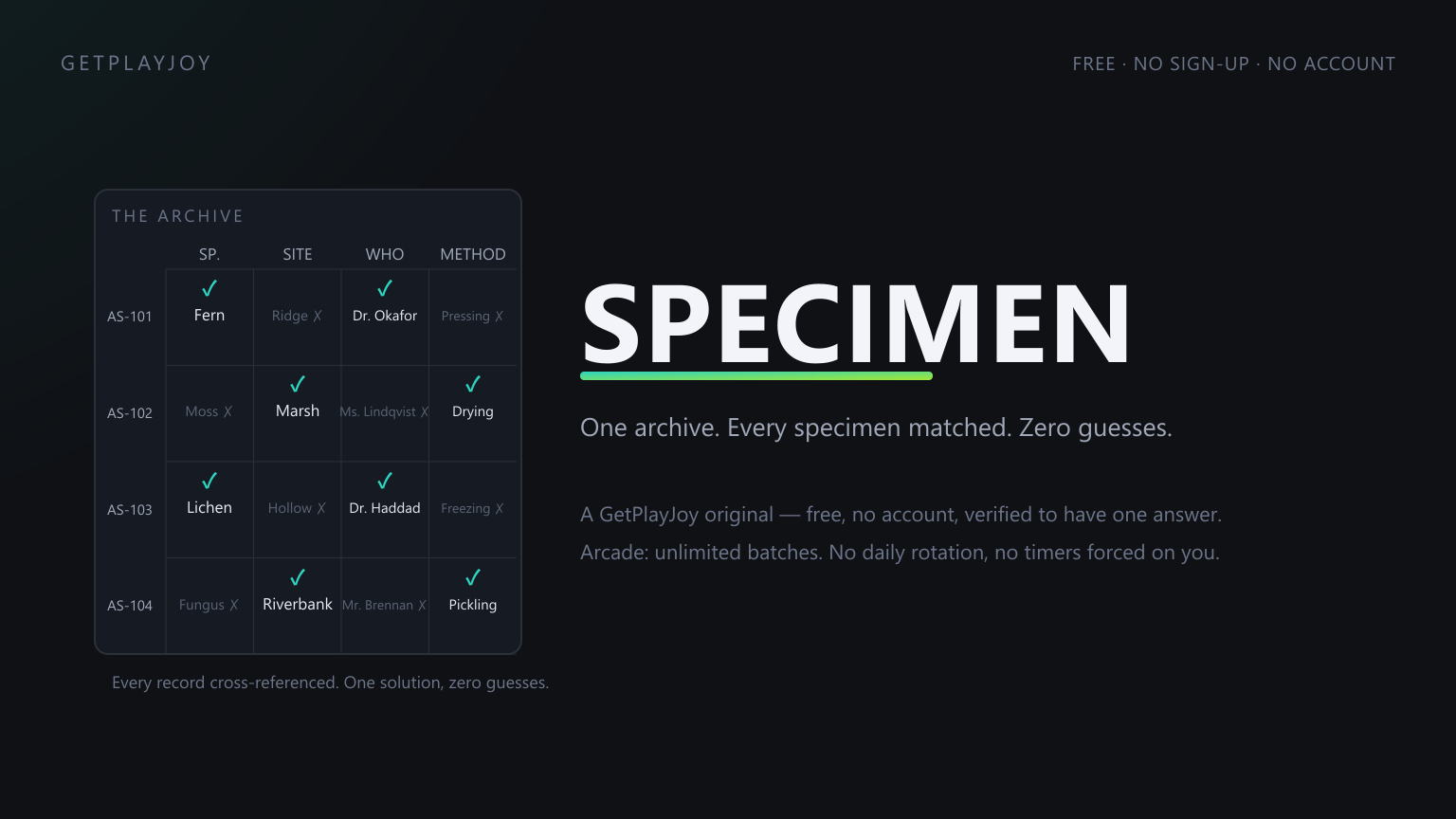
The literature on skill acquisition, separate from the brain-training debate, is consistent about what works: spaced practice over time, a difficulty that rises as you improve, and immediate feedback on each attempt. Specimen is built around the last of these. Strict logic mode rejects an unforced mark the instant you make it, and Audit later lists every mark that conflicts with the records. That feedback loop is the training, and it is the part most paper puzzles lack.
What this means for puzzle play
Train the specific skill you want. If you want sharper deduction, solve logic grids. If you want faster memory recall, practise memory tasks. Do not expect one to fix the other.
Specimen rates two dimensions, logic and memory, with logic primary. The grid externalises candidates, which is why memory is secondary here. That design matches the research: it builds the practised skill and leaves the rest alone. Our scoring page shows how the two dimensions are weighed, and the best brain games list puts deduction in context.
Training deduction on purpose
If you want the narrow gain, train it deliberately rather than casually. Open a 4×4, leave strict mode on, and use Cross-reference only after you have spent a minute stuck — let the explanation show you the inference you missed, then replay the batch without it. That is deliberate practice: attempt, fail safely, see the correction, repeat.
Resist the urge to brute-force with hints. A hint that hands you the answer teaches nothing; a hint that shows you the reasoning teaches the move. The get-better guide lays out the six-step routine this practice targets, and the ability-profile page shows how the two rated dimensions respond to clean, fast work.
Measurement is not training
The score tells you how a session went. It does not build the skill by itself. Specimen grades each batch 0 to 100 and reports deepSteps, but those describe the puzzle, not your growth.
The training is the loop: read the records, place the forced marks, see the result. The number is feedback, not the exercise. Treat it as a mirror, not a mechanism.
Not a clinical assessment: Specimen is a puzzle game, not a diagnostic or therapeutic tool, and its scores are not measures of intelligence or cognitive health.
Reading the claims, not the hype
The trap in this whole field is the verb. "Trains your brain" can mean "makes you better at this task" or "makes you smarter overall," and only the first is supported. When a product uses the second sense, the FTC has already shown that claim is not just unsupported but illegal to make.
Specimen makes the narrower claim on purpose. It rates logic and memory on a single batch and calls the result a readout, not a diagnosis. Play it for the specific skill, train it with feedback, and treat any promise of general intelligence as a red flag rather than a feature.
Bottom Line
Near transfer is real; far transfer is not. Train the specific skill you care about and ignore general-intelligence promises. For deduction, open Specimen on GetPlayJoy and practise the narrow skill that actually improves.
FAQ
Does brain training improve intelligence?
Not broadly. Owen et al. (2010) found gains on trained tasks only, not on untrained reasoning.
What is far transfer?
It is improvement on skills you did not train. The research (Simons et al., 2016) finds little of it.
Did any regulator act?
Yes. The FTC settled with Lumosity in 2016 over unsupported cognitive claims.
Is working-memory training useless?
It helps the trained task. Melby-Lervåg & Hulme (2013) found little spread beyond it.
Can Specimen improve my memory?
It rates memory as a secondary dimension; the grid externalises candidates, so the gain is narrow.
Is Specimen a brain-training treatment?
No. It is a puzzle, not a clinical or diagnostic assessment.