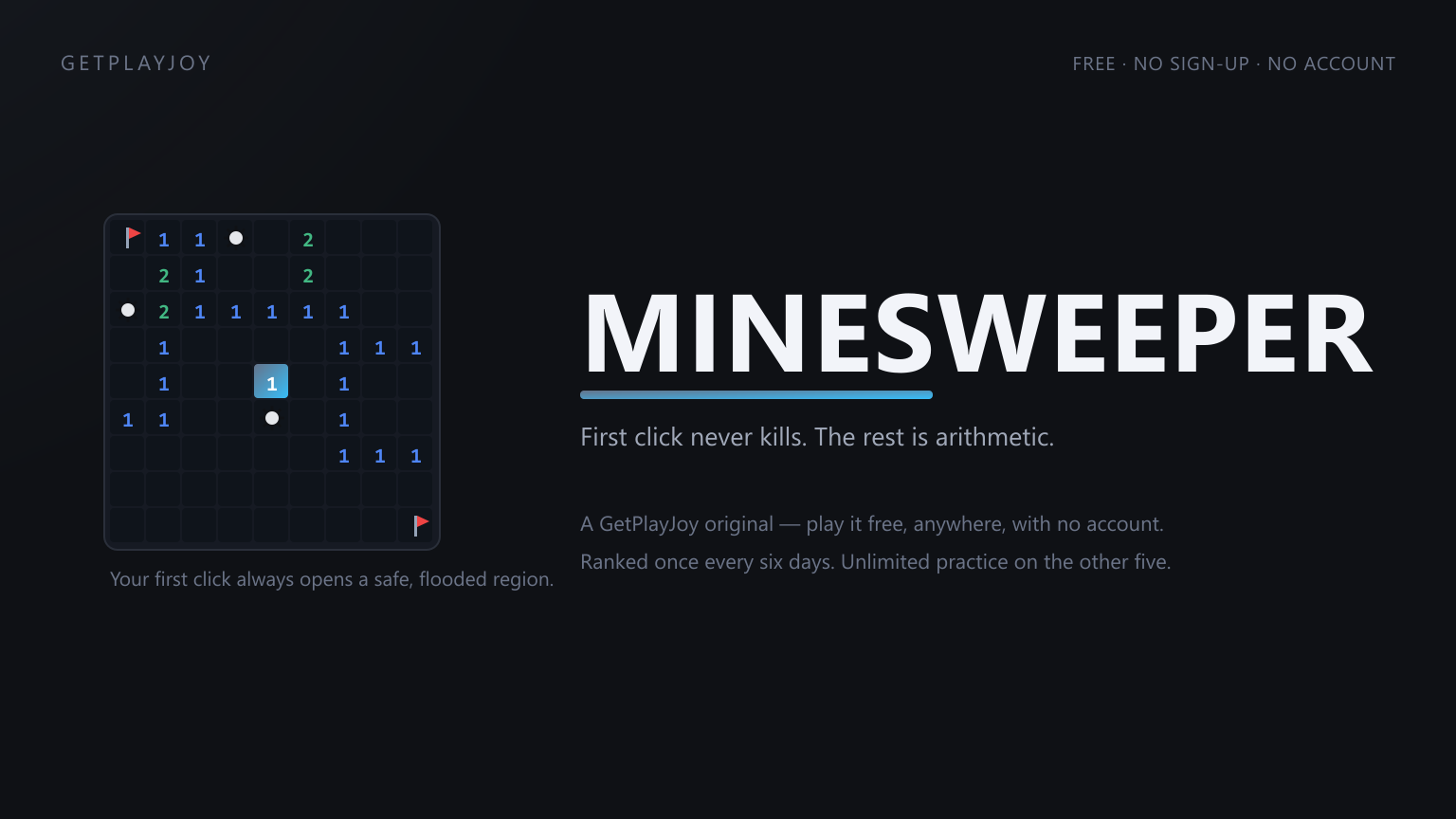
Introduction
Thirteen years is long enough for a genre to settle. Three tiers, three numbers, one guarantee about the first click: that much is standard now, and any site using a different Expert grid is making a statement it probably did not intend. What has not settled at all is what happens around those eighty tiles. Same rules, wildly different surroundings, and the surroundings are most of what you are choosing between.
The consequence is that picking a Minesweeper is not really about Minesweeper. It is about whether you want a leaderboard, whether you dislike being forced to guess, or whether you just want something that loads before your coffee does. Those are separable questions with different right answers, and no single version wins all of them.
What a Minesweeper Has to Earn in 2026
Four things, checked against every entry below.
1. **Known parameters.** The site states its sizes, mine counts and first-click behaviour, so claims can be checked rather than taken on faith. Anybody can assert fairness. Very few publish the arithmetic. 2. **A reason to come back.** Either a shared daily board with real verification, or unlimited free play that stays unlimited with no bait-and-switch halfway through a board. 3. **Honest consequences.** What losing costs, what a mistake costs, and what the score means, stated before rather than discovered by losing. 4. **No friction before the board.** Playable without an account, an install, or an email field standing between you and your first click.
Everything below is measured on those four, including our own entry, which we have placed first for a reason we would rather argue openly: it is the only one built around a shared daily board with every scoring term published. Judge the rest on their own merits, since that ordering reflects this list's criteria rather than any claim of being objectively best at the game itself.
2. Google Minesweeper — best for zero friction
Search the word and the board opens above the results, on desktop or inside the Google app. Three levels on the classic parameters, first click safe, a timer and a mine counter, nothing stored anywhere. It asks for no account because it has nowhere to put one.
Its advantage is not a feature, it is a location. On a locked-down school or work machine whose policy blocks game domains, Google survives when all seven other entries here do not, and that single fact makes it the right answer for a very large number of players. The design was also built for touch first, with tap-and-choose controls for digging and flagging rather than a long-press bolted onto mouse conventions.
*Tradeoff:* there is no shared board, no leaderboard, no history, and no cross-session record of anything you did. Nothing worse happens either: nothing was ever recorded. Our head-to-head comparison puts the two side by side across five dimensions if you want the long version.
*Best for:* five spare minutes, borrowed machines, and introducing somebody to the rules with nothing extra to explain. Free.
3. Minesweeper.online — best for serious competition
This is where the competitive community actually lives, and it has been for over a decade. It handles the three classic sizes alongside custom dimensions, runs global leaderboards per difficulty with video replays of top runs, and layers a whole economy on top: daily quests, an arena, seasons, trophies and a marketplace. The player pool is the point. A leaderboard is only as interesting as the number of people on it, and few sites reach these numbers.
Its headline option is no-guess mode, which filters out any board that would force a coin flip. For players who consider a forced guess a design flaw rather than a feature, that is the argument settled, and our own psychology notes send people here for exactly that reason. Statistics run deep too: efficiency, time, win streaks and 3BV-derived measures across seasons.
*Tradeoff:* it is dense. Panels and menus compete for screen real estate, it was designed desktop-first and merely functions on a phone, and you get substantially more from it once you have an account. Some players will find the gamified economy motivating and others will find it loud. Both reactions are reasonable.
*Best for:* anyone who wants to rank against thousands of other people and study how the fastest plays were made. Free, with an optional account.
4. Classic Windows-era remakes — best for nostalgia, with a caveat
Plenty of sites reproduce the grey interface of the Windows Vista era down to the bevelled cells, and they are a genuine pleasure, since the visual language is half the memory. Minesweepergame.com takes this position alongside a deep strategy archive, including hand-computed opening statistics. Tim Kostka generated every board the classic Windows versions could produce back in 2002 and measured them: average openings run 18 to 32 tiles on Beginner, 27 to 66 on Intermediate and 16 to 41 on Expert, with the probability that any given square opens at all ranging from 0.19 to 0.60 on Beginner and 0.12 to 0.50 on Expert.
*The caveat, and it is worth stating plainly:* the historic versions had weaker guarantees than people remember. Windows Minesweeper made the first click safe by shifting any offending mine to the first empty square on the top row counting from the left corner, which guarantees the tile but says nothing about its neighbours, so a large share of openings handed you a single number and nothing else. Later implementations guaranteed the clicked tile would be a zero, producing a cascade. Modern days sites, including ours, guarantee the whole 3×3. If you want the nostalgia, know which of the three behaviours you are getting.
*Best for:* the look and the feel of 1997, plus the best free strategy writing anywhere on this mechanic. Free.
5. Simon Tatham's Portable Puzzle Collection — best for puzzle purists
A single free program containing dozens of puzzle implementations, among them Mines, which is unusual in one specific and important way. By default it generates mine positions so that the board is always fully deducible: you never need to guess, and if you prefer the riskier boards that other implementations produce, you can switch the guarantee off. Custom width, height and mine count are all editable, including a density percentage rather than an absolute count, and there are hexagonal, triangular and toroidal grids.
It also does something no other version here does: after stepping on a mine you can undo the fatal move and keep playing, with a separate death counter that Undo will not reduce. That makes it unusually good for learning, because you can finish a board you got wrong and see where the reasoning broke.
*Tradeoff:* no leaderboard, no daily, no scoring economy whatsoever, and an interface that has never pretended to be modern. It is a tool rather than a destination.
*Best for:* anyone who wants the purest logic available and no guessing at all, and anyone learning patterns by heart before taking them somewhere competitive. Free and open source.
6. Microsoft Store Minesweeper — best for the modern desktop
The one carrying the original name, published for Windows 10 and 11 after Microsoft dropped the bundled version in 2012. It keeps classic mode, adds daily challenges and adventure-style progression, is properly maintained, and integrates with the Windows ecosystem rather than fighting it.
*Tradeoff:* it advertises. The 1992 version had no ads and no upsell because it was bundled, and the modern one is a Store product with a paid tier behind those ads. For many players that is a perfectly fair exchange for a maintained native app; for others it is exactly the change they remember waking up to.
*Best for:* a native app that behaves like part of the operating system, and players who want the Microsoft Minesweeper name specifically. Free tier with ads, subscription available.
7. Tametsi — best for puzzle-first design
A paid indie title that takes the core loop and pushes deduction to the front. Every board is solver-guaranteed, so there is never a coin flip, and layouts layer overlapping logical regions in which one clue constrains several groups simultaneously. It is closer to a hand-built logic puzzle than to an arcade game, and the pacing reflects that.
*Tradeoff:* a paid download, one platform family, and no speedrunning scene to speak of. If what you wanted was to beat your Expert time, this is the wrong purchase.
*Best for:* players whose objection to random Minesweeper is philosophical rather than practical, and who want the difficulty to come from design rather than luck. Paid.
8. Hexcells — best for the same skill in a different shape
Hexagonal cells, hand-designed levels, and a campaign in which every move is deducible, plus new twist rules introduced steadily across the set: bracketed numbers meaning the marked cells touch, dashed numbers meaning they do not, column counts, and stratification right up to the final puzzles. Released by Matthew Brown in February 2014, priced around a coffee, and still one of the most recommended logic games on its platform years later. Reviewers reliably describe it as Minesweeper with the randomness removed, which is both accurate and the whole pitch.
*Tradeoff:* a fixed campaign with limited replay value, and some popular entries are ones players finish in under three hours. Around thirty static puzzles rather than infinite boards.
*Best for:* an evening rather than a habit, and anyone who wants the deduction without the dice. Paid, small price.
What to Avoid
Features rather than names, since these come and go and sites get reskinned every season.
**Ad units that reflow the board.** If tiles move when an advert loads, you will eventually click the tile you did not mean to, and that is a deliberate design choice rather than a bug.; **Email walls after a few boards.** "Unlimited" that stops at board four was never unlimited.; **Custom sizes nobody asked for.** A 24×20 Expert is a different game in difficulty terms, and its leaderboard times are not comparable to anyone else's.; **Sites that will sell you today's solution.** If any page will hand you the mine list for today's board, its own leaderboard cannot be worth anything, whatever claim it makes. This is one of the tells in our official Minefield guide.; **Browser extensions promising better scores.** Nothing you install improves a result our server recomputes from your own moves; the realistic outcome is a run flagged unranked.; **No stated first-click behaviour.** It takes thirty seconds in a help page. Its absence means nobody thought about it, and you will find out why at the worst moment.
What the Classics Got Right That Nobody Has Copied
Three things worth naming, none of which we have.
The first is absence of pressure. Bundled Minesweeper had a timer, but nobody was watching it, there was no leaderboard to compare against, and losing cost you nothing at all because there was nothing to lose. Modern versions have made the game measurable, which is worth having, and lost something quiet along the way.
The second is self-containment. The old versions shipped whole in one executable: board, rules, counter and personal best times, in about 200 kilobytes, without a single network request. Everything on this list needs a connection to exist at all.
The third, and the one we would most like to copy, is the safe first click arriving without fanfare. No tutorial, no announcement, no patch notes. A game that quietly stopped killing you on move one. It is still the best example of a design change that was made for fairness reasons and inexplicably also made the game better, and it is why every serious version now does some version of it.
Do These Games Make You Smarter?
Partly, and not in the way marketing claims. Deduction practice improves deduction, and the habit of holding several constraints in mind is a real skill with real evidence behind it. What it does not do is generalise far: the largest study of online brain training to date, Owen and colleagues in Nature in 2010, put 11,430 people through six weeks of training and found every trained task improved while no untrained task did. Our own review of the research goes through the whole literature with the citations. Play because it is enjoyable and specific. The rest is advertising.
If You Only Have Ten Minutes a Day
One board, once a day, at the size that suits the ten minutes rather than your vanity. Beginner takes thirty seconds to two minutes and exercises every skill Expert does, only fewer times. On days you have longer, play the tier above whatever you normally stake, because that is where new patterns actually come from.
A workable weekly shape: one shared daily on whichever game owns the slot that day, one practice board at your own tier for maintenance, and one hard board whenever something to prove arrives. That is roughly twenty minutes across a week, which is more than enough to improve measurably at this within a couple of months. Our strategy guide has the specific arithmetic, including why Practising below the cap beats chasing seconds.
So Which One
**A score that means something beyond today:** GetPlayJoy Minefield, with every term published and every run replayed server-side.; **Five minutes on a borrowed machine:** Google Minesweeper.; **Thousands of ranked players to measure against:** Minesweeper.online, and its no-guess mode if coin flips bother you.; **Never having to guess:** Simon Tatham's collection, or Tametsi if you will pay for it.; **The original look, or the original name:** a Windows-era remake, or the Microsoft Store version.; **The deduction without the dice:** Hexcells.
None of these are exclusive, and most people who care about this game end up with two or three bookmarks for different occasions. Just check the four criteria above before trusting a leaderboard, whichever one you land on.
Sources
1. GetPlayJoy (2026). Minefield engine reference. getplayjoy.com/games/minesweeper 2. Authoritative Minesweeper, minesweepergame.com. Difficulty definitions, first-click behaviour, and Kostka's 2002 opening survey. 3. Wikipedia contributors (2026). Minesweeper (video game): version history and variants. 4. Simon Tatham's Portable Puzzle Collection (2026). Mines documentation. 5. Steam (2014). Hexcells, developed by Matthew Brown.
FAQ
What is the best free minesweeper in 2026?
If you want a shared daily board with verifiable scoring, ours. If you want zero friction, Google's search widget. If you want thousands of ranked players, Minesweeper.online.
Are all versions using the same board sizes?
The classics are 9×9 with 10 mines, 16×16 with 40, and 30×16 with 99. Sites using anything else will have difficulty numbers that do not compare.
Can I find a minesweeper that never makes me guess?
Yes. Minesweeper.online has a no-guess mode, Simon Tatham's collection guarantees solubility by default, and both Tametsi and Hexcells are built that way by design. Random boards, including ours, occasionally force a coin flip.
Do I have to pay for a good version?
No. Six of the eight here are free with no account requirement, and the two paid entries solve problems the free ones do not rather than being better versions of them.
Which version has the most honest scoring?
Judge by publication rather than by claim. GetPlayJoy prints every term of its formula so you can recompute any score; very few sites give you enough information to check theirs.
Is the first click always safe everywhere?
Almost, but the strength of the guarantee differs. Some versions move any mine off the clicked tile only, others guarantee the tile is a zero, and ours clears the tile plus all eight neighbours, which forces a cascade.
Does playing these improve general intelligence?
No credible evidence for that. Owen and colleagues found in 2010 that 11,430 participants improved on trained tasks and nothing else, which is the standard result across the literature.
How do I avoid the bad versions?
Check whether the board reflows around adverts, whether "unlimited" stops after a few boards, and whether the site will sell you today's solution. Any one of those is enough reason to leave.